John Logie Baird's First Colour Television Transmission
1928 · London, United Kingdom
John Logie Baird demonstrated the first colour television transmission.
October 2, 1925
John Logie Baird performs the first test of a working television system.
London, United Kingdom | Baird Television Development Company
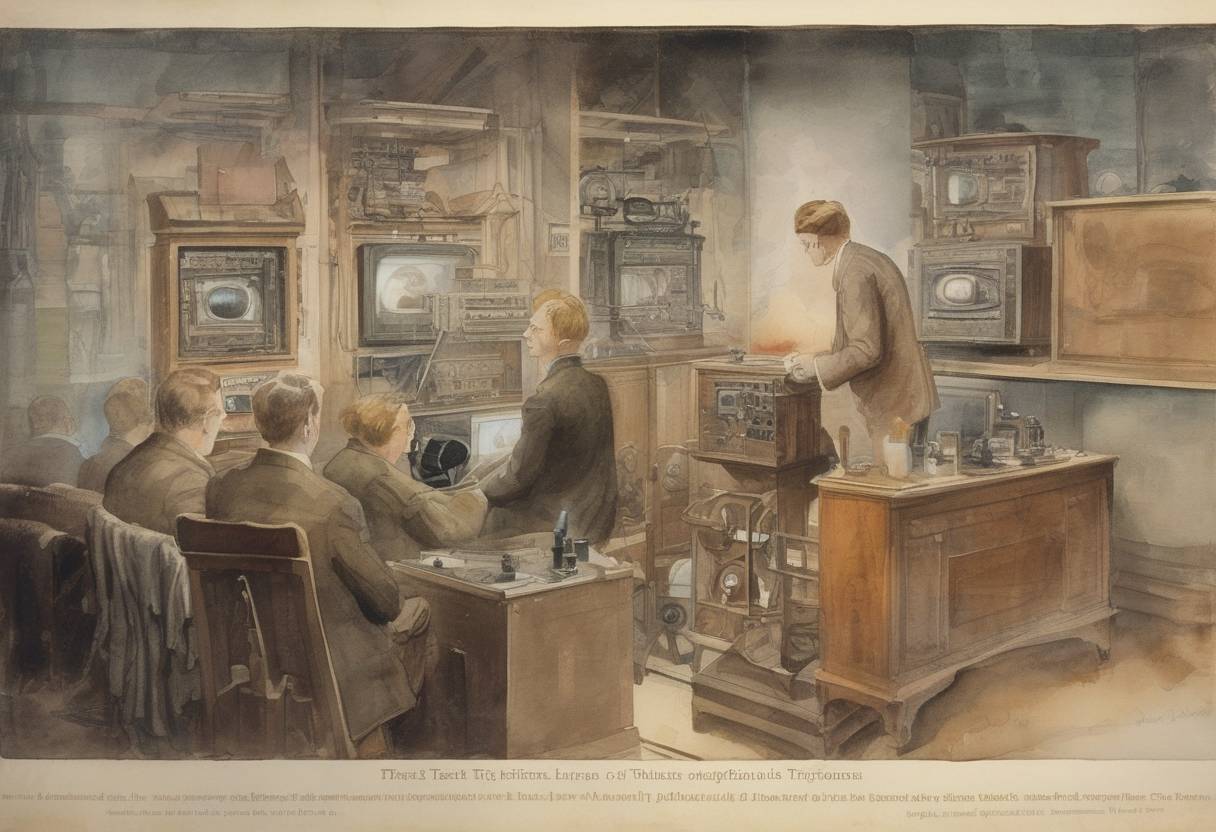
On October 2, 1925, Scottish inventor John Logie Baird performed the first successful test of a working television system. This groundbreaking demonstration took place in his laboratory at 22 Frith Street in the Soho district of London, marking a pivotal moment in the history of television technology.
John Logie Baird was born on August 13, 1888, in Helensburgh, Scotland. He was a pioneer in the development of television, driven by a vision to transmit moving images over a distance. Before his successful test in 1925, Baird had been experimenting with various methods to achieve this goal, often working with limited resources and facing skepticism from the scientific community.
Baird’s system was based on the Nipkow disk, an early mechanical device invented by Paul Nipkow in 1884. The disk was used to scan images and convert them into electrical signals. Baird’s innovation involved using this technology to transmit live images.
On the day of the test, Baird successfully transmitted the image of a ventriloquist’s dummy named “Stooky Bill” and later, a human face. The images were crude and flickered, but they represented the first time moving images were transmitted successfully using a television system.
The successful demonstration of Baird’s television system was a significant milestone in the development of television technology. It proved that it was possible to transmit moving images over a distance, laying the groundwork for future advancements in electronic television.
Baird’s work attracted attention and led to further developments in television technology. In 1926, he gave the first public demonstration of television, and by 1928, he had achieved the first transatlantic television transmission.
John Logie Baird’s contributions to television technology were instrumental in the medium’s evolution. Although mechanical television systems were eventually replaced by electronic systems, Baird’s pioneering work paved the way for the modern television industry.
Baird continued to innovate throughout his life, contributing to color television and stereoscopic (3D) television. He passed away on June 14, 1946, but his legacy endures as one of the founding figures of television technology.
In summary, the test conducted by John Logie Baird on October 2, 1925, was a landmark event that demonstrated the feasibility of television and set the stage for the medium’s future development and widespread adoption.
Source: en.wikipedia.org