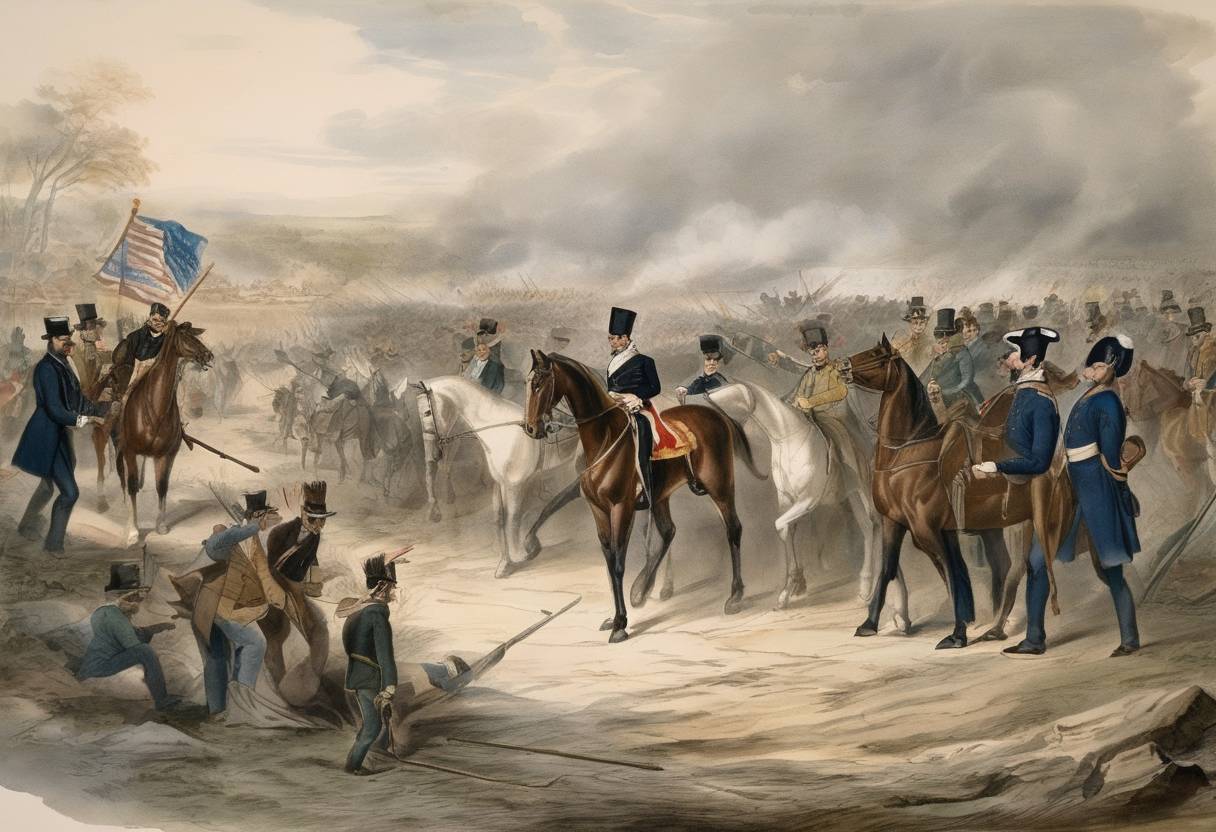
President James K. Polk’s Request to Congress for a Declaration of War Against Mexico
On May 11, 1846, President James K. Polk formally requested that the United States Congress declare war on Mexico, an action that initiated the Mexican-American War. This request followed a series of events and growing tensions between the two nations, primarily over territorial disputes, including the annexation of Texas and the desire of the U.S. to acquire California and other southwestern territories.
Background
The roots of the conflict trace back to the Texas Revolution (1835-1836), where Texas seceded from Mexico and later sought annexation by the United States. In 1845, President Polk achieved the annexation of Texas, an act perceived by Mexico as a provocation and breach of territorial sovereignty. The boundary disputes along the Rio Grande and the Nueces River further exacerbated tensions. Polk’s expansionist vision embodied the Manifest Destiny philosophy, fueling desires for American territorial growth to the Pacific Ocean.
Key Events Leading to the Declaration
The immediate catalyst for the war request was the clash between Mexican and American troops on April 25, 1846, in the disputed area along the Rio Grande. This skirmish, known as the Thornton Affair, resulted in the deaths or capture of several American soldiers. President Polk, emphasizing the incident in his address, claimed that Mexico had “shed American blood upon American soil,” using this assertion to justify a military response.
Congressional Deliberation and Response
Following Polk’s address, Congress swiftly deliberated the declaration, with different factions weighing the justifications for war. Despite some dissenting voices concerned about the expansion of slave territory and the ethical implications of the conflict, both the House of Representatives and the Senate voted to support the declaration. On May 13, 1846, the official declaration of war was issued, marking the beginning of what would become a two-year conflict.
Aftermath and Historical Significance
The Mexican-American War concluded with the Treaty of Guadalupe Hidalgo in 1848, which resulted in significant territorial gains for the United States, including present-day California, Arizona, New Mexico, Nevada, Utah, and parts of Colorado and Wyoming. This expansion reshaped the American landscape and accelerated the nation’s push westward, but also intensified debates over slavery in the new territories—a factor contributing to the sectional tensions that would eventually lead to the American Civil War.
The war remains a controversial episode in U.S. history, often critiqued for its role in exacerbating imperialistic tendencies and its impact on Mexico, which lost about half of its pre-war territory. Polk’s decision has been examined as a pivotal moment of American expansionism that significantly influenced the nation’s trajectory in the 19th century.