The First Documented Computer Bug - September 9, 1947
1947 · Cambridge, United States
The first actual case of a computer bug was found. Operators traced an error in the Harvard Mark II computer to a moth stuck in a relay.
August 7, 1944
IBM dedicates the Automatic Sequence Controlled Calculator (Harvard Mark I), the first program-controlled calculator, which was used during World War II for ballistic calculations.
Cambridge, United States | International Business Machines (IBM) and Harvard University
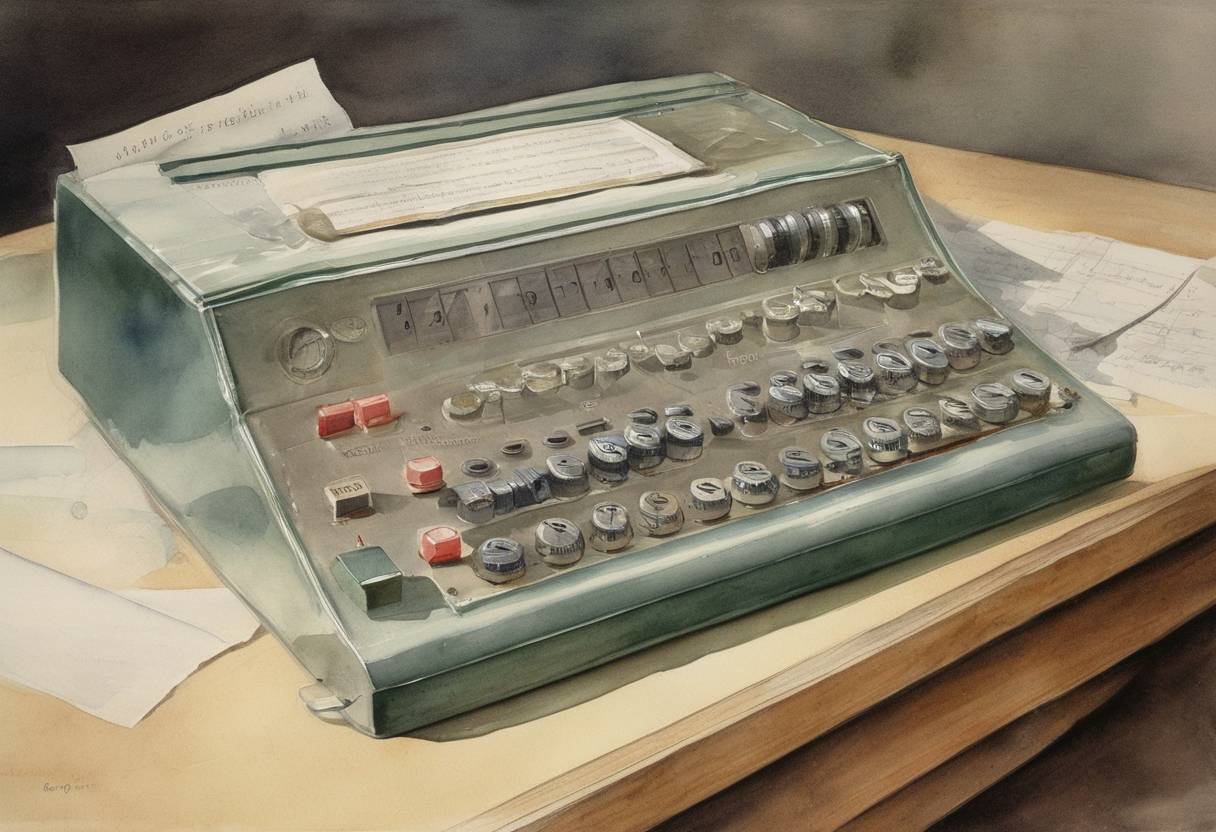
On August 7, 1944, International Business Machines Corporation (IBM) and Harvard University dedicated the Automatic Sequence Controlled Calculator, commonly known as the Harvard Mark I. This event marked a significant milestone in the history of computing, as the Mark I became one of the first program-controlled calculators.
The Harvard Mark I was borne out of collaborative efforts spearheaded by Professor Howard H. Aiken of Harvard University. Aiken envisioned a machine that could automate the process of mathematical calculations, which was increasingly important for complex scientific tasks. With funding and engineering support from IBM, the design and construction of the Mark I took seven years, starting in 1937.
The Harvard Mark I was a behemoth of its time, stretching 51 feet in length and weighing about 5 tons. It contained approximately 765,000 components, including miles of electrical wiring, relays, rotating shafts, and switches. Operated by punched cards, it was capable of performing arithmetic operations and data manipulations automatically and continuously.
During World War II, the Mark I played a crucial role by assisting the Allies in their war efforts. It was primarily used for ballistic calculations, solving complex mathematical equations needed for developing weapons and artillery. Its ability to perform continuous calculations was a game-changer for scientists and engineers engaged in wartime research.
The dedication of the Harvard Mark I signaled a significant advancement in computation, paving the way for the development of modern computers. It demonstrated the feasibility of automatic computation, influencing future designs and developments in the field of computing. The success of the Mark I would inspire further innovations, ultimately leading to the more sophisticated and compact digital computers that followed.
The machine continued to operate until 1959, long after its initial mission had concluded, as a testament to the enduring nature of IBM’s early contributions to computing technology. Its development established IBM as a leader in the emerging field of computer science and automation, while also affirming the importance of academia-industry collaboration in technological advancements.
Source: www.ibm.com