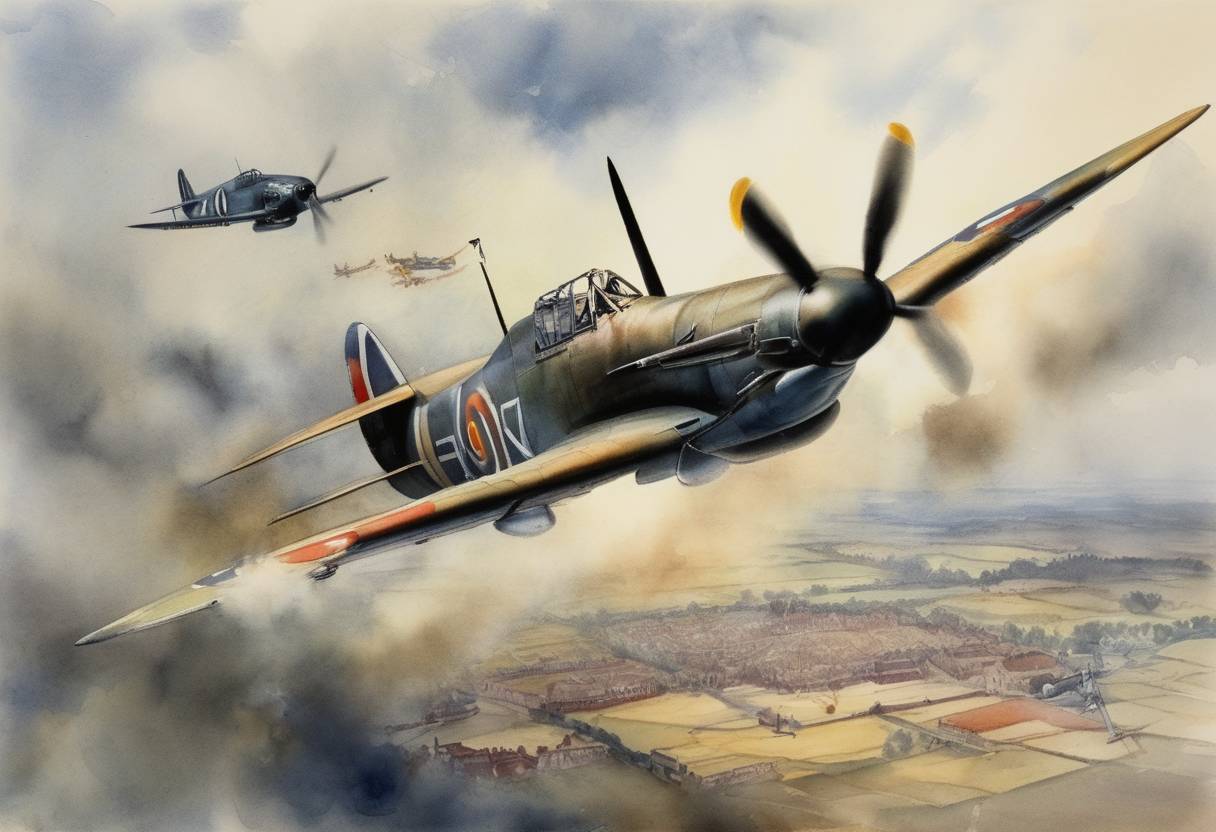
Adlertag: The Launch of the Main Luftwaffe Offensive in the Battle of Britain
Background
On August 13, 1940, Adolf Hitler’s Luftwaffe commenced the primary offensive of the Battle of Britain, codenamed ‘Adlertag’ or ‘Eagle Day.’ This operation marked the beginning of Germany’s attempt to gain air superiority over the Royal Air Force (RAF) as a precursor to Operation Sea Lion, Germany’s planned invasion of Britain. The directive for Adlertag was issued by Reichsmarschall Hermann Göring, who aimed to destroy the RAF’s capacity to defend Britain.
The Battle of Britain had taken on added urgency after the fall of France in June 1940, which left Britain isolated as the last major power opposing Nazi Germany in Western Europe. Control of the skies over Southern England was deemed essential by the German High Command to ensure the success of any invasion plans.
Events on Adlertag
Adlertag began with a series of coordinated attacks by the Luftwaffe aimed at crippling British airfields and radar installations along the southern coast of England. The offensive involved over 1,400 aircraft, including bombers and fighter escorts such as the Messerschmitt Bf 109. The Luftwaffe’s primary targets were RAF airfields in Hampshire, Sussex, and Kent, as well as radar stations and aircraft manufacturing hubs.
On this day, the weather did not completely cooperate with German plans, causing some delays and confusion among the Luftwaffe units. Despite these challenges, the Germans mounted several significant attacks:
- Early Morning and Afternoon Raids: The first wave of attacks began in the early morning and continued into the afternoon, focusing on disrupting the RAF’s forward operating bases and radar coverage.
- Major Targets: Notable targets included RAF Kenley, RAF Croydon, and radar stations along the Thames Estuary, all critical to Britain’s air defense infrastructure.
- RAF Response: The RAF’s sophisticated radar network and “Dowding System” of integrated air defense allowed British fighters to effectively intercept and engage up to forty German sorties throughout the day. Despite their numerical inferiority, the British fighters achieved significant success, aided by strategic fighter control.
Consequences
Adlertag did not achieve the decisive blow that Göring had anticipated. Although some RAF airfields were damaged, many were operational again soon after the attacks due to rapid repair efforts. British radar stations, critical to early warning and interception efforts, were mostly left unscathed or quickly restored. The RAF lost fewer aircraft than the Luftwaffe, showcasing the resilience and tenacity of British defenses.
The resilience exhibited on Adlertag bolstered British morale and demonstrated significant flaws in the Luftwaffe’s strategy, particularly their underestimation of the RAF’s capabilities and overestimation of their own effectiveness. This initial day of heavy engagement set the stage for the intensifying air battle over the following weeks, eventually culminating in the Luftwaffe’s strategic defeat in the Battle of Britain.
Historical Significance
Adlertag is remembered as a pivotal moment in World War II. It represented the start of one of the most famous aerial campaigns in history and demonstrated the effectiveness of Britain’s integrated air defense strategy. The failure of Adlertag and the wider Battle of Britain made Operation Sea Lion indefensible, forcing Hitler to reconsider his invasion plans and helping to shift the momentum of the war.