French Army's March in Egypt Under General Kléber – September 24, 1800
1800 · Cairo, Egypt
The French army under General Jean Baptiste Kléber began the march to recapture Egypt's towns from Ottoman forces following Napoleon's departure.
July 21, 1798
The Battle of the Pyramids took place during Napoleon Bonaparte's Egyptian campaign. French forces defeated the Mamluk rulers of Egypt, leading to French control over the region.
Giza, Egypt | French military
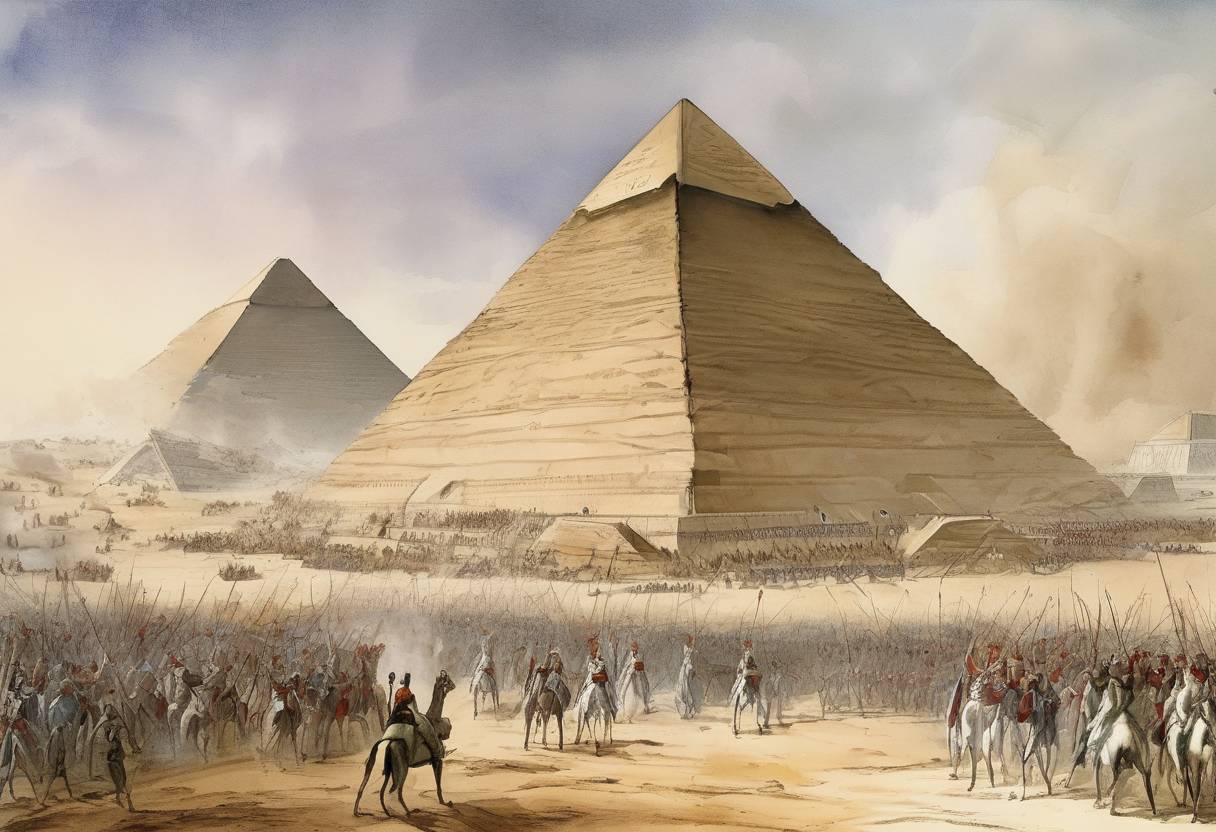
The Battle of the Pyramids was a pivotal engagement during Napoleon Bonaparte’s Egyptian campaign, marking a significant victory for the French forces over the Mamluk rulers of Egypt. This battle took place on July 21, 1798, and was instrumental in establishing French control over the region.
Napoleon’s Egyptian Campaign: Napoleon Bonaparte embarked on the Egyptian campaign with the dual objectives of undermining British trade routes to India and expanding French influence in the Middle East. The campaign was part of the larger French Revolutionary Wars.
Mamluk Rule: At the time, Egypt was under the control of the Mamluks, a military caste that had ruled the region for centuries. The Mamluks were known for their formidable cavalry and had maintained a strong grip over Egypt despite the declining power of the Ottoman Empire, to which Egypt was nominally subject.
Location: The battle took place near Cairo, close to the Giza pyramids, which provided the engagement with its iconic name.
French Strategy: Napoleon employed a tactical formation known as the “divisional square,” which was designed to counter the Mamluks’ cavalry charges. This formation involved infantry squares with artillery and cavalry positioned at the corners, providing a robust defense against mounted attacks.
Outcome: The French forces, numbering around 25,000, decisively defeated the Mamluk army, which was approximately 21,000 strong. The Mamluks suffered heavy casualties, with estimates of around 6,000 killed, while French losses were minimal.
French Control: The victory at the Battle of the Pyramids allowed Napoleon to capture Cairo and assert French control over Egypt. This victory was a significant strategic gain, although it would be short-lived due to subsequent British naval dominance in the region.
Cultural Impact: The campaign also had a profound cultural impact, as it led to increased European interest in Egyptology and the eventual discovery of the Rosetta Stone, which was crucial in deciphering Egyptian hieroglyphs.
Long-term Consequences: Despite the initial success, the French occupation of Egypt faced numerous challenges, including resistance from local populations and the eventual defeat of the French fleet at the Battle of the Nile by Admiral Horatio Nelson. This naval defeat isolated Napoleon’s forces and contributed to the eventual withdrawal of French troops from Egypt in 1801.
The Battle of the Pyramids remains a notable example of Napoleon’s military prowess and strategic innovation, illustrating the complexities of his campaigns and their lasting impact on both European and Middle Eastern history.
Source: en.wikipedia.org