Manuel Noriega's Surrender to U.S. Forces on January 3, 1990
1990 · Panama City, Panama
Former leader of Panama, Manuel Noriega, surrendered to U.S. forces.
December 20, 1989
The United States launched Operation Just Cause, an invasion of Panama to depose its leader, Manuel Noriega.
Panama City, Panama | United States Military
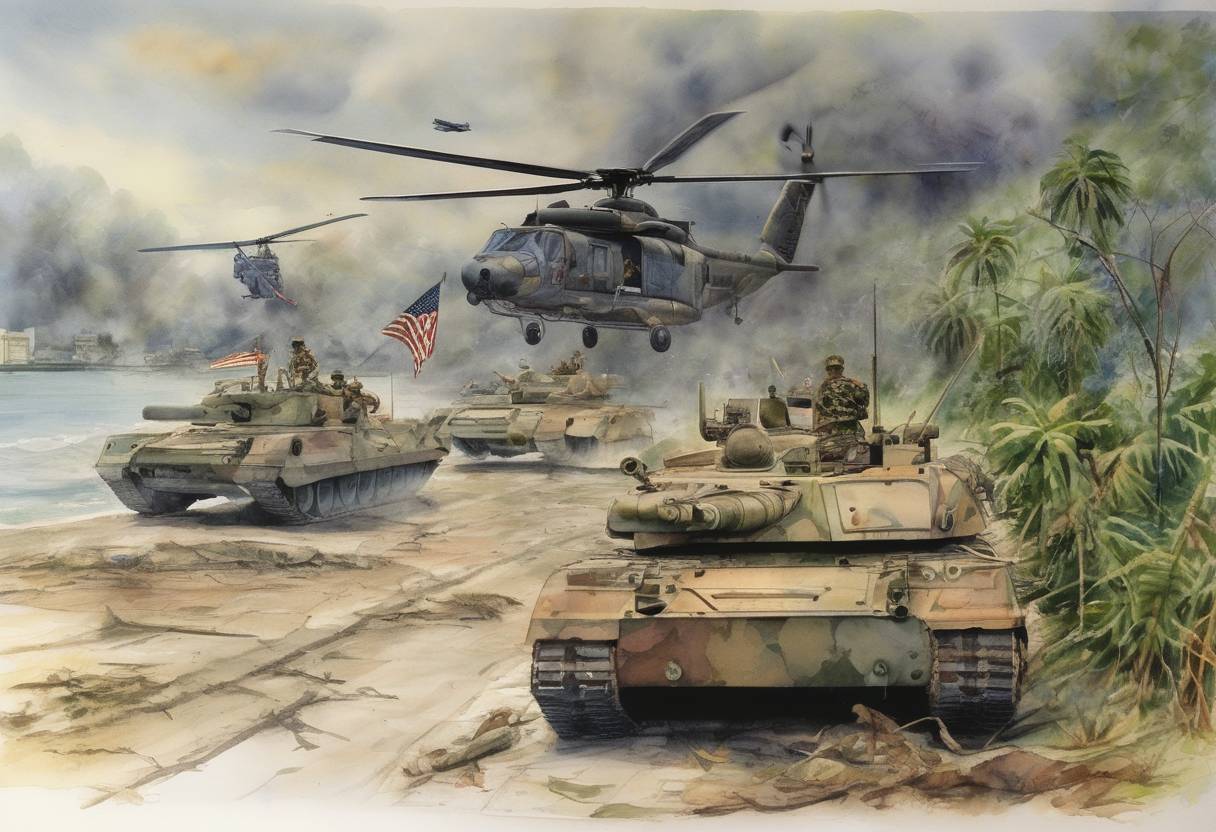
On December 20, 1989, the United States launched Operation Just Cause, a military invasion aimed at deposing Panamanian leader Manuel Noriega. This operation marked a significant moment in U.S. foreign policy and military history, reflecting the geopolitical dynamics of the late Cold War era.
Manuel Noriega, a former ally of the United States, had risen to power in Panama and was serving as the de facto military leader. Initially, Noriega had cooperated with U.S. intelligence agencies, but over time, his involvement in drug trafficking, money laundering, and human rights abuses strained relations. Tensions escalated further when Noriega annulled the results of the 1989 Panamanian presidential election, which was widely seen as fraudulent.
The situation deteriorated when a U.S. Marine was killed by Panamanian Defense Forces in December 1989, prompting President George H.W. Bush to order the invasion. The stated objectives were to safeguard American citizens, defend democracy and human rights in Panama, combat drug trafficking, and secure the integrity of the Panama Canal.
Operation Just Cause commenced in the early hours of December 20, 1989, involving approximately 27,000 U.S. troops and 300 aircraft. The operation was one of the largest and most complex military actions since the Vietnam War. Key targets included:
The operation was characterized by intense urban combat, with U.S. forces quickly overwhelming Panamanian defenses. The fighting resulted in significant casualties, with estimates of civilian deaths ranging from several hundred to over a thousand.
Manuel Noriega sought refuge in the Vatican nunciature in Panama City, where he remained for several days before surrendering to U.S. forces on January 3, 1990. He was subsequently extradited to the United States, where he faced charges of drug trafficking, racketeering, and money laundering. Noriega was convicted and served a lengthy prison sentence.
The invasion had several immediate and long-term consequences:
Operation Just Cause is often analyzed in the context of U.S. interventionism and the broader geopolitical landscape of the late 20th century. It underscored the complexities of U.S. foreign policy in Latin America and set a precedent for future military interventions. The operation also played a role in shaping the post-Cold War order, as the U.S. sought to assert its influence in the Western Hemisphere.
Overall, the invasion of Panama remains a controversial chapter in U.S. history, reflecting the tensions between national security interests and international law.
Source: www.history.com