Massachusetts Enacts First Punitive Law Against Quakers - October 14, 1656
1656 · Boston, Colonial America
Massachusetts enacts the first punitive law against the Quakers, fining the residents for harboring them.
March 22, 1638
Anne Hutchinson was expelled from the Massachusetts Bay Colony for her religious beliefs and practices, which challenged the established Puritan clergy.
Boston, Massachusetts Bay Colony | Massachusetts Bay Colony
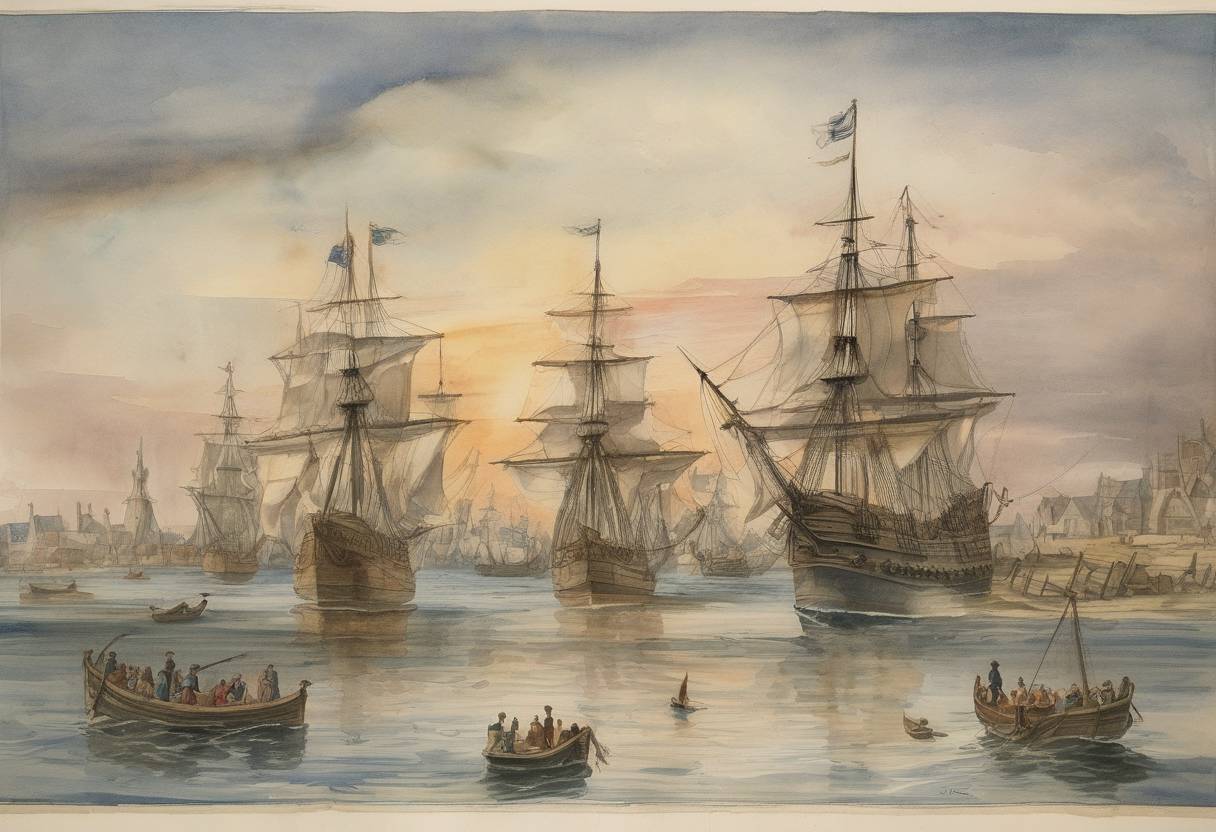
On March 22, 1638, Anne Hutchinson was formally expelled from the Massachusetts Bay Colony, marking a significant moment in the early history of religious freedom in America. Hutchinson, a prominent religious dissenter, challenged the rigid orthodoxy of the Puritan clergy, which led to her trial and subsequent banishment.
Anne Hutchinson was born in England in 1591 and emigrated to the Massachusetts Bay Colony in 1634 with her husband and children. She quickly became a central figure in a theological controversy that would shake the foundations of the colony.
The Massachusetts Bay Colony was established by Puritans seeking to create a “city upon a hill,” a community grounded in strict religious observance and governance. The Puritan leadership, including Governor John Winthrop, maintained a rigid interpretation of Calvinist theology, emphasizing predestination and the necessity of adhering to the colony’s religious doctrines.
Hutchinson began holding meetings in her home, where she discussed sermons and offered her interpretations of the Bible. Her gatherings attracted a significant following, including influential figures in the colony. Hutchinson espoused the belief in a “covenant of grace” rather than a “covenant of works,” suggesting that personal revelation and faith were more critical to salvation than strict adherence to moral law and church ordinances.
Hutchinson’s growing influence and her theological views, which were seen as antinomian (opposing the moral law), alarmed the colony’s leaders. In 1637, she was put on trial for heresy and sedition. The trial was a pivotal event, highlighting the tension between individual religious expression and communal conformity.
Following her expulsion, Anne Hutchinson and her family, along with some of her followers, relocated to Rhode Island, a colony known for its religious tolerance, founded by fellow dissenter Roger Williams. Later, she moved to what is now New York, where she lived until her death in 1643.
Hutchinson’s expulsion is a landmark event in the history of religious freedom in America. It underscores the challenges faced by those who sought to express dissenting religious views in a society that valued conformity. Her story is often cited as an early example of the struggle for religious liberty and the rights of individuals to challenge established authority.
Anne Hutchinson remains a symbol of courage and conviction, representing the enduring quest for freedom of conscience and the right to dissent in the face of rigid orthodoxy.
Source: www.britannica.com