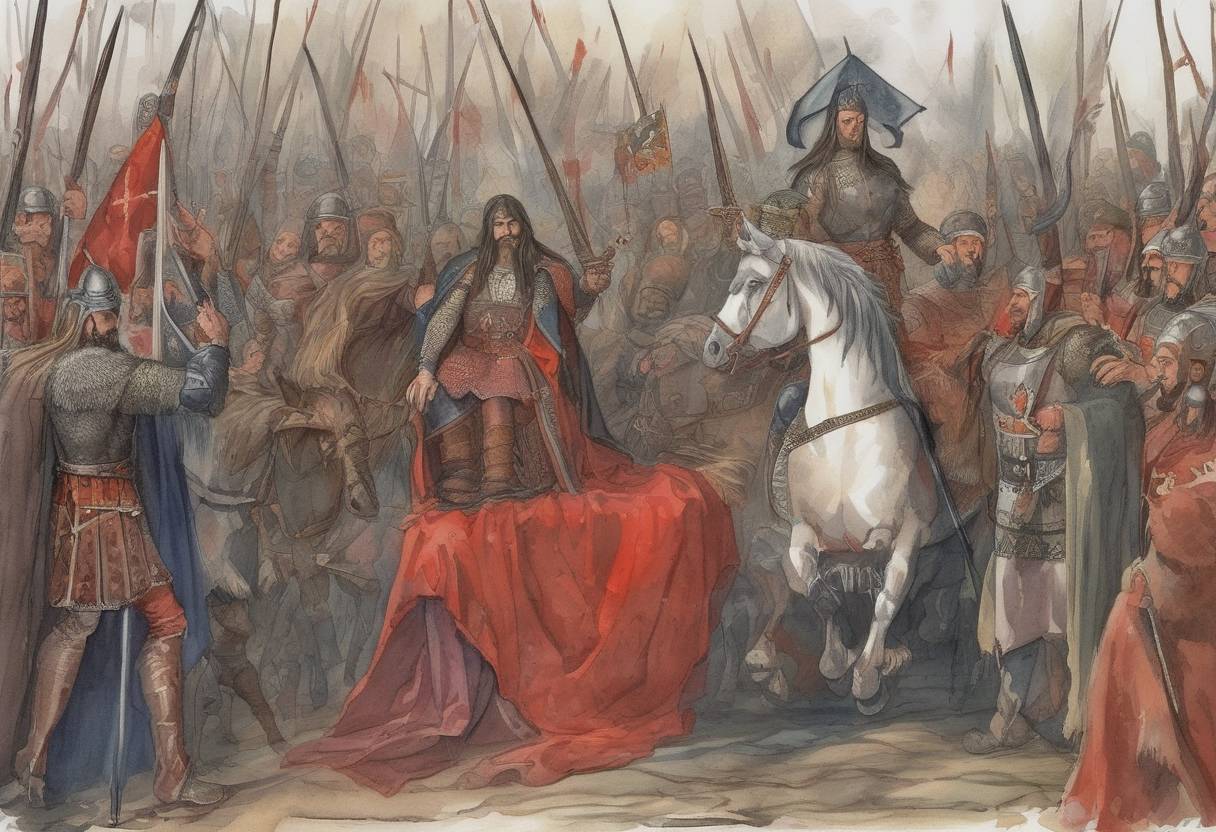
Vlad the Impaler’s Brief Reclamation of the Wallachian Throne
On November 26, 1476, Vlad III, commonly known as Vlad the Impaler, achieved a significant military victory by defeating Basarab Laiotă with the assistance of Stephen III of Moldavia and Stephen V Báthory. This victory allowed Vlad to briefly reclaim the throne of Wallachia, a position he had lost multiple times throughout his tumultuous reign.
Historical Context
Vlad III, also known as Vlad Dracula, was the Voivode (Prince) of Wallachia, a historical and geographical region of Romania. His rule was marked by a series of conflicts with the Ottoman Empire, internal strife, and a notorious reputation for his brutal methods of punishment, particularly impalement.
Background Leading to the Event
Political Instability: Wallachia during the 15th century was a region of significant political instability, caught between the interests of the Ottoman Empire and the Kingdom of Hungary. Vlad’s reign was characterized by frequent battles for control over the principality.
Previous Reigns: Vlad had previously ruled Wallachia in three separate periods: 1448, 1456–1462, and briefly in 1476. His reigns were interrupted by rival claimants supported by either the Ottomans or the Hungarians.
Alliances: Vlad’s return to power in 1476 was facilitated by his alliances with Stephen III of Moldavia, also known as Stephen the Great, and Stephen V Báthory, a Hungarian nobleman and military leader. These alliances were crucial in providing the military support needed to challenge Basarab Laiotă, who was backed by the Ottomans.
The Battle and Its Aftermath
The Battle: On November 26, 1476, Vlad, with the support of his allies, engaged Basarab Laiotă’s forces. The battle resulted in a decisive victory for Vlad, allowing him to reclaim the Wallachian throne.
Brief Reign: Despite this victory, Vlad’s third reign was short-lived. By the end of December 1476, he was killed in battle against the Ottomans, marking the end of his rule and life. His death remains shrouded in mystery, with various accounts suggesting different circumstances.
Broader Historical Significance
Legacy: Vlad the Impaler’s legacy is complex. He is remembered as a national hero in Romania for his resistance against Ottoman encroachment and as a symbol of national identity. However, his brutal methods have also contributed to his infamy, inspiring the fictional character Count Dracula.
Regional Impact: The constant power struggles in Wallachia during Vlad’s time highlight the broader geopolitical tensions in Eastern Europe during the 15th century, particularly the struggle between Christian states and the expanding Ottoman Empire.
Cultural Influence: Vlad’s life and reign have had a lasting cultural impact, influencing literature, folklore, and modern media, most notably through Bram Stoker’s “Dracula.”
In summary, Vlad the Impaler’s brief reclamation of the Wallachian throne on November 26, 1476, was a pivotal moment in his storied life, underscoring the volatile nature of Wallachian politics and the enduring legacy of one of history’s most enigmatic figures.