The Soviet Union Captures Warsaw, Poland - January 17, 1945
1945 · Warsaw, Poland
The Soviet Union captures Warsaw, Poland, from Nazi Germany during World War II.
September 27, 1939
Warsaw surrenders to Nazi Germany during the Invasion of Poland, marking a significant event in the early stages of World War II.
Warsaw, Poland | Nazi Germany
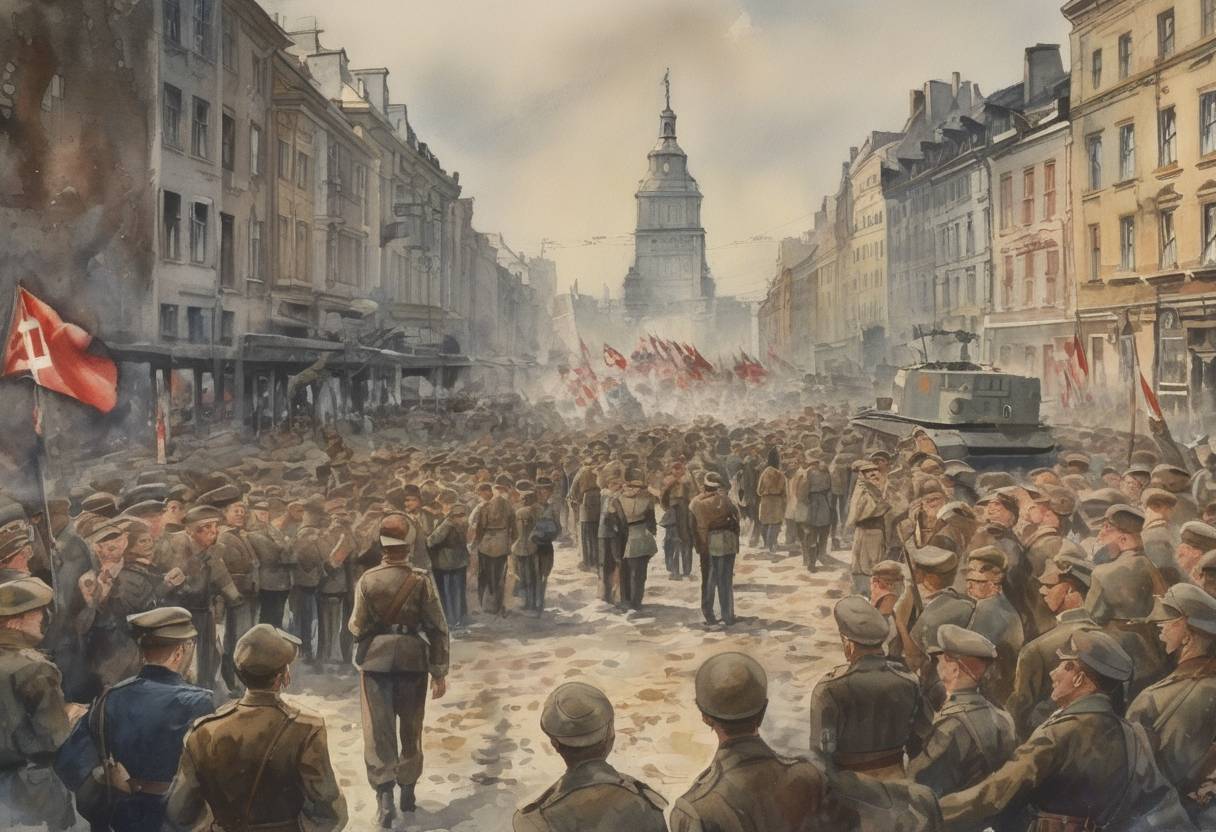
On September 27, 1939, Warsaw, the capital of Poland, officially surrendered to Nazi Germany, marking a pivotal moment in the early stages of World War II. This event concluded the intense and devastating Siege of Warsaw, which had begun on September 8, 1939, following the German invasion of Poland on September 1, 1939.
Invasion of Poland: The invasion of Poland by Nazi Germany on September 1, 1939, marked the beginning of World War II. This military campaign was characterized by the use of Blitzkrieg tactics, which involved rapid and overwhelming force, combining air raids, artillery bombardments, and fast-moving ground troops.
Polish Defense: Despite being outnumbered and outgunned, Polish forces mounted a determined defense. Warsaw, as the capital, became a focal point of resistance. The city’s defenders included regular Polish Army units, volunteers, and civilians who took up arms to protect their city.
German Assault: The siege began in earnest on September 8, 1939, when German forces reached the outskirts of Warsaw. The city was subjected to relentless aerial bombardments and artillery shelling, causing significant civilian casualties and widespread destruction.
Civilian Impact: The siege had a devastating impact on Warsaw’s civilian population. Essential services were disrupted, food and water supplies dwindled, and thousands of civilians were killed or wounded. Despite these hardships, the city’s inhabitants showed remarkable resilience.
International Response: The fall of Warsaw and the broader invasion of Poland prompted Britain and France to declare war on Germany on September 3, 1939, though their military response was limited at this stage.
Capitulation: After weeks of intense fighting and with no prospect of relief, Warsaw’s military commander, General Juliusz Rómmel, decided to surrender the city to prevent further civilian casualties and destruction. The formal surrender took place on September 27, 1939.
Occupation: Following the surrender, Warsaw fell under German occupation. The city would endure years of hardship, including the establishment of the Warsaw Ghetto and the brutal suppression of the Warsaw Uprising in 1944.
Significance: The fall of Warsaw symbolized the collapse of organized Polish resistance and the effective end of the September Campaign. It also highlighted the effectiveness of German military tactics and foreshadowed the brutal occupation policies that would be implemented across occupied Europe.
World War II Escalation: The swift defeat of Poland demonstrated the effectiveness of Blitzkrieg and emboldened Nazi Germany to pursue further aggressive expansion in Europe, leading to subsequent invasions of Denmark, Norway, Belgium, the Netherlands, and France in 1940.
Allied Response: The fall of Poland and the subsequent occupation galvanized the Allied powers, particularly Britain and France, to prepare for a prolonged conflict, ultimately leading to a global war that would last until 1945.
The surrender of Warsaw on September 27, 1939, remains a significant event in the history of World War II, illustrating the early successes of Nazi Germany’s military strategy and the immense challenges faced by the Allied powers in the initial stages of the conflict.
Source: en.wikipedia.org