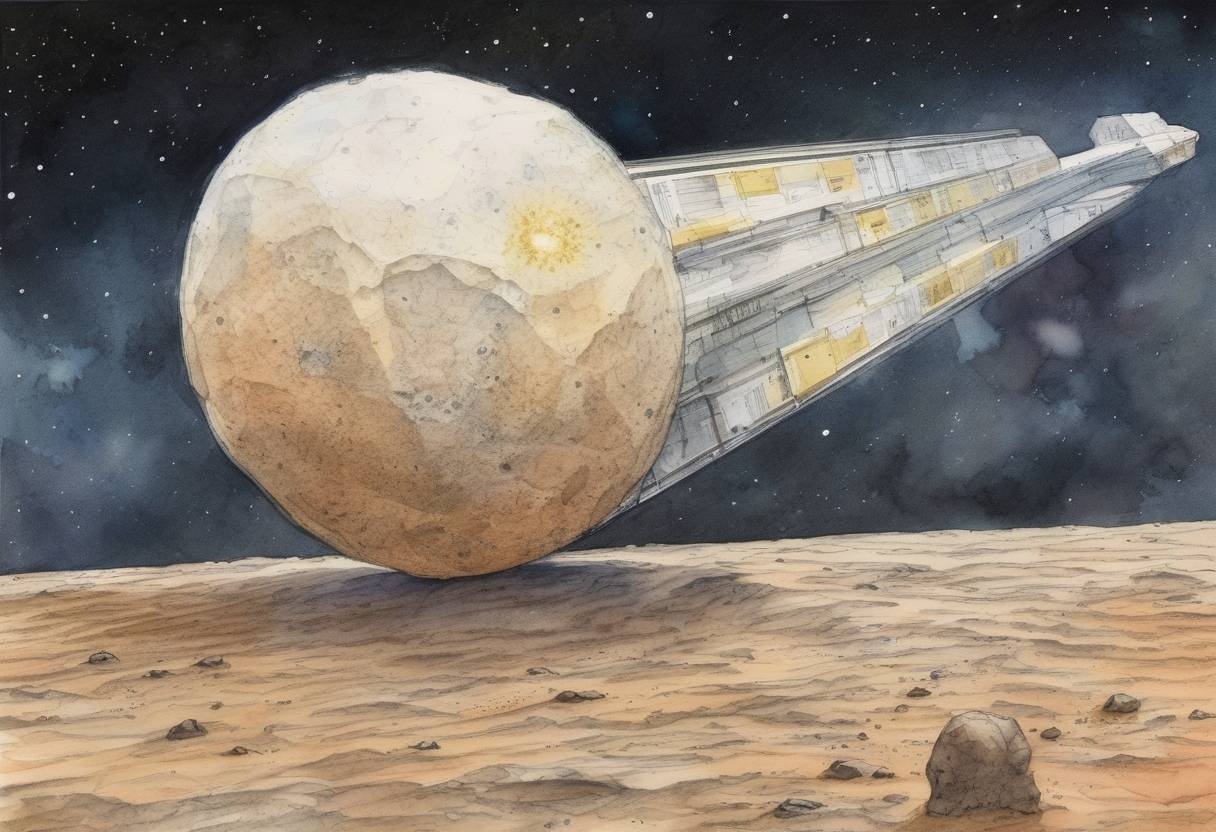
Asteroid 4179 Toutatis Close Approach - September 29, 2004
On September 29, 2004, asteroid 4179 Toutatis made a notable close approach to Earth, passing within approximately four lunar distances. This event provided a significant opportunity for scientific observation and study of near-Earth objects (NEOs).
Background
Asteroid 4179 Toutatis is a large, elongated, and irregularly shaped asteroid, first discovered in 1989 by French astronomer Christian Pollas. It is classified as an Apollo-type asteroid, which means its orbit crosses that of Earth, making it a subject of interest for astronomers studying potential Earth impactors.
Key Details of the 2004 Approach
- Distance: During its 2004 flyby, Toutatis passed Earth at a distance of about 1.5 million kilometers (approximately 930,000 miles), which is roughly four times the distance from the Earth to the Moon.
- Size and Shape: Toutatis is approximately 4.5 kilometers (about 2.8 miles) long and has a complex, tumbling rotation, which makes its motion through space particularly intriguing to scientists.
- Observation Opportunities: The close approach allowed astronomers to conduct detailed radar observations using facilities such as the Arecibo Observatory in Puerto Rico and the Goldstone Deep Space Communications Complex in California. These observations helped refine the understanding of Toutatis’s orbit, shape, rotation, and surface properties.
Scientific Significance
The 2004 flyby of Toutatis was significant for several reasons:
Improved Orbital Data: The observations helped refine the asteroid’s orbital parameters, improving predictions of its future paths and potential close approaches to Earth.
Surface and Composition Analysis: Radar imaging provided insights into the asteroid’s surface features and composition, contributing to the broader understanding of asteroid characteristics.
Rotation Dynamics: Toutatis’s complex rotation, which involves a non-principal axis spin (often described as “tumbling”), was studied in detail, offering valuable data on the rotational dynamics of irregularly shaped celestial bodies.
Broader Implications
The study of asteroids like Toutatis is crucial for planetary defense initiatives, as understanding the trajectories and physical properties of NEOs is essential for assessing potential impact threats. Additionally, these observations contribute to the scientific knowledge of the early solar system, as asteroids are considered remnants from its formation.
In summary, the close approach of asteroid 4179 Toutatis in 2004 was a pivotal event for astronomers and planetary scientists, providing a wealth of data that enhanced the understanding of near-Earth asteroids and their potential impact on Earth.