The Battle of Gettysburg: A Turning Point in the American Civil War
1863 · Gettysburg, United States
The Battle of Gettysburg ended, a turning point in the American Civil War with a Union victory.
July 16, 1861
Union General Irvin McDowell's army began marching from Washington, D.C., to Manassas, Virginia, marking the start of the First Battle of Bull Run, the first major land battle of the American Civil War.
Washington, D.C., United States | Union Army
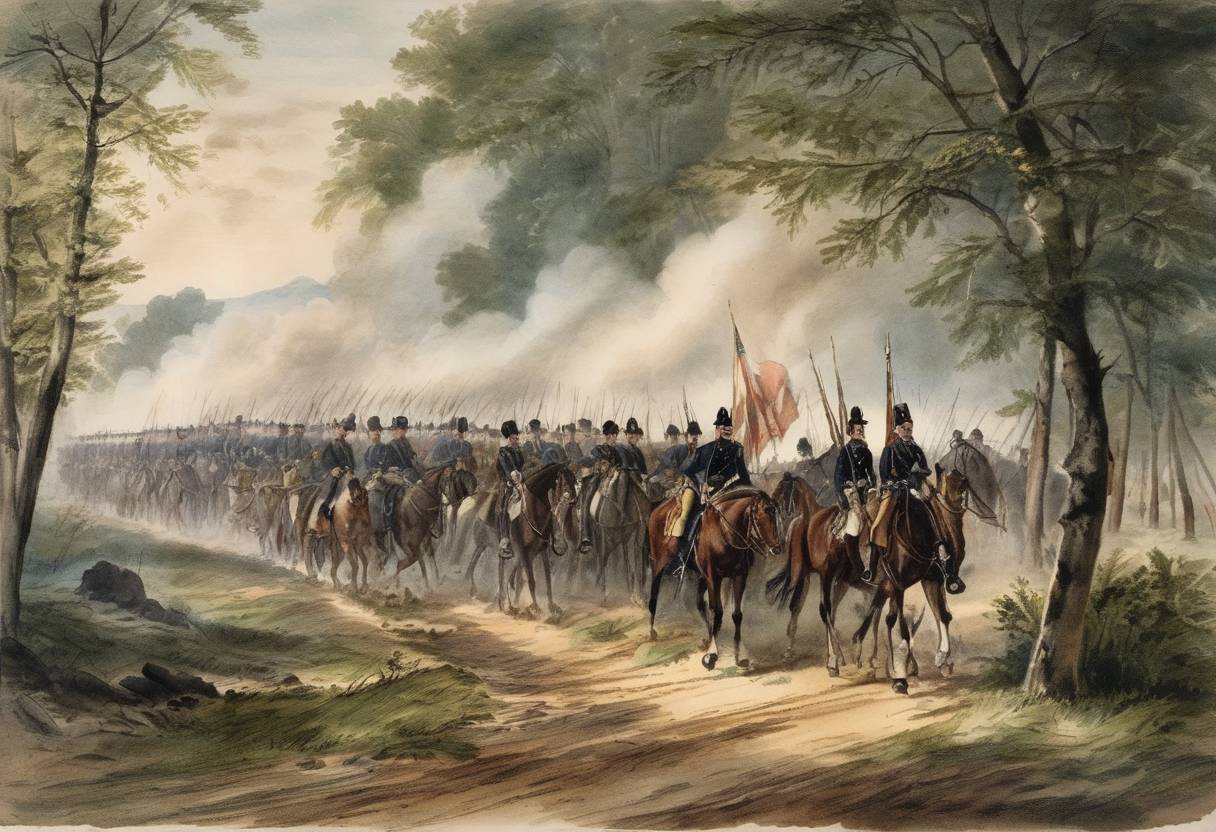
On July 16, 1861, Union General Irvin McDowell initiated the first major movement of Union forces marking the beginning of what would become known as the First Battle of Bull Run, also referred to as the First Battle of Manassas by Confederate forces. This movement from Washington, D.C., towards Manassas, Virginia, was a strategic attempt to strike a decisive blow against Confederate forces early in the American Civil War.
Following the Confederate victory at Fort Sumter in April 1861, there was a surge in public pressure from both the Union and Confederate sides for a quick end to the conflict. The Union, under President Abraham Lincoln, sought to quell the rebellion and restore the Union with swift military action. As such, McDowell, entrusted with leading the Union Army of Northeastern Virginia, was ordered to mount an offensive against the Confederate forces under the command of General P.G.T. Beauregard, stationed near Manassas Junction in Northern Virginia.
Irvin McDowell’s army, approximately 35,000 strong, began their advance on the morning of July 16. The march was marked by logistical challenges, as McDowell’s forces were largely inexperienced and untested in combat. The journey aimed to engage and defeat the Confederate troops positioned about 25 miles southwest of Washington, D.C., which posed a direct threat to the capital.
The march towards Manassas was slow and cumbersome. McDowell faced significant challenges, including inadequate training of his troops, issues with supplies, and the oppressive summer heat, which all contributed to delays. The plan depended on speed and surprise, but McDowell’s cautious approach allowed the Confederates time to gather reinforcements.
The engagement at Bull Run, which commenced shortly after the march, was a pivotal early battle in the Civil War. It shattered any illusion that the war would be a brief campaign and highlighted the need for more thorough preparation and strategy on both sides. The First Battle of Bull Run ended in a Confederate victory, and the chaotic retreat of Union forces back to Washington prompted a reevaluation of Union military leadership and strategy.
The events of July 16, 1861, marked a key point in the escalation of the Civil War, demonstrating both the scale and the seriousness of the conflict that lay ahead for the nation.
Source: www.battlefields.org