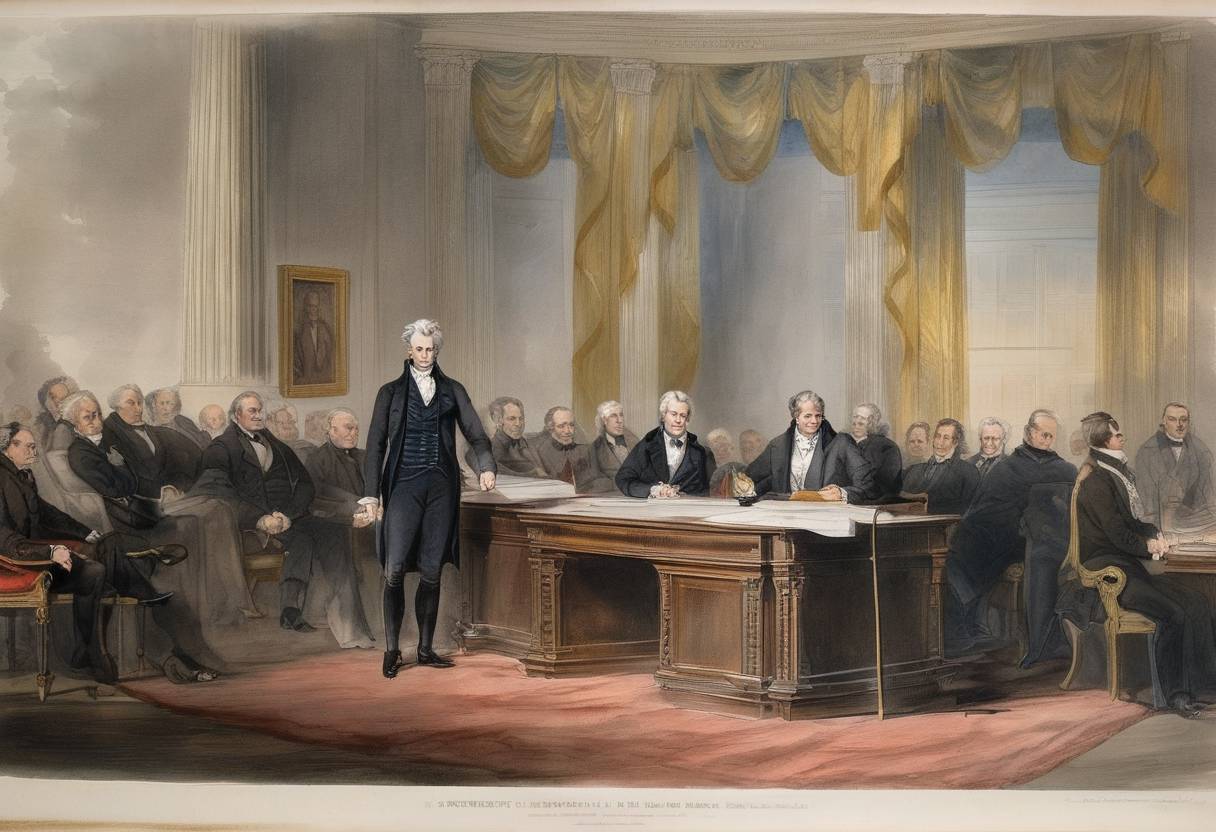
President Andrew Jackson’s Veto of the Recharter Bill for the Second Bank of the United States
On July 10, 1832, President Andrew Jackson exercised his executive power by vetoing the bill that sought to renew the charter of the Second Bank of the United States, a pivotal moment in American financial and political history.
Background
The Second Bank of the United States was established in 1816, following the financial disarray of the War of 1812. The bank was intended to stabilize the national currency and provide credit to burgeoning industries. Its original 20-year charter was set to expire in 1836.
However, the bank faced considerable opposition from various quarters, particularly from Jacksonian Democrats who saw it as an embodiment of elitist power and corruption. These critics argued that the Bank wielded excessive control over credit and was biased toward Eastern financial interests, disadvantaging Western farmers and entrepreneurs.
Events Leading up to the Veto
In 1832, with the bank’s charter due to expire in four years, Senator Henry Clay and other supporters decided to push for an early renewal. They believed that bringing the issue to the forefront would politically corner Jackson, gambling that a veto could erode his popularity as he sought re-election.
The Veto
President Jackson’s veto message on July 10 was lengthy and strongly worded, attacking the Bank as unconstitutional and socially unjust. He argued that the Bank conferred too much power into the hands of a privileged few, essentially creating a government-sanctioned monopoly that undermined the rights of the states and threatened American liberty.
Jackson stated:
“The Bank is, in fact, but one vast imitation of the monied aristocracy of our Government, without foreign control, that seeks the subversion of our free institutions and the destruction of our liberties.”
Aftermath
Jackson’s veto did not kill the Bank immediately, but it signified the beginning of its demise. The veto played a significant role in the election of 1832, which Jackson won decisively, interpreting his re-election as a mandate to dismantle the Bank. In a later move, Jackson withdrew federal deposits from the Bank and redistributed them to state banks, a maneuver that his opponents termed the “Bank War.”
In 1836, the Bank’s charter expired and it ceased to operate as a national institution. This event significantly influenced the evolution of the American financial system and showcased the emerging power of the presidency in shaping national policy.
The aftermath of this conflict also highlighted the growing tension between different economic regions of the United States, setting the stage for future political conflicts that would eventually lead to the Civil War.