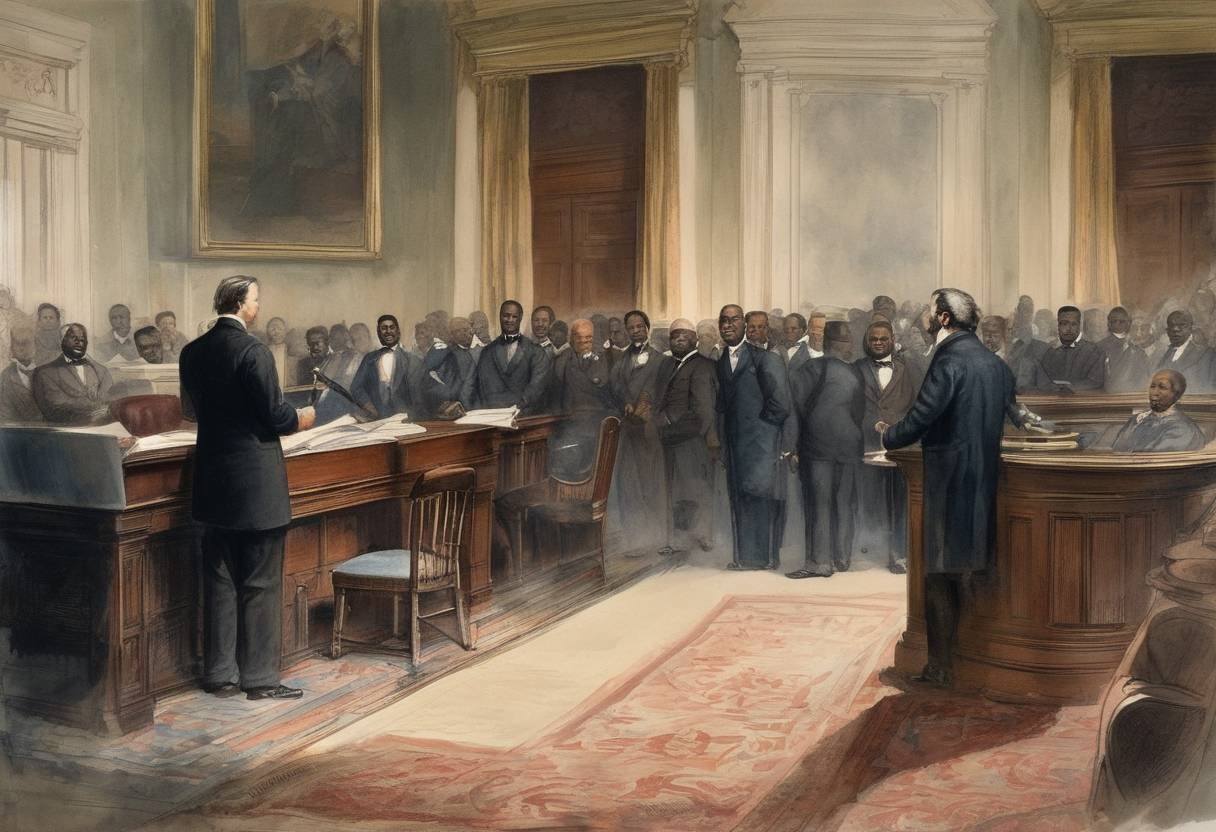
The Civil Rights Act of 1866
On April 9, 1866, the United States Congress enacted the Civil Rights Act of 1866, a landmark piece of legislation designed to protect the civil rights of African Americans following the end of the Civil War. This Act is particularly notable for marking one of the first major legislative steps towards civil rights and racial equality in the United States.
Background
After the Civil War concluded in 1865, the nation was in a state of reconstruction and transformation. The abolition of slavery through the Thirteenth Amendment had left millions of formerly enslaved individuals seeking to integrate into American society as free and equal citizens. However, the post-war Southern states enacted “Black Codes,” restrictive laws aimed at limiting the freedom of African Americans and ensuring their availability as a cheap labor force.
In response to these developments and the Southern states’ attempts to undermine the newly granted freedoms, Radical Republicans in Congress sought to provide federal protection for the civil rights of the freedmen. The Civil Rights Act of 1866 was introduced as part of these efforts.
Legislative Journey and Veto
The bill was initially passed by Congress but was met with a veto by President Andrew Johnson, who was opposed to the expansion of federal power and sympathetic to the Southern states’ positions. Johnson’s veto message characterized the Act as an overreach of federal authority and contended that it infringed upon states’ rights.
Despite the presidential veto, Congress pushed forward with the legislation. On April 9, 1866, Congress successfully overrode Johnson’s veto with a two-thirds majority in both the House of Representatives and the Senate. This marked the first time in American history that Congress overrode a presidential veto on a major piece of legislation.
Provisions and Impact
The Civil Rights Act of 1866 declared that all persons born in the United States, with the exception of Native Americans, were to be considered citizens, regardless of race, color, or previous condition of servitude. This was a groundbreaking affirmation of civil rights at the national level, underscoring the federal government’s commitment to protecting the rights of African Americans.
The Act guaranteed several key rights, including the ability to make and enforce contracts, sue and be sued, give evidence in court, and inherit, purchase, lease, sell, hold, and convey real and personal property. By addressing these fundamental civil rights, the Act aimed to dismantle the legal foundations of racial discrimination and ensure legal equality for African Americans.
Aftermath and Legacy
While the Civil Rights Act of 1866 laid important groundwork for the future of civil rights in America, it faced significant resistance and was rarely enforced in the years immediately following its enactment. Nevertheless, it set important legal precedents that would be reinforced by subsequent legislation, particularly the Fourteenth Amendment to the Constitution, which was ratified in 1868 and provided broader protections by embedding the principle of equal protection under the law.
The Act’s significance extends into modern discussions on civil rights, exemplifying the enduring struggle for racial equality and justice in the United States. It is remembered as a pioneering step that paved the way for future civil rights advancements and remains a reference point in the ongoing pursuit of equality.