The Graf Zeppelin's First Transatlantic Flight
1928 · Lakehurst, United States
The airship Graf Zeppelin completes its first transatlantic flight, landing in Lakehurst, New Jersey.
July 13, 1919
The British airship R34 lands in Norfolk, England, completing the first round-trip transatlantic flight.
Norfolk, United Kingdom | Royal Air Force
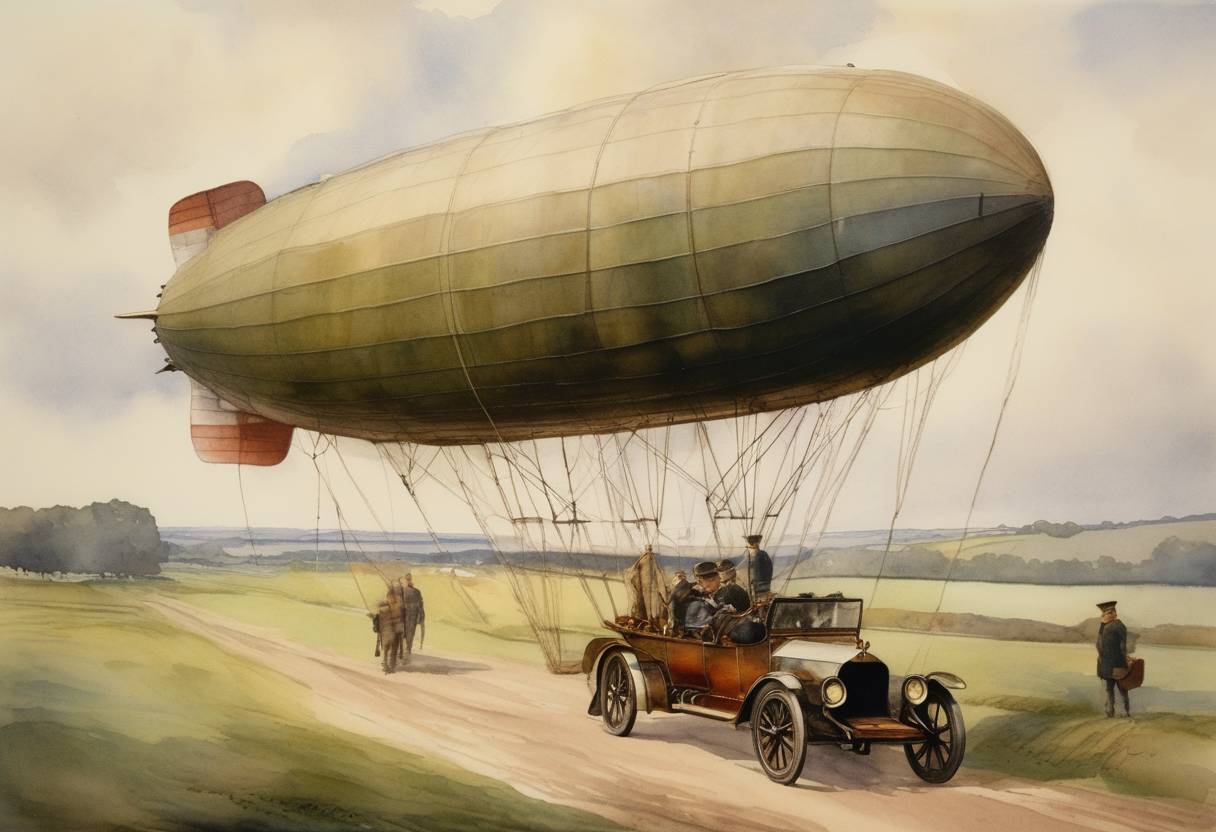
On July 13, 1919, the British airship R34 made aviation history by landing in Norfolk, England, after completing the first-ever round-trip transatlantic flight. This remarkable feat solidified the R34’s place in aviation history as a pioneer of intercontinental air travel.
Following the end of World War I, there was a keen interest in advancing aviation technology, particularly for extended flight capabilities over oceans. The R34, a dirigible constructed by the Royal Air Force (RAF), was a vital component of this post-war aviation experimentation. With a length of 634 feet (193 meters) and powered by five 275-horsepower Sunbeam Maori engines, the airship was initially designed for military purposes.
The journey began on July 2, 1919, when the R34 embarked on its east-to-west leg from East Fortune, Scotland, under the command of Major George Herbert Scott. The airship carried a crew of 30 men and one stowaway, William Ballantyne, a crewman’s brother, who revealed himself once airborne. The flight took 108 hours, where the R34 encountered challenging weather conditions, highlighting both the risks and potential of airship travel.
After successfully reaching Mineola, Long Island, New York, on July 6, the R34 was refueled and prepared for the return journey. The west-to-east return was aided by favorable tailwinds, enabling a faster crossing.
The R34 touched down at RAF Pulham in Norfolk, England, at 7:57 AM on July 13, 1919. The conclusion of the round-trip journey validated the potential for airships in commercial and military applications across vast distances.
The successful completion of this pioneering transatlantic air journey demonstrated the practicality of intercontinental air travel, laying the groundwork for the development of future aviation technology. It illustrated the growing promise of airships, even as airplanes were being rapidly developed for passenger and cargo transport. The journey also underscored the international cooperation and spirit of exploration emerging in the post-war era.
This event is a landmark in the annals of aviation history, showcasing human ingenuity and the relentless pursuit of breaking barriers in travel and communication.
Source: www.rafmuseum.org.uk