The First Issue of The Wall Street Journal
1889 · New York City, United States
The first issue of The Wall Street Journal was published, becoming one of the most influential financial newspapers in the world.
January 15, 1870
A political cartoon for the first time symbolized the Democratic Party with a donkey.
New York City, United States | Harper's Weekly
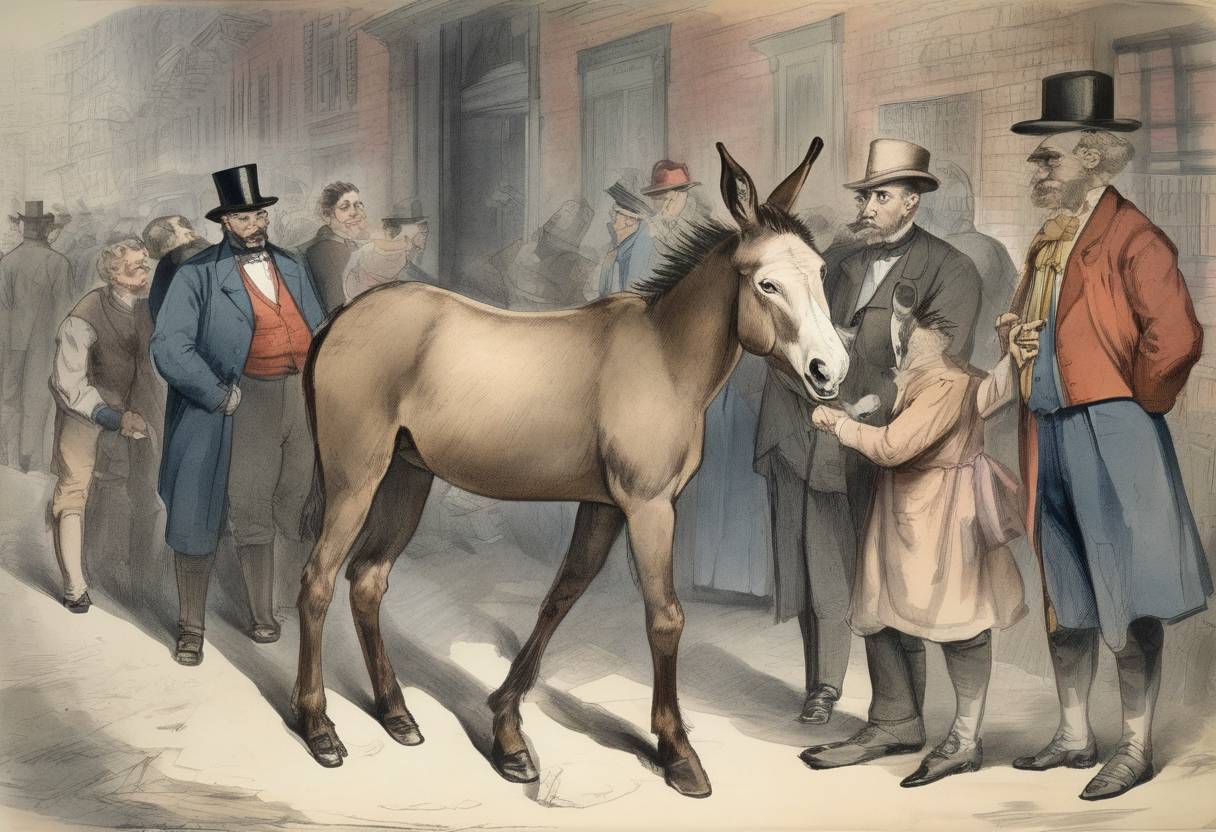
On January 15, 1870, the Democratic Party was symbolized by a donkey in a political cartoon for the first time. This significant event in American political history was the work of Thomas Nast, a prominent political cartoonist of the 19th century, who published his illustration in Harper’s Weekly.
Thomas Nast: Known as the “Father of the American Cartoon,” Nast was influential in shaping public opinion through his illustrations. He was a staunch supporter of the Republican Party and used his art to critique political figures and parties.
Political Climate: The period following the Civil War was marked by intense political rivalry and reconstruction efforts. The Democratic Party, at the time, was often criticized by Republicans for its opposition to certain Reconstruction policies.
Title and Imagery: The cartoon, titled “A Live Jackass Kicking a Dead Lion,” depicted a donkey (representing the Democratic Party) kicking a dead lion, which symbolized Edwin M. Stanton, the recently deceased Secretary of War under President Lincoln. The donkey was labeled “Copperhead Papers,” referring to Northern Democrats who opposed the Civil War.
Symbolism: The use of the donkey was not entirely new; Andrew Jackson’s opponents had previously used the term “jackass” to describe him, which he embraced, turning it into a symbol of stubbornness and determination. However, Nast’s cartoon was pivotal in cementing the donkey as a lasting emblem of the Democratic Party.
Enduring Symbol: Following Nast’s cartoon, the donkey gradually became an enduring symbol of the Democratic Party, much like the elephant would later become for the Republican Party, also popularized by Nast in 1874.
Cultural Impact: The use of animals as political symbols became a staple in American political discourse, providing a visual shorthand for party identification and political commentary.
Legacy of Thomas Nast: Nast’s work, including his creation of the Democratic donkey and Republican elephant, left a lasting legacy on American political iconography, influencing how political parties are perceived and represented in media.
In summary, the political cartoon published on January 15, 1870, by Thomas Nast played a crucial role in establishing the donkey as the symbol of the Democratic Party, a symbol that remains in use to this day. This event highlights the power of visual media in shaping political narratives and party identities.
Source: en.wikipedia.org