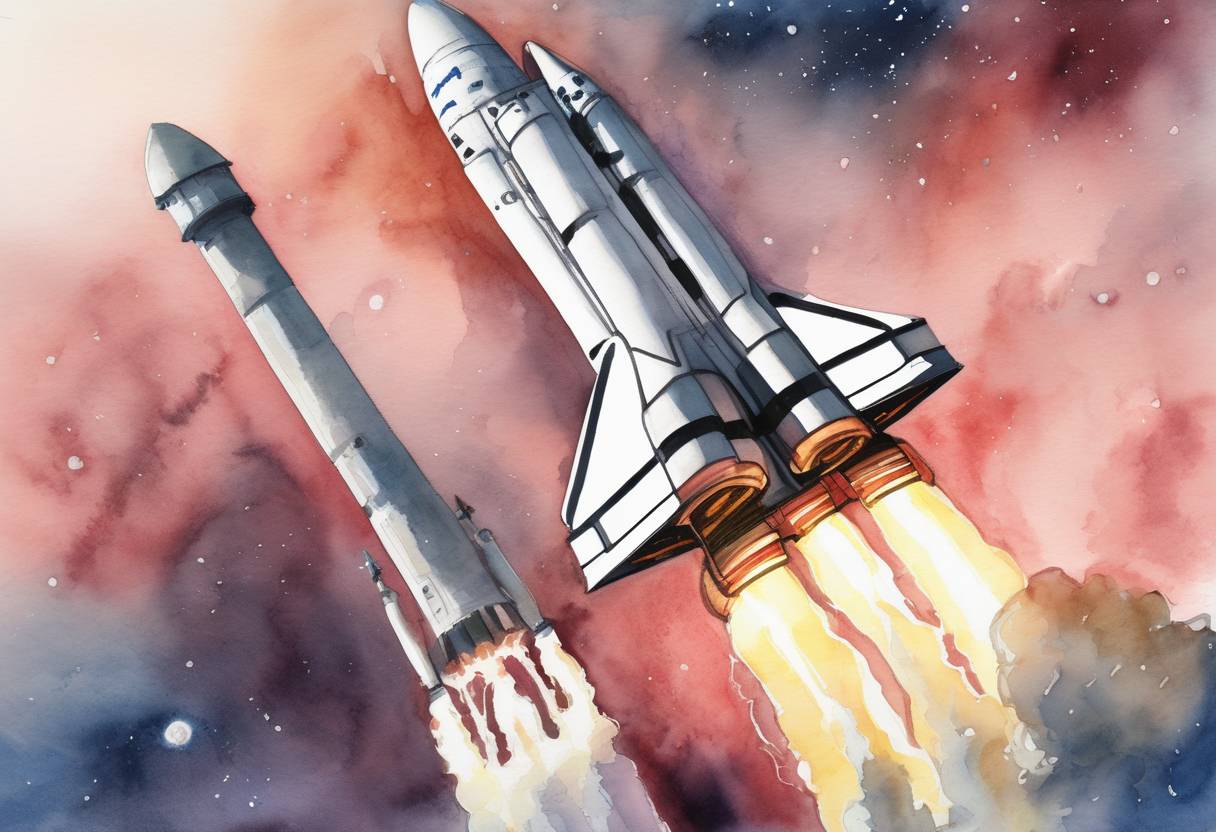
SpaceX Falcon Heavy Launch: February 6, 2018
On February 6, 2018, SpaceX successfully launched the Falcon Heavy rocket from Kennedy Space Center in Florida. This event marked a significant milestone in space exploration and commercial spaceflight, as the Falcon Heavy was the most powerful operational rocket in the world at the time.
Background
SpaceX, founded by Elon Musk in 2002, aimed to reduce space transportation costs and enable the colonization of Mars. The Falcon Heavy was developed as a part of this vision, designed to carry large payloads into space and support missions beyond Earth’s orbit.
The Falcon Heavy Rocket
- Design: The Falcon Heavy consists of three Falcon 9 nine-engine cores, making it a total of 27 Merlin engines capable of generating over 5 million pounds of thrust at liftoff.
- Capacity: It can lift nearly 64 metric tons (141,000 pounds) into orbit, more than twice the payload capacity of the next closest operational vehicle at the time.
The Launch
- Date and Location: The launch took place on February 6, 2018, from Launch Complex 39A at Kennedy Space Center, a historic site used for Apollo and Space Shuttle missions.
- Payload: The payload for this demonstration mission was a Tesla Roadster, an electric sports car manufactured by Tesla, Inc., another company led by Elon Musk. The car was equipped with cameras to provide “driver’s seat” views of space.
- Objective: The primary goal was to demonstrate the rocket’s capabilities and gather data for future missions. The inclusion of the Tesla Roadster was both a marketing move and a symbolic gesture, showcasing the potential for commercial payloads.
The Launch Sequence
- Liftoff: The Falcon Heavy lifted off smoothly, with its 27 engines firing in unison.
- Booster Landing: Two of the three boosters successfully returned to Earth, landing simultaneously at Cape Canaveral Air Force Station. The central core attempted to land on a drone ship but missed due to a fuel shortage.
- Payload Deployment: The Tesla Roadster, with a mannequin named “Starman” in the driver’s seat, was deployed into an elliptical orbit around the Sun, extending as far as the asteroid belt.
Aftermath and Significance
- Technological Achievement: The successful launch and partial recovery of the boosters demonstrated SpaceX’s advancements in reusable rocket technology, significantly reducing costs.
- Inspiration and Public Interest: The launch captured public imagination, with live streams watched by millions worldwide. The image of “Starman” in the Tesla Roadster became iconic.
- Future Missions: The Falcon Heavy’s success paved the way for future missions, including potential crewed missions to the Moon and Mars, and commercial satellite launches.
The February 6, 2018, launch of the Falcon Heavy was a landmark event in the history of space exploration, showcasing the potential of private companies to contribute to space travel and exploration.