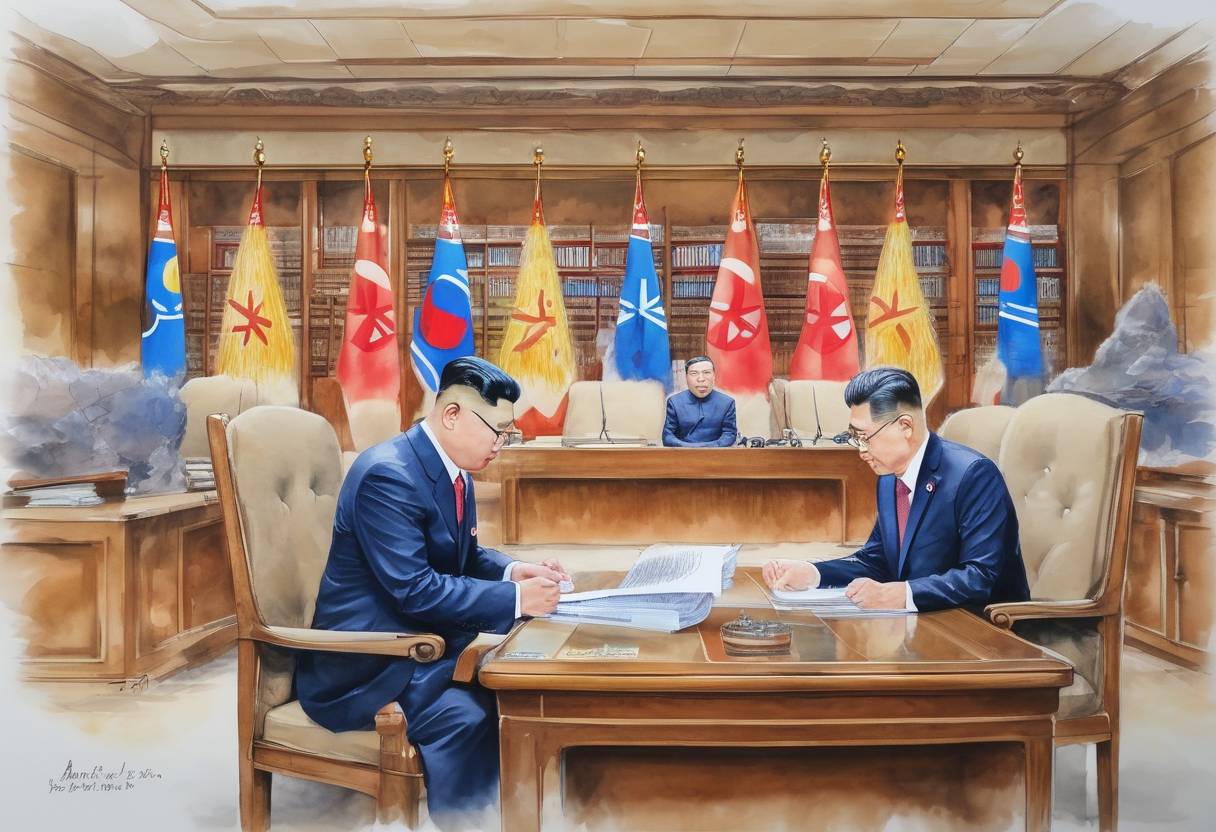
The Panmunjom Declaration for Peace, Prosperity and Unification of the Korean Peninsula
Overview
On April 27, 2018, North Korean leader Kim Jong-un and South Korean President Moon Jae-in signed the Panmunjom Declaration for Peace, Prosperity and Unification of the Korean Peninsula. This historic event took place at the Peace House in the Joint Security Area of Panmunjom, located within the Korean Demilitarized Zone (DMZ). The declaration marked a significant step towards improving relations between the two Koreas, which have technically been at war since the Korean War armistice in 1953.
Context
Historical Background
- Korean War (1950-1953): The Korean Peninsula was divided into North and South Korea following World War II. The Korean War resulted in a ceasefire but no formal peace treaty, leaving the two countries in a state of war.
- Previous Inter-Korean Summits: Prior to 2018, there were two significant summits in 2000 and 2007, which aimed to improve relations but did not lead to lasting peace.
Lead-Up to the Declaration
- Tensions and Diplomacy: The years leading up to the declaration saw heightened tensions due to North Korea’s nuclear tests and missile launches. However, diplomatic efforts, including the 2018 Winter Olympics in South Korea, paved the way for renewed dialogue.
Key Points of the Declaration
Denuclearization: Both leaders committed to the complete denuclearization of the Korean Peninsula, aiming to eliminate nuclear threats and promote peace.
End of Hostilities: The declaration included a pledge to formally end the Korean War by converting the armistice into a peace treaty.
Family Reunions: The agreement called for the resumption of family reunions for those separated by the Korean War, highlighting humanitarian concerns.
Economic Cooperation: Both nations agreed to pursue joint economic projects and infrastructure development, including reconnecting railways and roads.
Military De-escalation: Measures were proposed to reduce military tensions, including the cessation of hostile acts along the DMZ.
Aftermath and Significance
Subsequent Meetings: The Panmunjom Declaration set the stage for further summits between the two leaders and contributed to the diplomatic environment that led to the Singapore Summit between Kim Jong-un and U.S. President Donald Trump in June 2018.
Challenges: Despite the initial optimism, progress on the declaration’s goals has been slow, with denuclearization and peace treaty negotiations facing significant hurdles.
Historical Impact: The declaration remains a symbol of hope for peace and reconciliation on the Korean Peninsula, reflecting the complex interplay of diplomacy, security, and regional politics.
The Panmunjom Declaration represents a pivotal moment in inter-Korean relations, highlighting the potential for peace and cooperation despite longstanding challenges.