The Dedication of ENIAC: February 14, 1946
1946 · Philadelphia, United States
The Electronic Numerical Integrator and Computer (ENIAC), the first general-purpose electronic digital computer, was formally dedicated at the University of Pennsylvania.
February 15, 1946
ENIAC, the first electronic general-purpose computer, is formally dedicated at the University of Pennsylvania in Philadelphia.
Philadelphia, United States | University of Pennsylvania
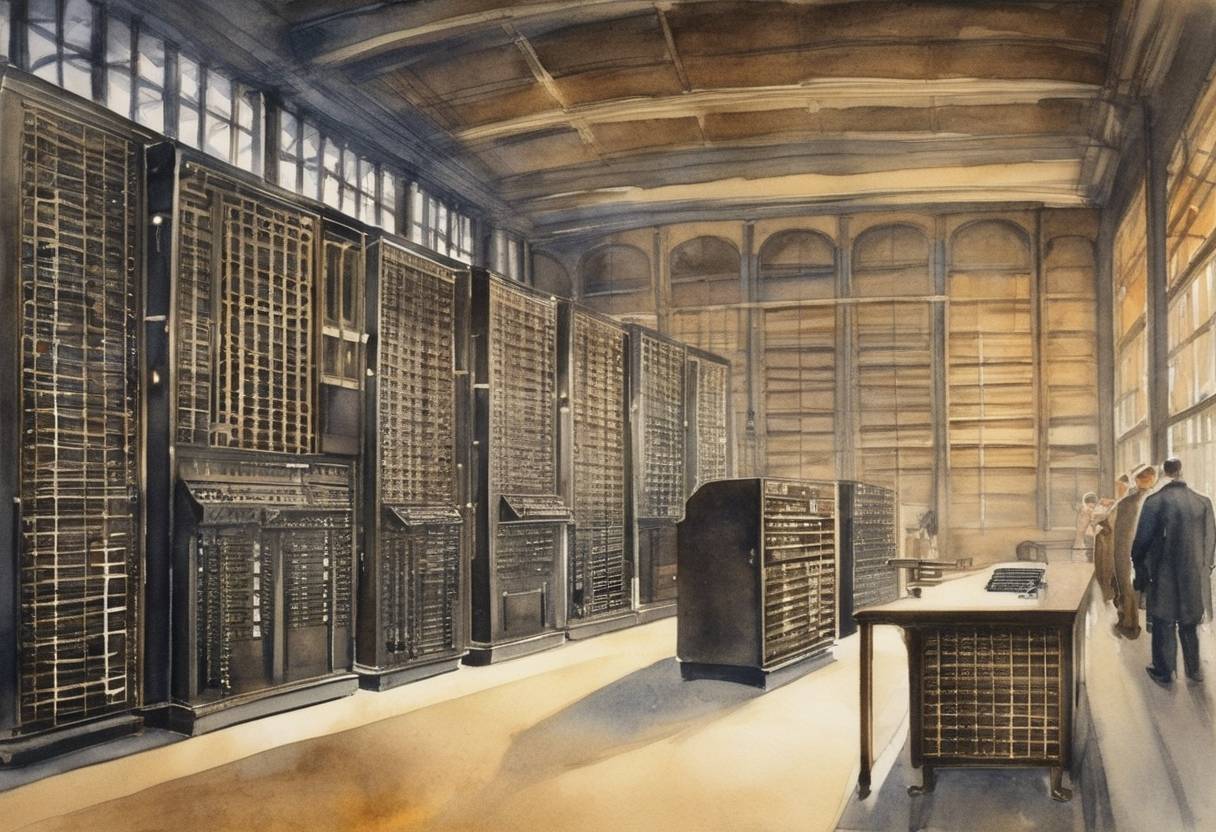
The Electronic Numerical Integrator and Computer (ENIAC) was formally dedicated at the University of Pennsylvania in Philadelphia on February 15, 1946. This event marked a significant milestone in the history of computing as ENIAC became the first electronic general-purpose computer.
ENIAC was a product of the collaborative efforts of John W. Mauchly and J. Presper Eckert, who developed the computer under a contract with the United States Army during World War II. The machine was designed to calculate artillery firing tables for the United States Army’s Ballistic Research Laboratory. Its development began in 1943 and culminated in its completion in late 1945, followed by the official dedication in 1946.
ENIAC was a massive machine, both in physical size and computational capability. It filled a 30 by 50-foot room and weighed around 30 tons. The computer contained approximately 18,000 vacuum tubes, 1,500 relays, and hundreds of thousands of resistors, capacitors, and inductors. Despite its size, ENIAC could perform complex calculations at unparalleled speeds during its time, executing about 5,000 simple operations per second.
Operational until 1955, ENIAC was instrumental in various computations and simulations, significantly reducing the time required to perform complex mathematical problems. It laid the groundwork for future advances in computing technology, demonstrating the feasibility and potential of electronic computers.
The dedication of ENIAC on February 15, 1946, served as a critical point in computing history. It heralded the transition from mechanical computing methods to electronic computing, influencing the design and development of subsequent computers. ENIAC’s architecture and its use of electronic circuitry set precedents that would guide future computational developments and revolutionize numerous fields including science, military applications, and eventually, personal computing. The machine earned its place as a foundational milestone in the history of technology.
Source: en.wikipedia.org