Public Announcement of Charles V as Holy Roman Emperor on July 16, 1519
1519 · Frankfurt, Holy Roman Empire
Public announcement of King Charles of Spain becoming Holy Roman Emperor Charles V.
January 24, 1742
Charles VII Albert becomes Holy Roman Emperor, exemplifying the challenges to Habsburg domination and marking a moment of significant political realignment in Europe.
Frankfurt, Holy Roman Empire | Holy Roman Empire
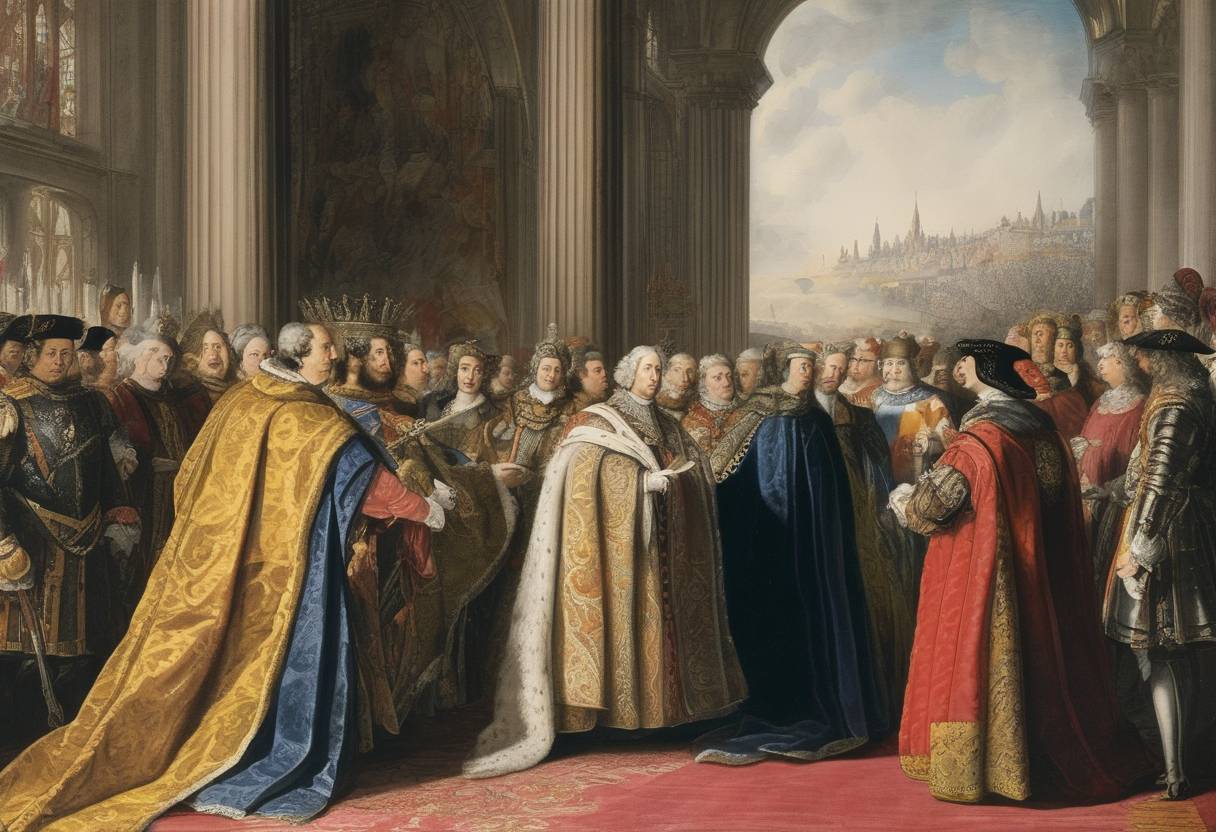
On January 24, 1742, Charles VII Albert of Bavaria was elected and crowned Holy Roman Emperor, marking a significant moment in the history of the Holy Roman Empire and highlighting the enduring challenges to Habsburg domination. His ascension was emblematic of the ongoing power struggles and shifting alliances within European politics during the 18th century.
The Holy Roman Empire in the 18th century was a patchwork of territories under varying sovereignties, nominally united under an emperor. Traditionally, the position of the Holy Roman Emperor had been dominated by the Habsburg dynasty since the 15th century. However, the death of Emperor Charles VI in 1740 without a male heir created an opportunity for rival claimants to the imperial title, fueled by existing tensions and political rivalries.
Charles VII Albert, the Elector of Bavaria, capitalized on the circumstances created by the War of the Austrian Succession (1740-1748). He contested the Pragmatic Sanction, a decree issued by Charles VI that allowed his daughter, Maria Theresa, to succeed to the Habsburg hereditary lands. Charles VII’s marriage to Maria Amalia of Austria, a daughter of the Habsburg family, bolstered his claim.
With the support of France, Spain, and Saxony, Charles VII managed to gather enough backing to be elected Holy Roman Emperor by the electoral college, securing a rare victory for the Wittelsbach dynasty.
The election of Charles VII marked a significant deviation from Habsburg dominance. His reign, however, was fraught with difficulties. Maria Theresa, who retained control over her hereditary domains, was his chief opponent. Her forces occupied Bavaria shortly after his election, undermining his rule and leading to his brief and unstable reign.
The ascension of Charles VII also prompted a reevaluation of alliances across Europe. It further intensified the War of the Austrian Succession as different powers vied for influence. His inability to gain widespread support for his rule highlighted the fractured nature of the empire and the limits of his authority.
Charles VII’s reign as Holy Roman Emperor was short-lived; he passed away on January 20, 1745. His son, Maximilian III Joseph, was forced to compromise and ultimately support the election of Francis I, the husband of Maria Theresa, as Holy Roman Emperor. Consequently, the Habsburgs quickly regained the imperial seat, re-establishing their hold on the Holy Roman Empire.
Charles VII’s election remains a pivotal moment in European history, underscoring the complexities of succession, the fragility of political alliances, and the transient nature of power within the imperial structure of the time.
Source: en.wikipedia.org