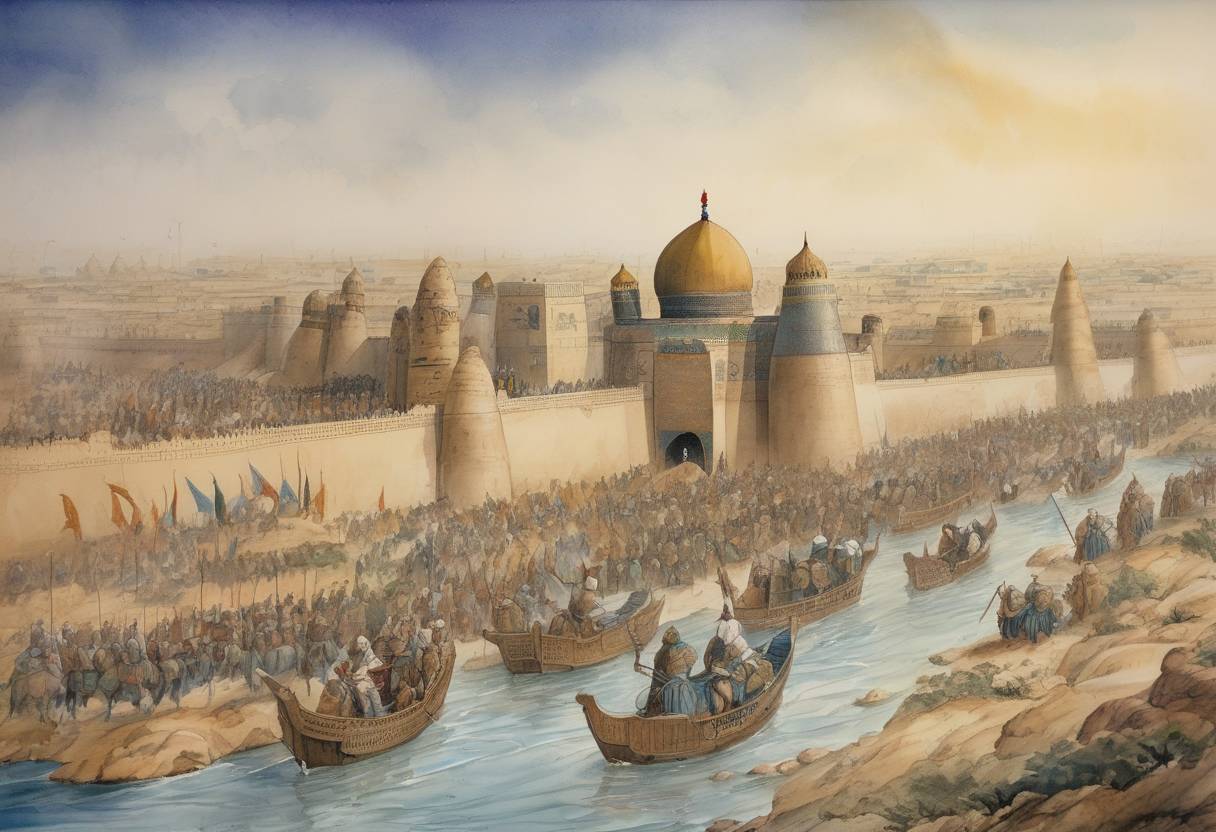
The Fall of Baghdad: February 10, 1258
On February 10, 1258, the Mongol forces led by Hulagu Khan captured Baghdad, marking a pivotal moment in history that effectively ended the Islamic Golden Age and the Abbasid Caliphate. This event had profound implications for the Islamic world and the broader historical landscape.
Background
The Abbasid Caliphate
- Established in 750 CE, the Abbasid Caliphate was a major Islamic empire that presided over a flourishing period known as the Islamic Golden Age.
- Baghdad, the capital, was a center of learning, culture, and commerce, renowned for its libraries, scholars, and contributions to science, philosophy, and the arts.
The Rise of the Mongols
- The Mongol Empire, founded by Genghis Khan in the early 13th century, rapidly expanded across Asia and into Europe, known for its military prowess and strategic acumen.
- Hulagu Khan, a grandson of Genghis Khan, was tasked with expanding Mongol influence into the Middle East.
The Siege of Baghdad
Prelude to the Siege
- Hulagu Khan’s campaign began in 1255, with the objective of subduing the Islamic world and securing Mongol dominance.
- The Abbasid Caliph, Al-Musta’sim, underestimated the Mongol threat and failed to adequately prepare for the impending invasion.
The Siege
- The Mongol army, estimated to be around 150,000 strong, reached the outskirts of Baghdad in January 1258.
- After a brief siege, the Mongols breached the city’s defenses on February 10, 1258.
The Aftermath
- The capture of Baghdad resulted in widespread destruction and loss of life. The city, once a beacon of Islamic culture, was devastated.
- The House of Wisdom, a renowned center of learning, was destroyed, and countless manuscripts and books were lost.
Consequences
End of the Abbasid Caliphate
- The fall of Baghdad marked the end of the Abbasid Caliphate as a political entity, though a shadow caliphate persisted in Cairo under Mamluk protection.
- The Islamic Golden Age, characterized by significant advancements in various fields, effectively came to an end.
Broader Impact
- The Mongol invasion disrupted trade routes and led to a period of instability in the region.
- The cultural and intellectual loss was immense, affecting the Islamic world for generations.
Historical Significance
The capture of Baghdad by the Mongols is considered one of the most catastrophic events in Islamic history. It not only marked the end of a significant era but also demonstrated the far-reaching impact of Mongol expansion. The event serves as a reminder of the vulnerability of even the most advanced civilizations to external threats and the importance of adaptability and preparedness in the face of change.