Kansas Admitted to the Union as the 34th State
1861 · Washington D.C., United States
Kansas was admitted to the Union as the 34th U.S. state.
May 22, 1856
In the United States Senate, Congressman Preston Brooks of South Carolina severely beat Senator Charles Sumner of Massachusetts with a cane in retaliation for a speech Sumner had made attacking Southerners who sympathized with the pro-slavery violence in Kansas.
Washington, D.C., United States | United States Congress
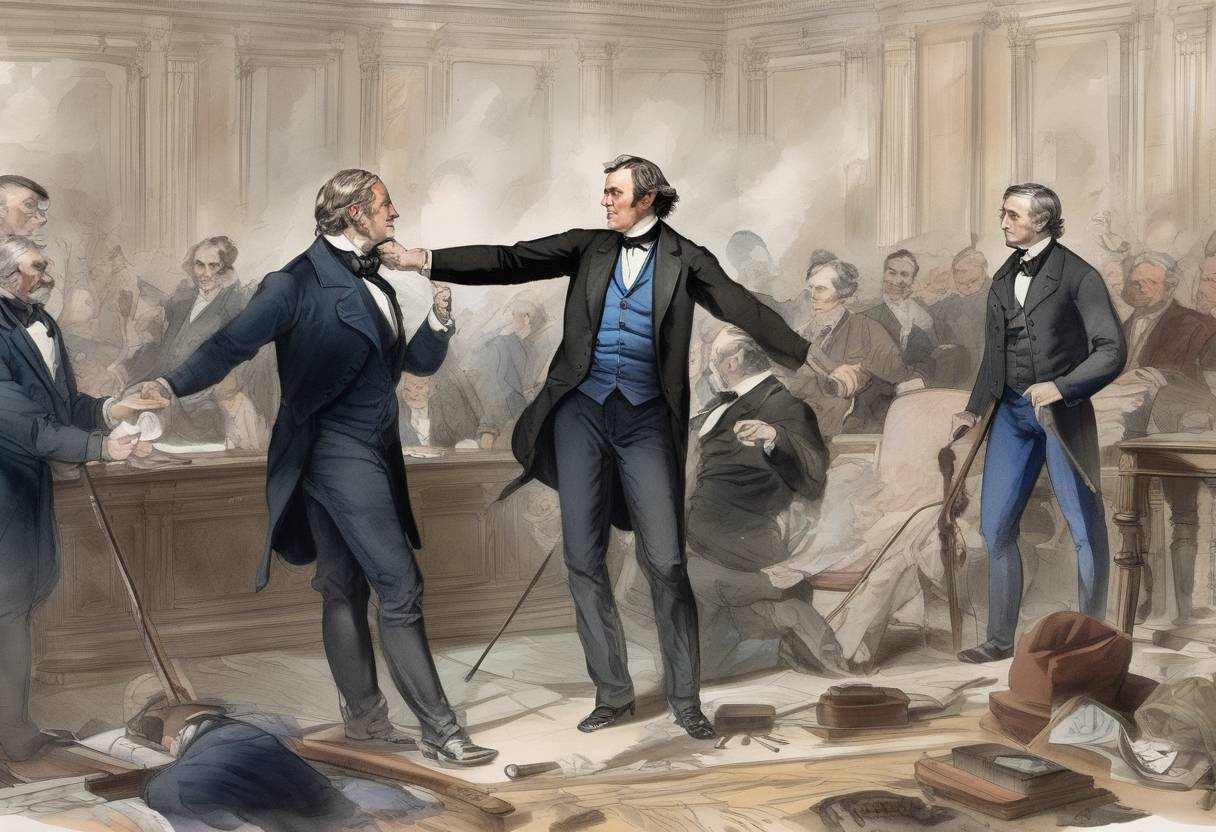
On May 22, 1856, a violent incident occurred on the floor of the United States Senate that underscored the deepening sectional tensions over slavery in the United States. Congressman Preston Brooks of South Carolina brutally attacked Senator Charles Sumner of Massachusetts with a cane, an event that shocked the nation and highlighted the volatile political climate leading up to the American Civil War.
The mid-1850s were marked by intense national debate over the expansion of slavery into new territories. The Kansas-Nebraska Act of 1854, which allowed the residents of these territories to decide the issue of slavery for themselves, led to violent confrontations known as “Bleeding Kansas.” This period was characterized by clashes between pro-slavery and anti-slavery settlers, creating a microcosm of the national conflict.
On May 19 and 20, 1856, Senator Charles Sumner, a staunch abolitionist, delivered a fiery speech titled “The Crime Against Kansas.” In it, he condemned the pro-slavery forces in Kansas and criticized several Southern senators, including Andrew Butler of South Carolina. Sumner’s speech was particularly scathing and personal, employing vivid and harsh language to attack the institution of slavery and its supporters.
Three days after Sumner’s speech, Congressman Preston Brooks, a relative of Senator Butler, entered the Senate chamber. Brooks confronted Sumner at his desk and, without warning, began to beat him with a heavy cane. Sumner, trapped under his desk, was unable to defend himself and suffered severe injuries, including head trauma and shock.
The attack left Sumner incapacitated for several years, requiring a lengthy recovery. The incident polarized the nation:
Northern Reaction: Many in the North viewed the attack as a symbol of Southern brutality and the lengths to which pro-slavery advocates would go to silence opposition. Sumner became a martyr for the abolitionist cause, and his empty Senate seat was a powerful symbol of the violence inherent in the slavery debate.
Southern Reaction: In the South, Brooks was hailed as a hero who defended Southern honor. He received numerous canes from admirers, some inscribed with messages of support.
The caning of Charles Sumner was more than just a personal assault; it was a manifestation of the deep divisions within the United States over slavery. It highlighted the breakdown of civil discourse and foreshadowed the violent conflict that would erupt in the Civil War just a few years later. The incident also contributed to the growing polarization between the North and South, making compromise increasingly difficult.
In summary, the attack on Charles Sumner by Preston Brooks was a pivotal moment in American history, illustrating the intense emotions and divisions that would eventually lead to the Civil War. It remains a powerful reminder of the period’s political and social turmoil.
Source: en.wikipedia.org