The Battle of Bennington: August 16, 1777
1777 · Bennington, United States
The Battle of Bennington occurred during the American Revolutionary War, resulting in a decisive victory for American forces over British and Hessian troops.
December 9, 1775
American Revolutionary War: The Siege of Quebec begins, a joint colonial military campaign aiming to bring Quebec into the rebellious colonies' fold.
Quebec City, Canada | Continental Army
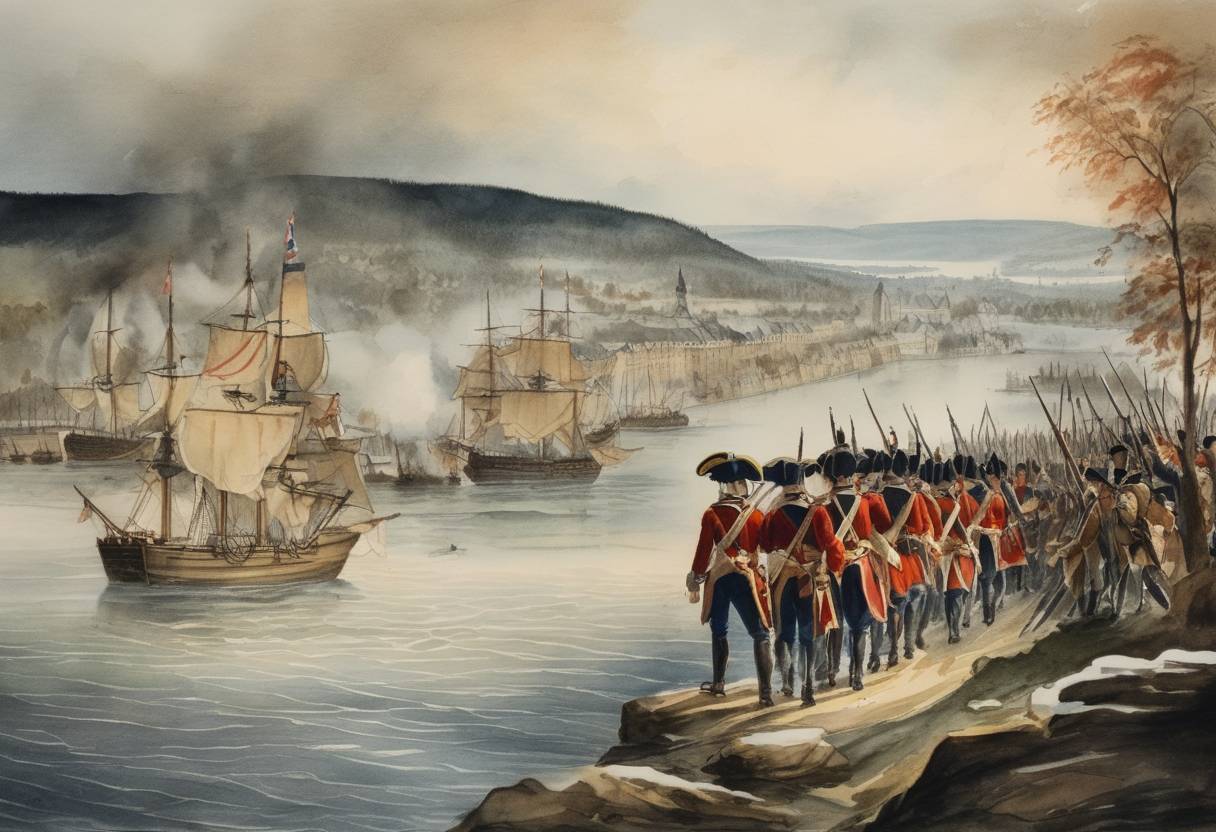
The Siege of Quebec, a significant episode in the American Revolutionary War, commenced on December 9, 1775. This joint colonial campaign was marked by American forces’ efforts to bring the British-held province of Quebec into support of the Thirteen Colonies’ rebellion against British rule.
In the latter half of 1775, the Continental Congress sanctioned an expedition into Canada, aiming to neutralize a potential British counteroffensive from the north and to inspire Canadian support for the revolutionary cause. Two expeditions were launched, one led by General Richard Montgomery via Lake Champlain and another under the command of Colonel Benedict Arnold through the wilderness of Maine.
Montgomery’s force successfully captured Montreal on November 13, 1775, before advancing toward Quebec City. Meanwhile, Arnold’s expedition faced harrowing conditions, suffering from navigation errors and harsh weather before finally reaching the vicinity of Quebec by late November.
The siege officially commenced on December 9, 1775, when American forces took up positions outside the fortified city of Quebec. The city’s defenses were stout, controlled by British Governor General Guy Carleton, who had fortified the city and integrated a defensive garrison composed of British regulars, Canadian militia, and local volunteers within the robust walls of the Old City.
The Americans, numbering around 1,200 men but weakened by illness, cold, and supply shortages, established batteries to bombard the city. However, their lack of heavy artillery severely hampered the effectiveness of their siege efforts. Additionally, harsh winter conditions impeded operations, further exacerbating the challenges faced by the besieging forces.
The siege continued until late December when, realizing that prolonged siege tactics were impractical, Montgomery and Arnold attempted a desperate assault on December 31, 1775. This attack, aimed to coincide with a storm to mask their movements, resulted in a decisive British victory. Montgomery was killed in action, and Arnold was wounded, leading to the eventual retreat of American forces.
The failure of the Siege of Quebec was pivotal in solidifying Canada’s stance as a British stronghold during the Revolutionary War. The defeat highlighted the limits of the American military campaign in the Canadian front and underlined the challenges of colonial supply lines and winter warfare. This engagement also marked the beginning of a sustained conflict in the northern theater that would persist throughout the duration of the war.
Source: www.history.com