The Peace of Constance: August 14, 1183
1183 · Constance, Holy Roman Empire
The Peace of Constance was ratified, granting the Lombard League official recognition and freedoms by the Holy Roman Emperor Frederick I Barbarossa.
November 28, 1170
The Lombard League, an alliance of northern Italian cities, defeated Holy Roman Emperor Frederick I Barbarossa at the Battle of Legnano.
Legnano, Italy | Lombard League
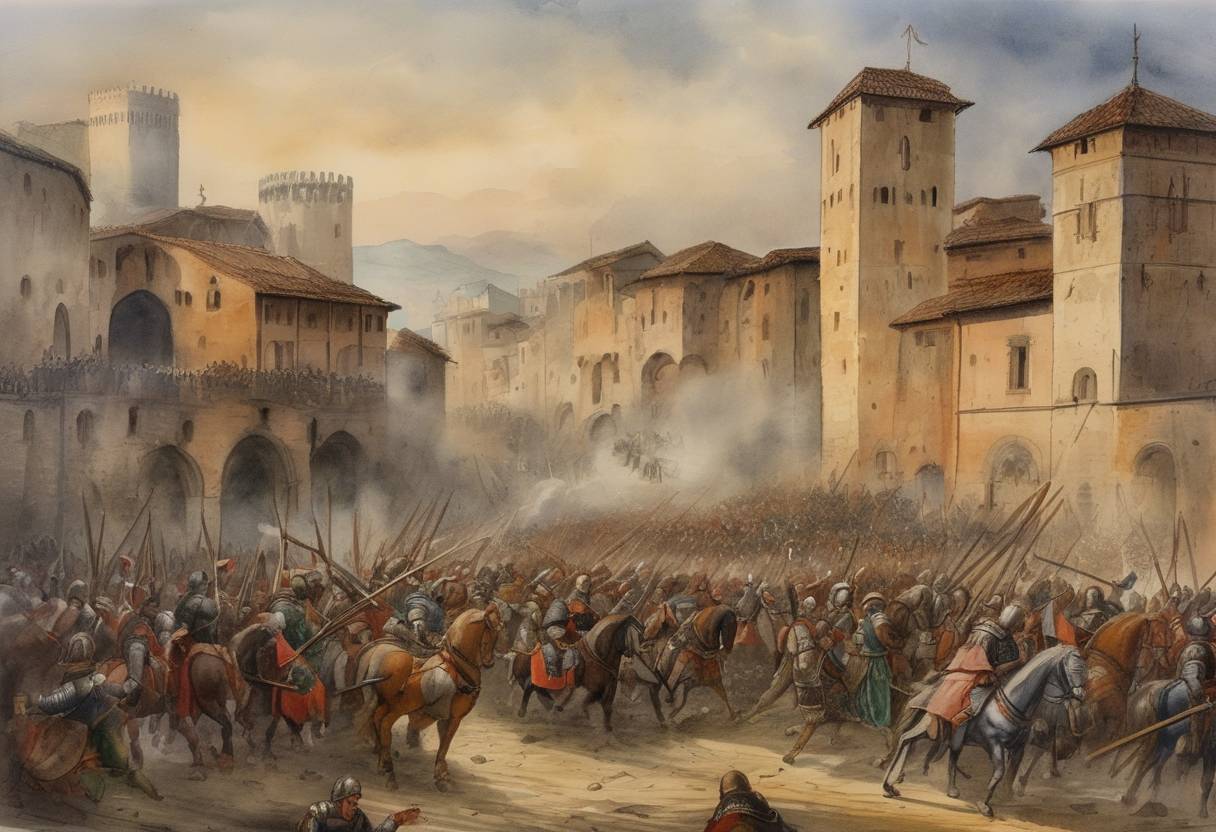
It appears there is a slight chronological discrepancy in your request. The Battle of Legnano between the Lombard League and the Holy Roman Emperor Frederick I Barbarossa did not occur on November 28, 1170. The battle actually took place on May 29, 1176. Here is the historical account of the correct event:
The Battle of Legnano was a crucial engagement between the forces of the Lombard League, an alliance of northern Italian city-states, and the army of the Holy Roman Emperor Frederick I Barbarossa. It occurred on May 29, 1176, near the town of Legnano, northwest of Milan.
In the mid-12th century, the political landscape of Italy was tumultuous as Frederick I sought to assert imperial control over the region, which often brought him into conflict with the increasingly independent and economically powerful northern Italian communes. The Lombard League formed in 1167 as a defensive alliance to resist Frederick’s ambitions. Key members included cities like Milan, Venice, Bologna, and Verona. These cities banded together to protect their autonomy from the emperor’s centralizing policies.
On May 29, 1176, Frederick’s forces, arrayed with heavily armored knights and disciplined infantry, faced the militias of the Lombard League, primarily composed of citizen-soldiers. The league’s forces cleverly used local geography and tactics to counter the advantages of Frederick’s cavalry.
This event significantly weakened the dominance of the Holy Roman Empire over northern Italy and emboldened further movements for local independence throughout the peninsula.
Source: en.wikipedia.org