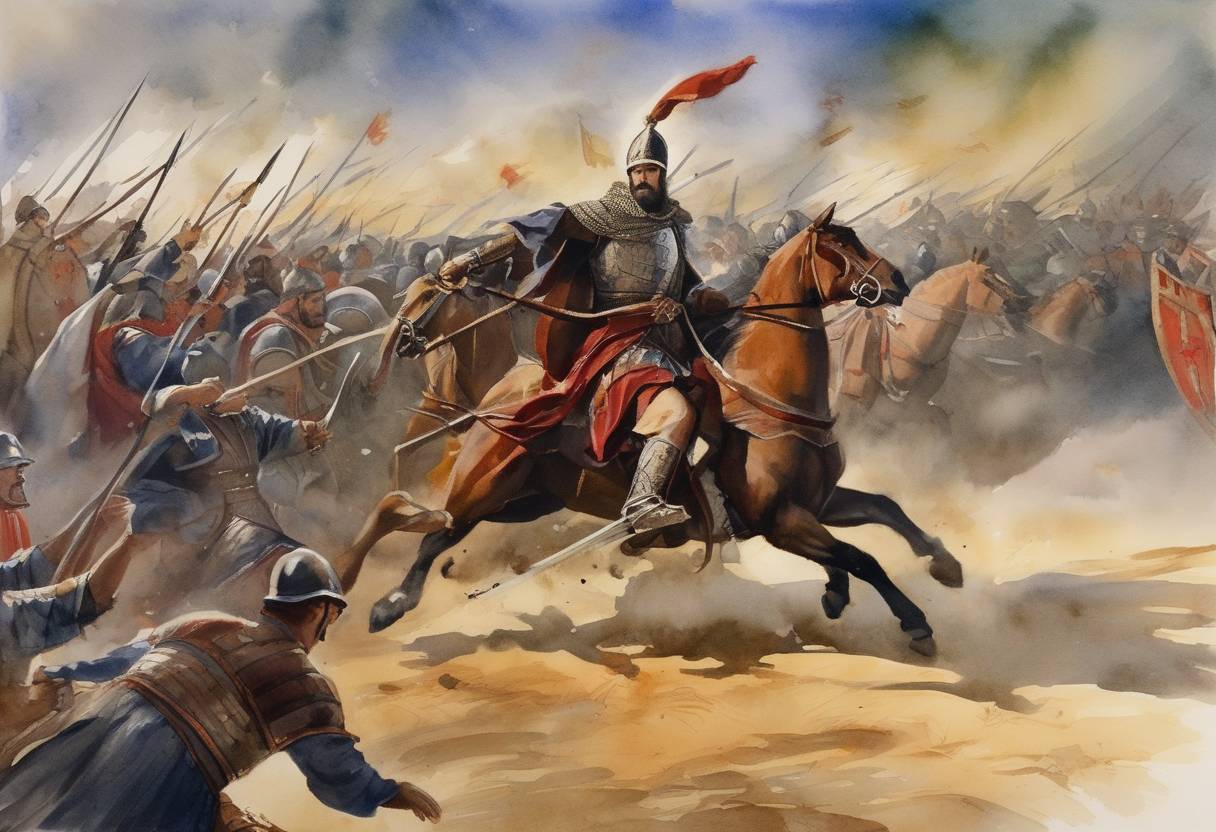
The Battle of Caesarea: Byzantine Victory on September 4, 1063
In the mid-11th century, the Byzantine Empire was under the rule of Emperor Constantine X Doukas, who faced numerous challenges, including threats from the rising power of the Turkish forces in Anatolia. On September 4, 1063, a pivotal engagement took place at Caesarea, which is situated in modern-day central Turkey.
Background
The Byzantine Empire, once a formidable power in the eastern Mediterranean, was experiencing internal strife and external threats during the 11th century. Emperor Constantine X Doukas ascended the throne in 1059. His reign saw the continuation of military pressures from various frontiers, particularly the Seljuk Turks who were making increasingly bold incursions into Byzantine-held territories in Anatolia.
Prelude to the Battle
The Seljuk Turks, under their dynamic leaders, had been expanding westward, taking advantage of Byzantine weaknesses to capture and raid towns. Their campaign in Anatolia put significant pressure on the region’s infrastructure and the local Byzantine command structure. The battle at Caesarea was part of a series of ongoing conflicts aimed at reversing Turkish advances and maintaining Byzantine influence in the area.
The Battle and Its Outcome
The encounter on September 4, 1063, saw Emperor Constantine X Doukas rally Byzantine forces to face the Turkish invaders. Utilizing strategic advantages and leveraging the experienced Byzantine military commanders, the empire managed to successfully defeat the Turkish forces at Caesarea. This victory was significant as it temporarily reasserted Byzantine control over strategic parts of Anatolia.
Aftermath
The Byzantine triumph at Caesarea was a critical moment in the ongoing struggle for control over Anatolia. While it did not result in a long-term halt to Turkish incursions, it was a notable success for Constantine X Doukas’s administration, demonstrating a brief resurgence in Byzantine military capability.
Historical Significance
This battle exemplified the chronic instability in the Byzantine eastern provinces during the 11th century and highlighted the perpetual challenge of defending vast territories against agile and determined foes like the Seljuk Turks. The victory also underscored the Byzantines’ ability to conduct effective military operations despite internal difficulties.
The continued conflicts, however, would eventually lead to greater challenges for the Byzantine Empire, culminating in larger confrontations that shaped the medieval history of the region. The struggle for Anatolia remained a dominant theme until the Empire’s ultimate decline in later centuries.