President Harry S. Truman Announces Hydrogen Bomb Development Program
1950 · Washington D.C., United States
President Harry S. Truman announces a program to develop the hydrogen bomb.
August 24, 1968
France explodes its first hydrogen bomb, becoming the world's fifth thermonuclear power.
Fangataufa, French Polynesia | French government
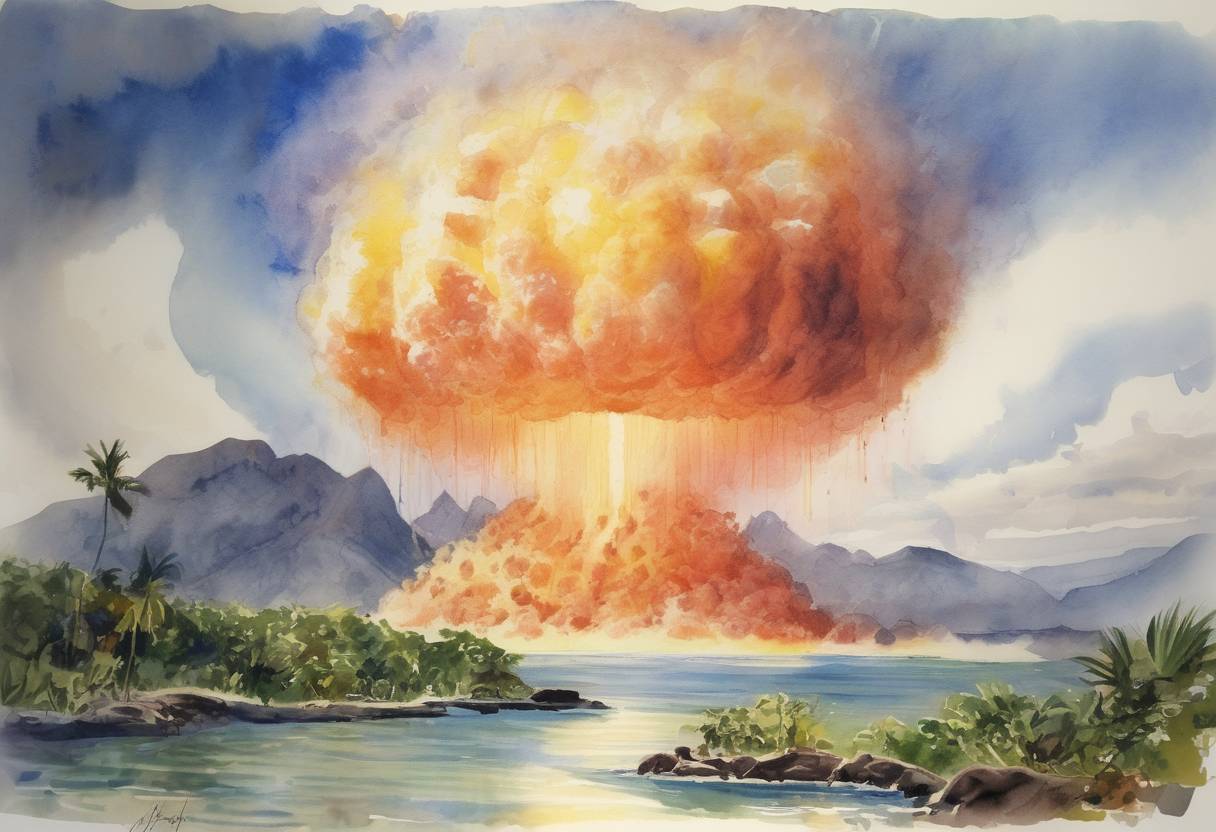
On August 24, 1968, France successfully detonated its first hydrogen bomb, marking a significant milestone in its military and technological capabilities. This event took place at the Fangataufa Atoll in French Polynesia, part of the Pacific Ocean test site used by France for its nuclear testing program. With this detonation, France became the world’s fifth thermonuclear power, joining the ranks of the United States, the Soviet Union, the United Kingdom, and China.
Nuclear Ambitions: France’s pursuit of nuclear weapons began in the post-World War II era, driven by a desire to assert its independence and maintain its status as a major world power. The French government, under President Charles de Gaulle, was particularly focused on ensuring that France had its own nuclear deterrent, independent of NATO and the United States.
Development Program: The French nuclear program, known as the “Force de Frappe,” was initiated in the late 1950s. The program aimed to develop a comprehensive nuclear arsenal, including both fission and fusion weapons. France conducted its first atomic bomb test in 1960, and the successful hydrogen bomb test in 1968 was a culmination of years of research and development.
Operation Canopus: The test, codenamed “Operation Canopus,” involved the detonation of a two-stage thermonuclear device. The explosion had a yield of approximately 2.6 megatons, significantly more powerful than the atomic bombs previously tested by France.
Location: The test was conducted at the Fangataufa Atoll, a remote location chosen to minimize the impact on populated areas. The atoll had been used for previous nuclear tests and was part of the larger French nuclear testing site in the Pacific.
International Reaction: The test drew criticism from various countries and anti-nuclear groups, who were concerned about the environmental and health impacts of atmospheric nuclear testing. Despite this, France continued its nuclear testing program until 1996, when it signed the Comprehensive Nuclear-Test-Ban Treaty (CTBT).
Strategic Impact: By developing a hydrogen bomb, France solidified its position as a major nuclear power. This capability enhanced its strategic autonomy and deterrence posture, allowing it to maintain a credible defense policy independent of other nations.
Nuclear Policy: The successful test reinforced France’s commitment to maintaining a robust nuclear arsenal. The French government continued to invest in its nuclear forces, which remain a key component of its national defense strategy to this day.
In summary, the successful detonation of France’s first hydrogen bomb on August 24, 1968, was a pivotal moment in the country’s history, underscoring its technological prowess and strategic independence. This event not only marked France’s entry into the exclusive club of thermonuclear powers but also had lasting implications for its defense policy and international standing.
Source: en.wikipedia.org