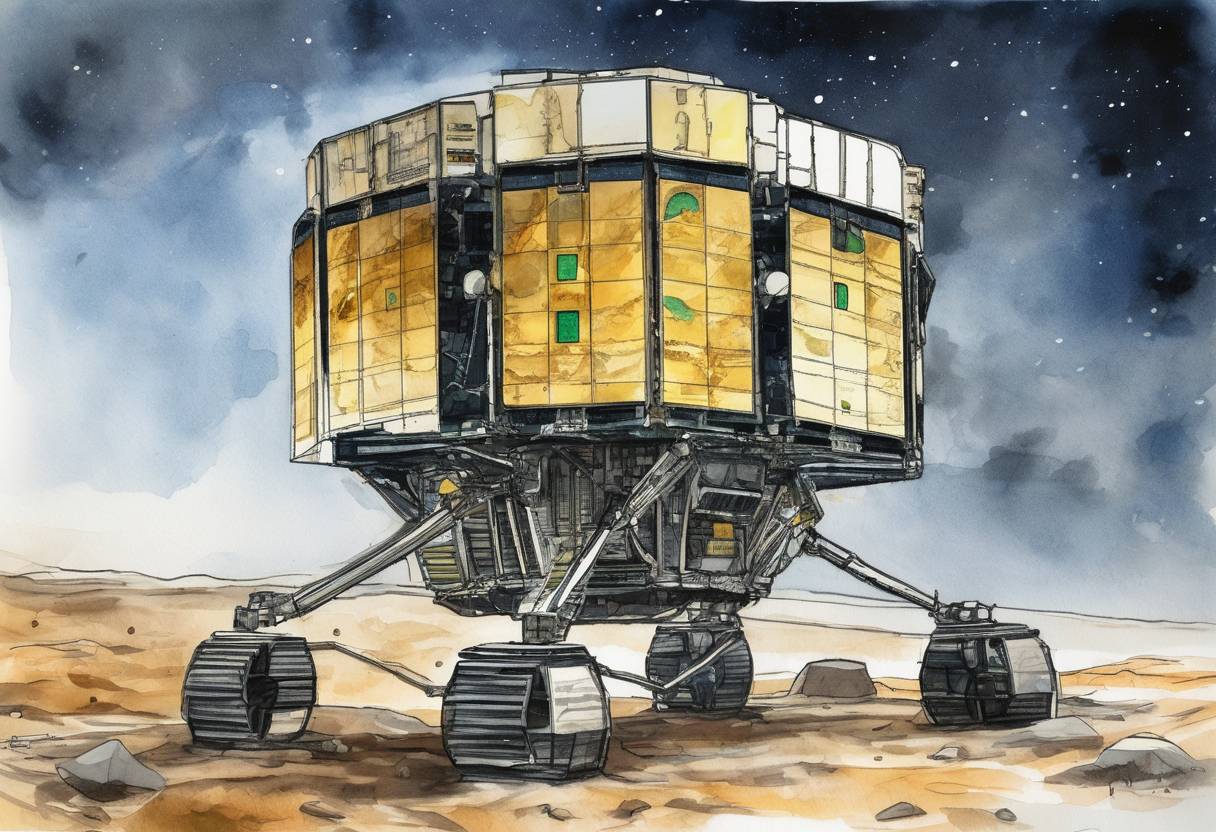
Philae Lander’s Historic Comet Landing
On November 12, 2014, the European Space Agency’s (ESA) Philae lander achieved a historic milestone by successfully landing on the surface of comet 67P/Churyumov-Gerasimenko. This event marked the first time a spacecraft had ever landed on a comet, representing a significant achievement in space exploration and scientific research.
Background
The Philae lander was part of the Rosetta mission, which was launched by the ESA on March 2, 2004. The mission’s primary objective was to study comet 67P/Churyumov-Gerasimenko, a comet with a distinctive duck-shaped nucleus, to gain insights into the early solar system. Comets are considered time capsules, containing primitive material from the solar system’s formation.
Key Events Leading to the Landing
Launch and Journey: Rosetta was launched aboard an Ariane 5 rocket and embarked on a 10-year journey through the solar system. It traveled over 6 billion kilometers, utilizing gravity assists from Earth and Mars to reach its destination.
Rendezvous with the Comet: In August 2014, Rosetta successfully entered orbit around comet 67P, becoming the first spacecraft to orbit a comet. This allowed for detailed mapping and analysis of the comet’s surface to identify a suitable landing site for Philae.
Landing Site Selection: After extensive analysis, a landing site named “Agilkia” was chosen on the comet’s “head” region. The site was selected for its relatively smooth terrain and scientific potential.
The Landing
On November 12, 2014, Philae was deployed from the Rosetta orbiter and began its descent to the comet’s surface. The landing process was complex due to the comet’s low gravity and irregular shape.
Challenges: During the descent, Philae’s harpoons, designed to anchor it to the comet’s surface, failed to deploy. As a result, the lander bounced twice before coming to rest in a shaded area, which limited its solar power intake.
Scientific Operations: Despite the challenges, Philae was able to conduct a series of scientific experiments during its initial 60-hour battery life. It sent back valuable data on the comet’s composition, structure, and magnetic field.
Aftermath and Significance
Data Contribution: The data collected by Philae and Rosetta has provided unprecedented insights into the nature of comets, including the discovery of organic molecules and the presence of water ice.
Legacy: The mission has significantly advanced our understanding of comets and their role in the solar system’s history. It has also demonstrated the feasibility of landing on small celestial bodies, paving the way for future missions.
Rosetta’s Conclusion: The Rosetta mission continued to study the comet until September 30, 2016, when the orbiter was intentionally crash-landed onto the comet’s surface, concluding the mission.
The successful landing of Philae on comet 67P/Churyumov-Gerasimenko remains a landmark achievement in space exploration, showcasing human ingenuity and the quest for knowledge about our cosmic origins.