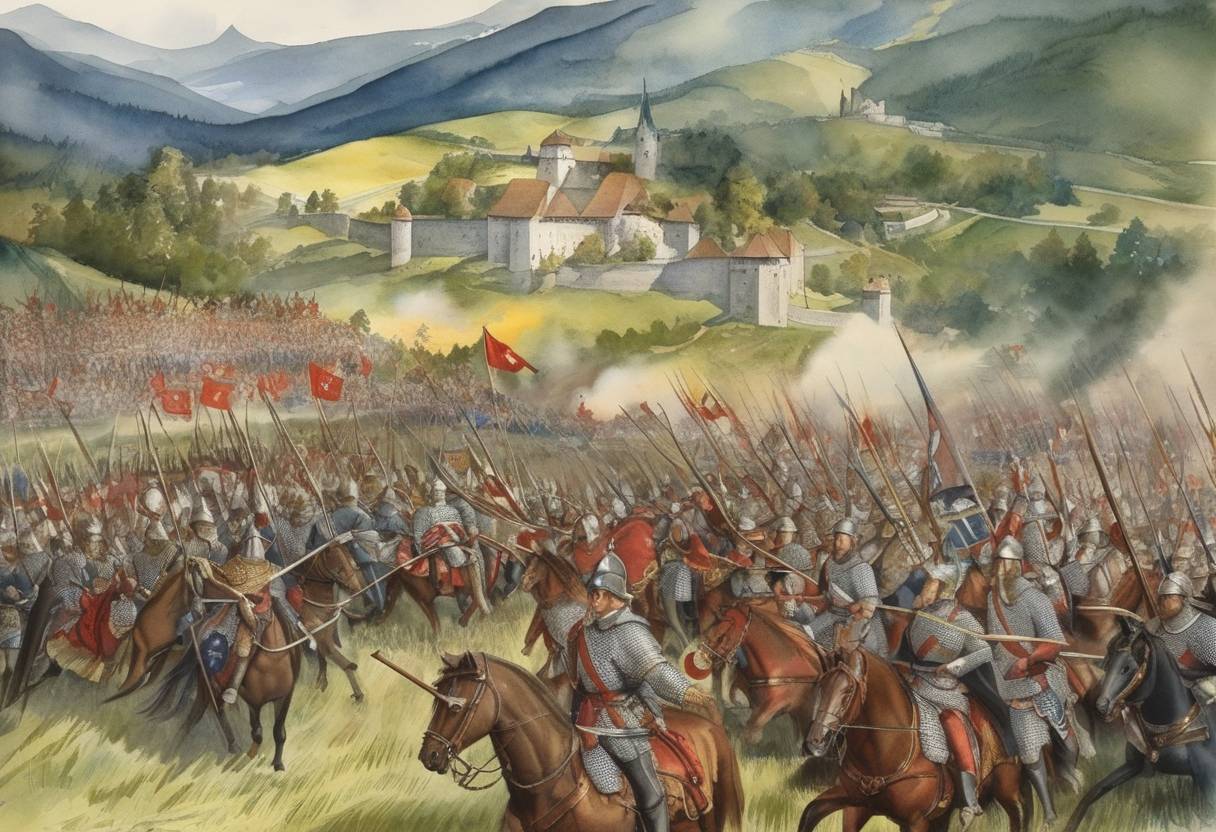
The Battle of Morgarten: November 15, 1315
On November 15, 1315, the Battle of Morgarten marked a significant turning point for the Swiss Confederation as they achieved a decisive victory against the House of Habsburg. This battle took place near the Morgarten Pass, close to Lake Ägerisee in present-day Switzerland.
Context and Background
In the early 14th century, the Swiss Confederation was a loose alliance of independent territories, which had formed in response to external pressures and for mutual defense. The Habsburgs, a powerful noble family at the time, sought to reassert control over the Swiss regions following the death of Holy Roman Emperor Henry VII in 1313. The Habsburgs aimed to strengthen their influence over territories such as Uri, Schwyz, and Unterwalden, crucial parts of the nascent Swiss Confederacy.
The Battle
The conflict originated when Duke Leopold I of Austria organized a military expedition to subdue the rebellious Swiss regions. Underestimating the Swiss forces, Leopold aimed to take the direct route over the Morgarten Pass. His army, consisting heavily of knights and mounted troops, was ill-prepared for the rugged and narrow terrain.
Meanwhile, the Swiss Confederation, made up mainly of foot soldiers, utilized their knowledge of the local geography to their advantage. As the Habsburg army advanced through the pass, the Swiss forces launched a surprise attack from higher ground, pelting the enemy with rocks, logs, and other projectiles. The difficult terrain exacerbated the chaos and limited the maneuverability of the Habsburg forces.
Aftermath and Consequences
The resounding defeat of the Habsburg army at Morgarten had far-reaching implications for European politics and the future of the Swiss Confederation. This victory significantly bolstered the unity and resolve of the Swiss states, fostering a stronger sense of independence and identity among them. In 1315, shortly following the battle, the “Brunnen UR Confederal Pact” was signed, solidifying the alliance among the original cantons and setting the foundational framework for what would evolve into the modern Swiss Confederation.
The Battle of Morgarten is often viewed as a seminal event in Swiss history, symbolizing the strength and determination of a small, autonomous region successfully defending itself against one of the most powerful families in Europe. This battle is remembered as a testament to the strategic prowess and resolve of the Swiss forces, playing a critical role in shaping the political landscape of Central Europe in the centuries to come.