Colorado's Admission as the 38th State of the United States
1876 · Denver, United States
Colorado was admitted as the 38th state of the United States of America.
May 26, 1864
The Montana Territory was officially organized by an Act of Congress.
Helena, United States | United States Congress
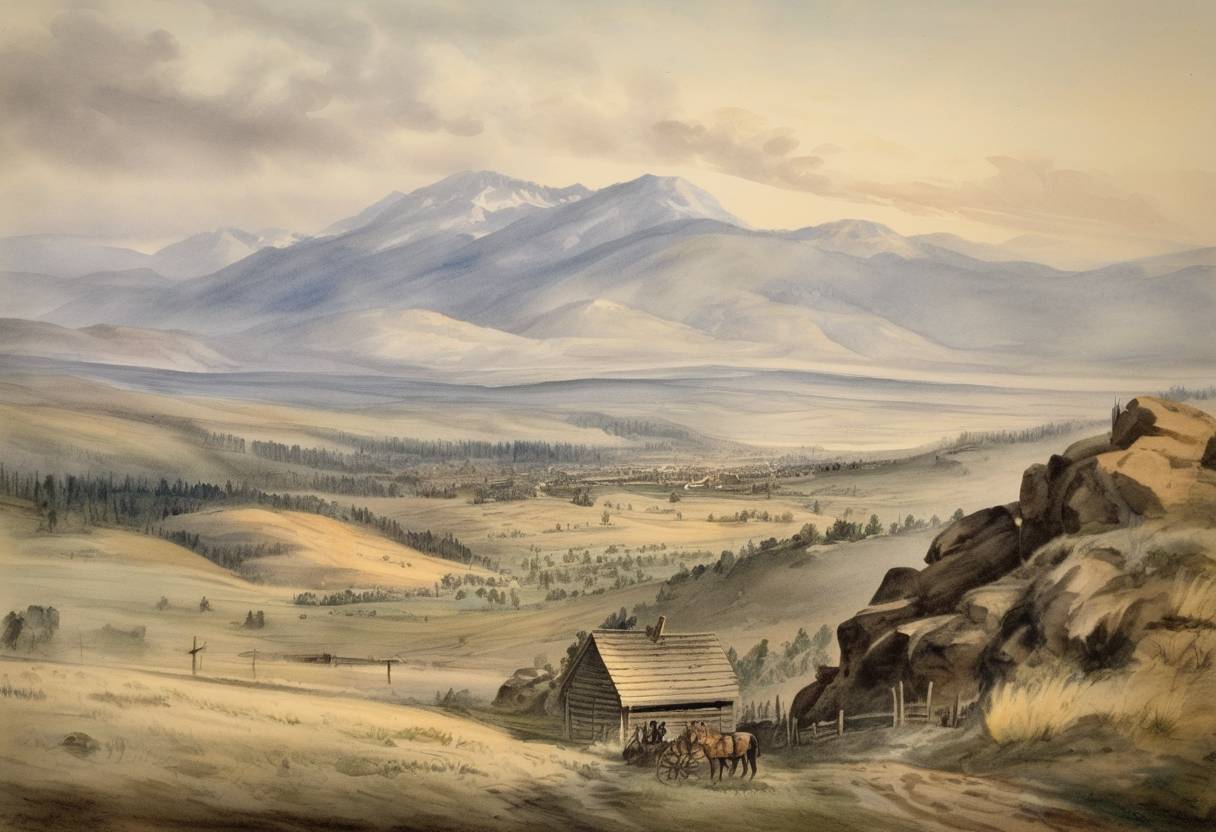
On May 26, 1864, the Montana Territory was officially organized by an Act of Congress, marking a significant development in the westward expansion of the United States during the mid-19th century. This act established the region as a separate territory, distinct from other territories such as Idaho, and laid the groundwork for its eventual path to statehood.
The mid-19th century was a period of rapid territorial expansion in the United States, largely driven by the concept of Manifest Destiny, which held that the expansion of the U.S. throughout the American continents was both justified and inevitable. As settlers moved westward in search of land, mining opportunities, and other economic prospects, the organization of new territories became a practical necessity to administer these growing populations and to maintain order and governance across vast, often sparsely populated, areas.
The Montana Territory, encompassing the present-day state of Montana, was carved out of the Idaho Territory. The discovery of gold in the region accelerated the influx of settlers and prospectors, raising the demand for a more localized government structure to address the specific needs and challenges faced by the inhabitants.
The Act of Congress that established the Montana Territory delineated its boundaries, which included land from the east of the Continental Divide that had previously been part of the extensive Idaho Territory. Notably, its creation was a response to the increasing population and economic activity in the area due to the gold rush, which necessitated a separate governmental authority.
The Act provided for the appointment of key territorial officials, including a governor, a secretary, and a judicial authority to oversee legal matters. It also established a legislative assembly, giving residents a degree of local self-governance to address immediate issues within the territory.
The formal organization of the Montana Territory played a crucial role in structuring the governance and economic development of the region. The establishment of a territorial government facilitated improved administration and infrastructure development, which supported the burgeoning population drawn by mining opportunities.
In a broader sense, the creation of the Montana Territory is a reflection of the broader patterns of settlement and development characterizing the American West during this period. It stands as an example of how the United States extended its federal governance structures westward to incorporate new populations and resources effectively.
Montana would remain a U.S. territory for nearly 25 years, with its eventual admission to the Union as the 41st state on November 8, 1889. The organization of the Montana Territory thus represents a foundational moment in its journey to statehood, setting the stage for its future economic and political developments.
Source: www.loc.gov