Henry VIII's Coronation: June 24, 1509
1509 · London, England
Henry VIII was crowned King of England at Westminster Abbey, marking the beginning of a reign that would include significant religious and political changes.
October 30, 1485
Henry VII of England was crowned at Westminster Abbey, marking the beginning of the Tudor dynasty.
London, England | The English Monarchy
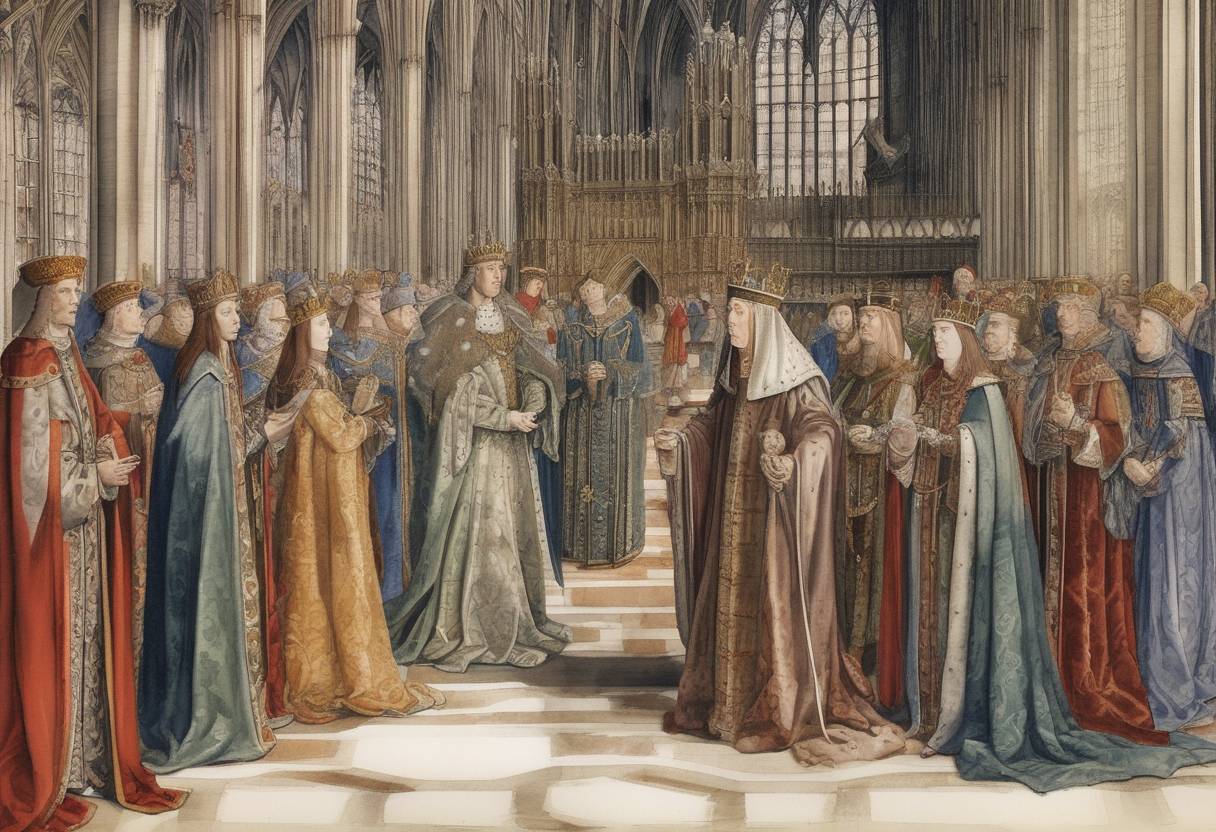
On October 30, 1485, Henry VII was crowned King of England at Westminster Abbey, marking the beginning of the Tudor dynasty. This event was a pivotal moment in English history, bringing an end to the Wars of the Roses and establishing a new era of stability and prosperity.
The Wars of the Roses were a series of dynastic conflicts that took place between 1455 and 1487, involving two rival branches of the royal House of Plantagenet: the House of Lancaster and the House of York. The conflict was named after the symbols of the two houses: the red rose of Lancaster and the white rose of York.
Henry Tudor, a Lancastrian claimant, was born in 1457. His claim to the throne was tenuous, primarily through his mother, Margaret Beaufort, a descendant of John of Gaunt, the third son of King Edward III. After years of exile in Brittany and France, Henry returned to England and defeated King Richard III, the last Yorkist king, at the Battle of Bosworth Field on August 22, 1485. This victory effectively ended the Wars of the Roses.
Henry’s coronation at Westminster Abbey was a carefully orchestrated event designed to legitimize his claim to the throne and unify the country. By choosing to be crowned before marrying Elizabeth of York, Henry emphasized his right to rule in his own right, not merely through his future wife’s Yorkist lineage.
The ceremony was conducted by Thomas Bourchier, the Archbishop of Canterbury, and was attended by many nobles and dignitaries. The coronation was a grand affair, symbolizing the hope for a new era of peace and stability.
The coronation of Henry VII marked the beginning of the Tudor dynasty, which would rule England for over a century. Henry’s reign focused on consolidating power, restoring the authority of the monarchy, and strengthening the financial position of the crown. He implemented policies that reduced the power of the nobility and increased the efficiency of government.
Henry’s marriage to Elizabeth of York in January 1486 further solidified his position by uniting the warring houses of Lancaster and York. This union symbolized the end of the dynastic conflict and was embodied in the Tudor rose, a combination of the red and white roses.
The Tudor dynasty would go on to produce some of England’s most famous monarchs, including Henry VIII and Elizabeth I, and play a crucial role in shaping the nation’s history.
In summary, Henry VII’s coronation was not just the crowning of a new king but the beginning of a transformative era in English history, laying the foundations for the modern British state.
Source: en.wikipedia.org