The Molotov-Ribbentrop Pact: A Non-Aggression Treaty
1939 · Moscow, Soviet Union
The Molotov-Ribbentrop Pact, a non-aggression treaty between Nazi Germany and the Soviet Union, was signed.
September 28, 1939
Nazi Germany and the Soviet Union sign the German–Soviet Frontier Treaty, dividing Eastern Europe into spheres of influence.
Moscow, Soviet Union | Nazi Germany and Soviet Union
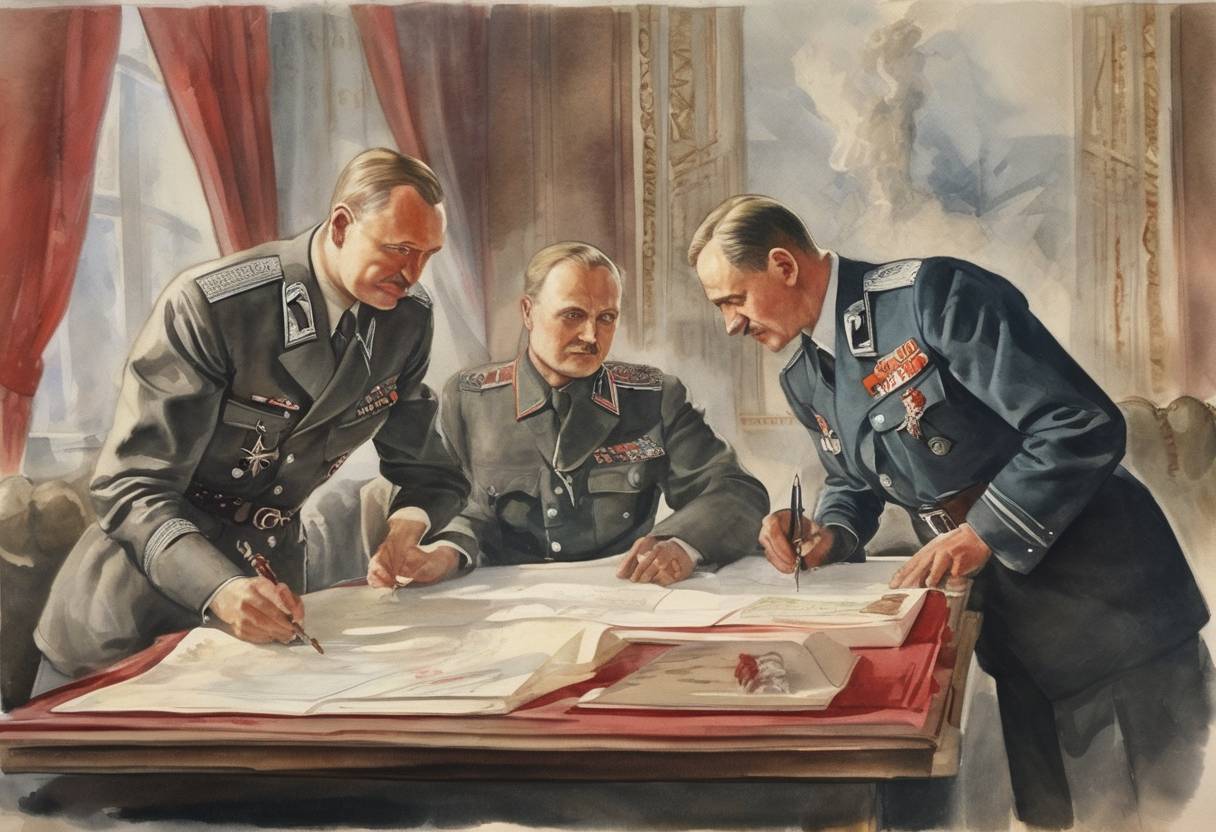
On September 28, 1939, Nazi Germany and the Soviet Union signed the German–Soviet Frontier Treaty, a pivotal agreement that further delineated their spheres of influence in Eastern Europe following the invasion of Poland. This treaty was a follow-up to the earlier Molotov-Ribbentrop Pact, signed on August 23, 1939, which had initially outlined the division of territories in Eastern Europe between the two powers.
Molotov-Ribbentrop Pact: The non-aggression pact between Germany and the Soviet Union included secret protocols that divided Eastern Europe into German and Soviet spheres of influence. This agreement paved the way for the invasion of Poland, which began on September 1, 1939, by Germany and on September 17, 1939, by the Soviet Union.
Invasion of Poland: The coordinated invasions led to the rapid defeat of Poland, with Warsaw falling on September 27, 1939. The country was divided between the two powers, effectively erasing Poland as an independent nation at that time.
Territorial Adjustments: The German–Soviet Frontier Treaty formalized the division of Poland, with the Bug River serving as a significant demarcation line. Germany took control of the western part of Poland, while the Soviet Union annexed the eastern regions.
Population Transfers: The treaty included provisions for the transfer of populations, allowing for the relocation of ethnic Germans from Soviet-controlled areas to German territories and vice versa for ethnic Ukrainians and Belarusians.
Economic Cooperation: The agreement also facilitated economic cooperation between the two nations, with the Soviet Union supplying raw materials to Germany in exchange for industrial goods.
Impact on Poland: The division of Poland had devastating effects on its population, leading to widespread displacement, persecution, and the beginning of a brutal occupation by both Nazi and Soviet forces.
Soviet Expansion: The treaty allowed the Soviet Union to expand its influence further into Eastern Europe, setting the stage for subsequent annexations of the Baltic States and parts of Romania.
Prelude to Conflict: Although the treaty temporarily solidified the alliance between Nazi Germany and the Soviet Union, it was a fragile arrangement. The ideological differences and territorial ambitions of both powers would eventually lead to conflict, culminating in Operation Barbarossa, the German invasion of the Soviet Union in June 1941.
The German–Soviet Frontier Treaty was a significant moment in the early stages of World War II, illustrating the opportunistic and expansionist policies of both Nazi Germany and the Soviet Union. It had profound implications for the geopolitical landscape of Eastern Europe and set the stage for further conflict and upheaval in the region.
Source: en.wikipedia.org