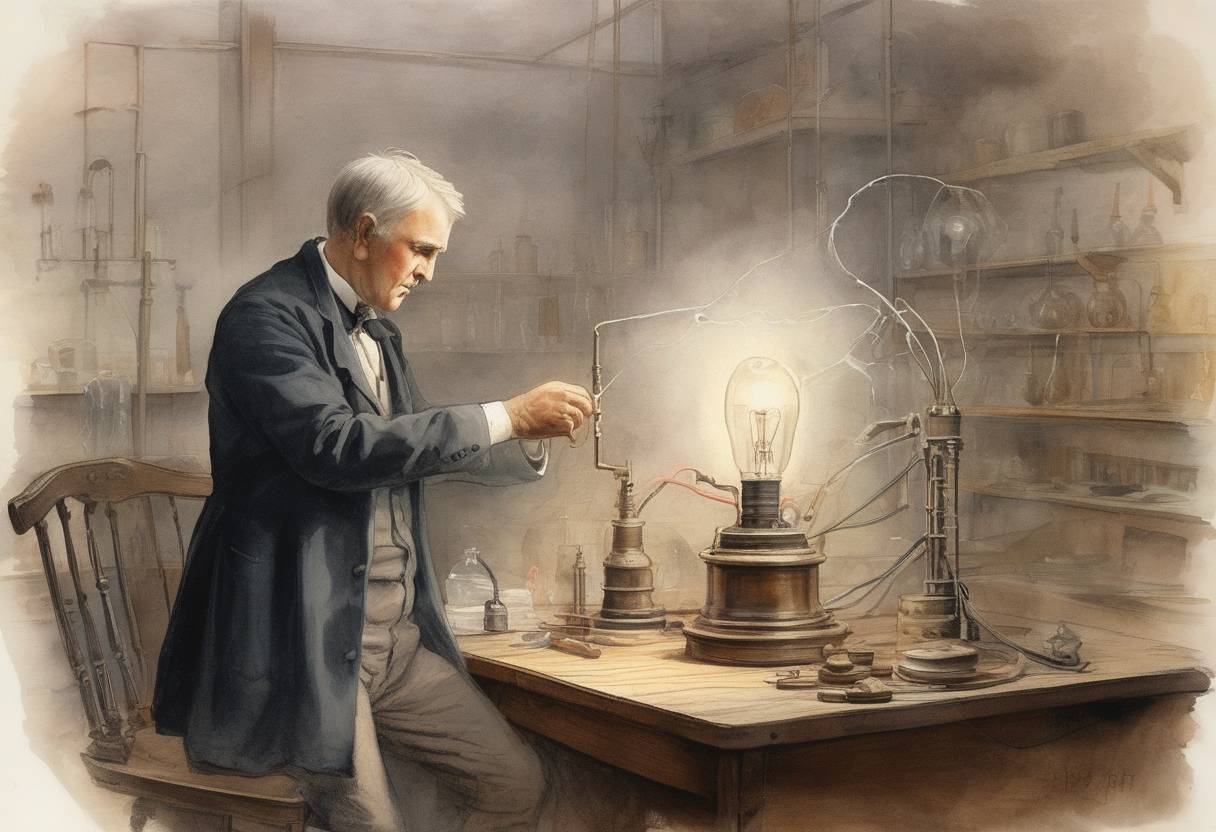
Thomas Edison’s First Practical Electric Light Bulb Test
On October 22, 1879, Thomas Edison conducted a pivotal experiment that would illuminate the future of electric lighting. This date marks the successful test of the first practical electric light bulb, which utilized a carbon filament and lasted for 13.5 hours before burning out. This achievement was a significant milestone in the development of electric lighting and had profound implications for society and industry.
Context and Background
Before Edison’s breakthrough, the concept of electric lighting was not new. Inventors such as Humphry Davy and Sir Joseph Swan had previously demonstrated electric light using arc lamps and other methods. However, these earlier designs were impractical for widespread use due to their short lifespan, high cost, and intense brightness.
Edison’s work on electric lighting began in earnest in the late 1870s. He aimed to create a reliable, long-lasting, and affordable light bulb that could be used in homes and businesses. His research was conducted at his laboratory in Menlo Park, New Jersey, where he and his team experimented with thousands of different materials for the filament.
The Experiment
On October 22, 1879, Edison successfully tested a light bulb with a carbonized cotton thread filament. This bulb was placed in a vacuum-sealed glass bulb to prevent the filament from burning up too quickly. The vacuum environment was crucial in extending the life of the filament by reducing oxidation.
The bulb glowed for 13.5 hours, a significant improvement over previous attempts. This test demonstrated the viability of Edison’s design and marked a turning point in the development of electric lighting.
Aftermath and Significance
Edison’s successful test paved the way for the commercialization of electric lighting. In 1880, he founded the Edison Electric Light Company to produce and market his light bulbs. By the early 1880s, electric lighting systems began to be installed in cities around the world, revolutionizing the way people lived and worked.
The invention of the practical electric light bulb had far-reaching effects:
- Urban Development: Electric lighting enabled cities to extend productive hours beyond daylight, contributing to urban growth and the rise of nightlife.
- Industrial Impact: Factories could operate longer hours, increasing productivity and economic output.
- Social Change: Electric lighting improved safety and quality of life, reducing reliance on gas lamps and candles.
Edison’s work on the electric light bulb is often cited as one of the key innovations of the Second Industrial Revolution, highlighting the transformative power of electricity in modern society.
Conclusion
Thomas Edison’s successful test of the first practical electric light bulb on October 22, 1879, was a landmark event in technological history. It showcased the potential of electric lighting and set the stage for widespread adoption, fundamentally altering the landscape of modern civilization.