Abolition of Serfdom in the Austrian Empire - April 8, 1848
1848 · Vienna, Austrian Empire
The Austrian Empire abolishes serfdom as part of revolutionary changes sweeping Europe in 1848.
November 9, 1848
Robert Blum, a German politician and revolutionary, was executed in Vienna following his involvement in the Revolutions of 1848.
Vienna, Austria | Austrian government
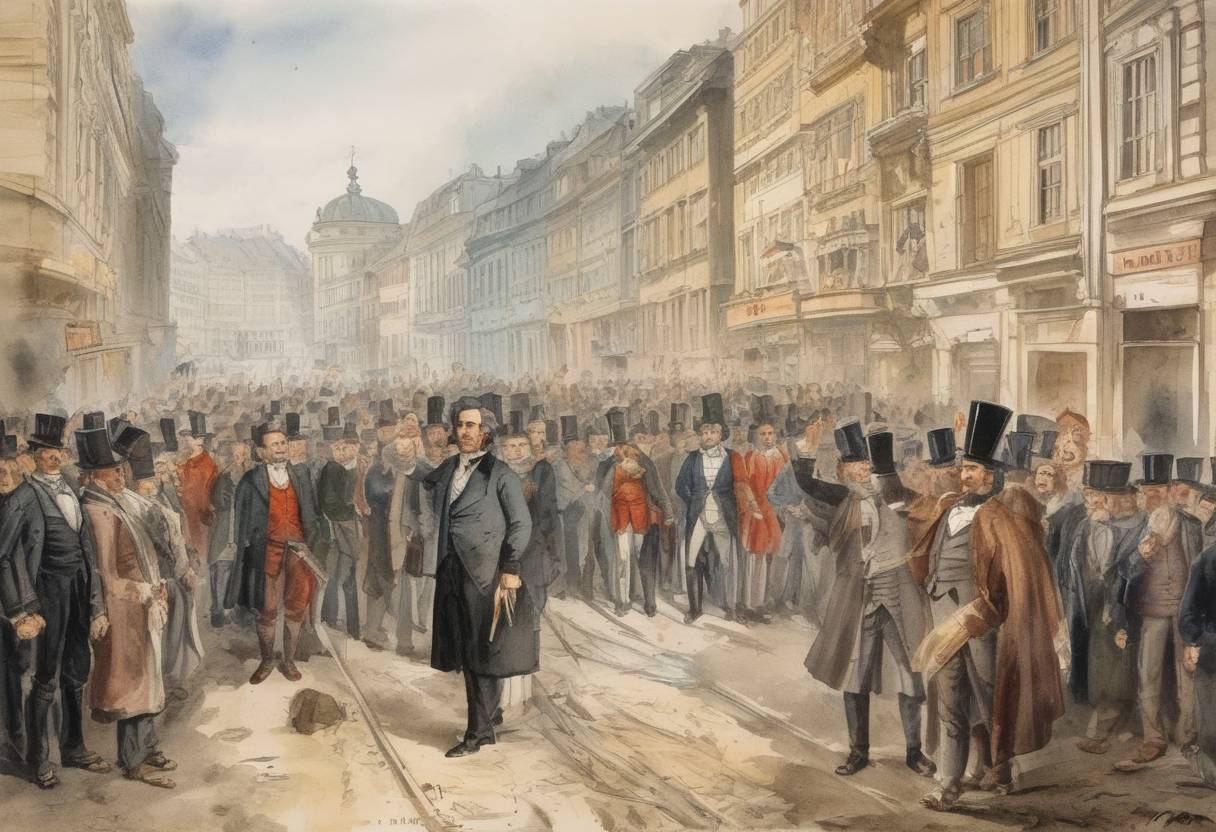
Robert Blum was a significant figure in the German revolutions of 1848, a series of loosely coordinated protests and rebellions across the German Confederation. These revolutions were part of a broader wave of upheavals across Europe, driven by demands for political reform, national unification, and greater civil liberties.
Born on November 10, 1807, in Cologne, Robert Blum was a prominent German politician, journalist, and revolutionary. He was a key member of the liberal movement in Germany and became a leading figure in the March Revolution of 1848. Blum was a member of the Frankfurt Parliament, the first freely elected parliament for all of Germany, where he advocated for a constitutional monarchy and the unification of Germany.
The Revolutions of 1848 were fueled by widespread dissatisfaction with the political order established by the Congress of Vienna in 1815. In Germany, the revolutionaries sought to challenge the autocratic rule of the various German states and push for national unity and democratic reforms.
Blum was actively involved in the revolutionary activities in Vienna, where he supported the uprising against the conservative Austrian government led by Prince Klemens von Metternich. The revolutionaries in Vienna demanded a more liberal constitution and greater autonomy from the Austrian Empire.
In October 1848, the Austrian government launched a military campaign to suppress the revolution in Vienna. Blum, who had traveled to Vienna to support the revolutionaries, was arrested on October 4, 1848, after the Austrian forces regained control of the city.
Despite his status as a member of the Frankfurt Parliament, which should have granted him immunity, Blum was tried by a military court. On November 9, 1848, he was executed by firing squad, becoming a martyr for the revolutionary cause. His execution was widely condemned and seen as a symbol of the reactionary forces’ determination to crush the revolutionary movements across Europe.
Blum’s execution had a profound impact on the revolutionary movement in Germany and beyond. It highlighted the challenges faced by the revolutionaries in their struggle against entrenched autocratic regimes. The failure of the 1848 revolutions in Germany led to a period of political repression, but the ideas and aspirations of the revolutionaries continued to influence future movements for democracy and national unity.
Robert Blum is remembered as a symbol of the fight for freedom and democracy in Germany. His legacy is commemorated in various ways, including memorials and streets named in his honor, reflecting his enduring impact on German political history.
Source: en.wikipedia.org