Creation of Martin Luther King Jr. Day
1983 · Washington, D.C., United States
U.S. President Ronald Reagan signed a bill creating Martin Luther King Jr. Day, a federal holiday to honor the civil rights leader.
June 18, 1873
Susan B. Anthony is fined $100 for voting in the United States presidential election of 1872.
Canandaigua, United States | United States Government
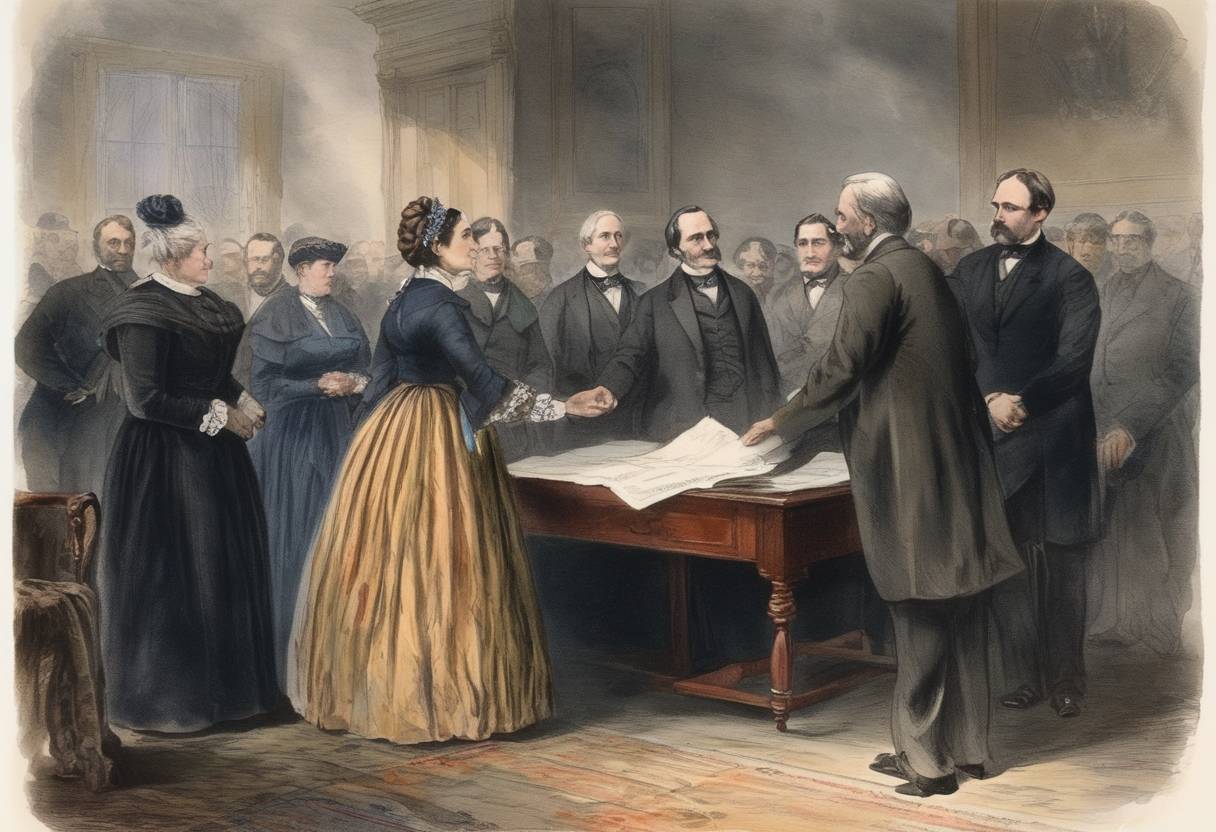
On June 18, 1873, Susan B. Anthony, a prominent leader in the women’s suffrage movement, was fined $100 for illegally voting in the 1872 United States presidential election. This event took place in Canandaigua, New York, and became a pivotal moment in the history of women’s rights in America.
Susan B. Anthony, along with fourteen other women, cast their votes in Rochester, New York, in November 1872. They did so to challenge the legal restrictions that barred women from voting. Anthony believed that the Fourteenth Amendment, which granted all citizens equal protection under the law, implicitly granted women the right to vote.
Following her act of civil disobedience, Anthony was arrested and charged with voting illegally. Her trial became a symbol of the fight for women’s suffrage.
The trial was held at the Ontario County Courthouse. Despite her compelling defense argument that the Constitution provided her the right to vote, the presiding Judge Ward Hunt directed the jury to deliver a guilty verdict. This judicial overreach was indicative of the systemic bias against women’s suffrage at the time.
Anthony was fined $100, a substantial sum in 1873, and ordered to pay the costs of the prosecution. She refused to pay the fine, declaring it unjust, and famously stating, “I shall never pay a dollar of your unjust penalty.”
Susan B. Anthony’s trial brought national attention to the women’s suffrage movement and highlighted the inequalities entrenched in the legal system. Her actions and the subsequent trial became emblematic of the struggle for women’s rights and galvanized activists to push harder for change.
The incident underscored the systemic barriers women faced and inspired further activism, leading eventually to the passage of the Nineteenth Amendment to the United States Constitution in 1920, which granted women the right to vote.
The trial of Susan B. Anthony is remembered today as a critical moment in both the women’s suffrage movement and the broader struggle for civil rights in the United States.
Source: en.wikipedia.org