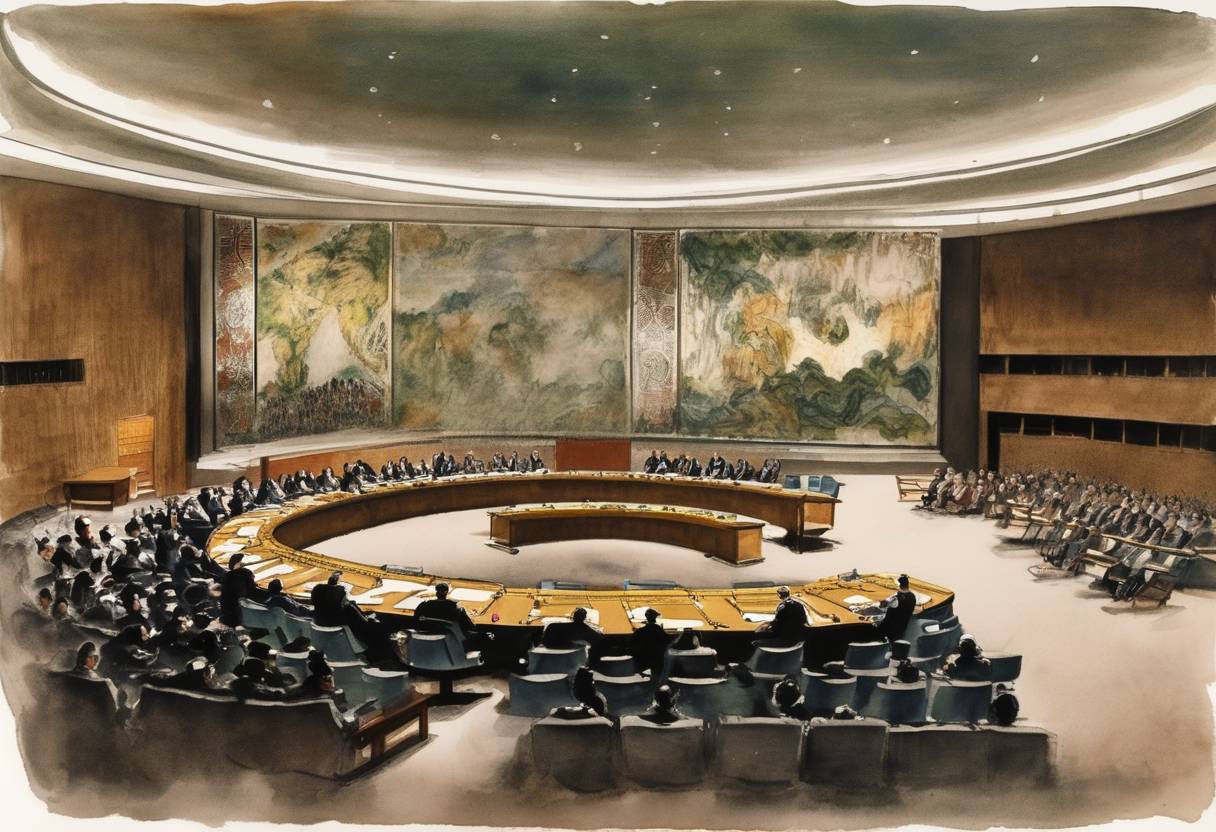
United Nations Security Council Resolution 90 - November 4, 1950
On November 4, 1950, the United Nations Security Council adopted Resolution 90, a pivotal decision during the early stages of the Korean War. This resolution specifically removed the Korean conflict from the Council’s active agenda. The decision was precipitated by the complex geopolitical shifts following China’s substantial intervention in the conflict.
Context Leading to the Resolution
The Korean War began on June 25, 1950, when North Korean forces, backed by the Soviet Union, invaded South Korea. The United Nations, primarily driven by the United States, was swift to respond, deploying a coalition to repel the North Korean advance. By late 1950, UN forces had pushed the North Korean army back past the 38th parallel, nearing China’s border.
China perceived this movement as a direct threat to its security. On October 19, 1950, Chinese forces, referred to as “Chinese People’s Volunteers,” crossed into Korea, significantly altering the war’s dynamics. This intervention led the United Nations and involved nations to reassess their strategies and engagement in the conflict.
Adoption of Resolution 90
Resolution 90 was adopted as an acknowledgment of the strategic complexities introduced by the Chinese intervention. The resolution effectively suspended active UN deliberations on the Korean War. This move also underscored the global recognition of the war’s evolution into a broader conflict involving major powers, casting it in a potentially different light than initially perceived.
The adoption of Resolution 90 by the Security Council was aligned with the geopolitical reality of Chinese forces supporting North Korea, thereby elevating the conflict from a regional to an international flashpoint. This development compelled the United Nations to reconsider direct involvement and pursue alternative diplomatic channels.
Significance and Aftermath
Resolution 90 highlighted the limitations of the UN’s influence when faced with interventions by powerful states like China, which were not part of the initial UN-backed coalition. It marked a significant moment, reflecting the Cold War tensions that underscored international relations during this period.
Following the resolution, the Korean War continued, characterized by a series of intense military engagements that would eventually culminate in the stalemate leading to the armistice in 1953.
Although it suspended active discussion on the matter, Resolution 90 did not end UN involvement in Korea entirely. The UN continued to provide humanitarian assistance and engage in diplomatic efforts behind the scenes. The Korean Peninsula remained a significant focus of international diplomacy, with repercussions that continued to influence global politics in the years following the war.
Resolution 90 was a testament to the evolving nature of international conflicts during the 20th century and an early demonstration of the emerging influence of new superpowers in the global order.