The Siege of Jerusalem Begins - June 6, 1099
1099 · Jerusalem, Kingdom of Jerusalem (modern-day Israel)
The First Crusade: Crusaders begin the Siege of Jerusalem, a pivotal moment in the campaign to capture the Holy City from Muslim control.
June 9, 1099
The First Crusade: Crusaders begin the siege of Jerusalem, marking the start of a pivotal moment in the campaign to capture the city from the Fatimid Caliphate.
Jerusalem, Fatimid Caliphate (present-day Israel) | Crusaders
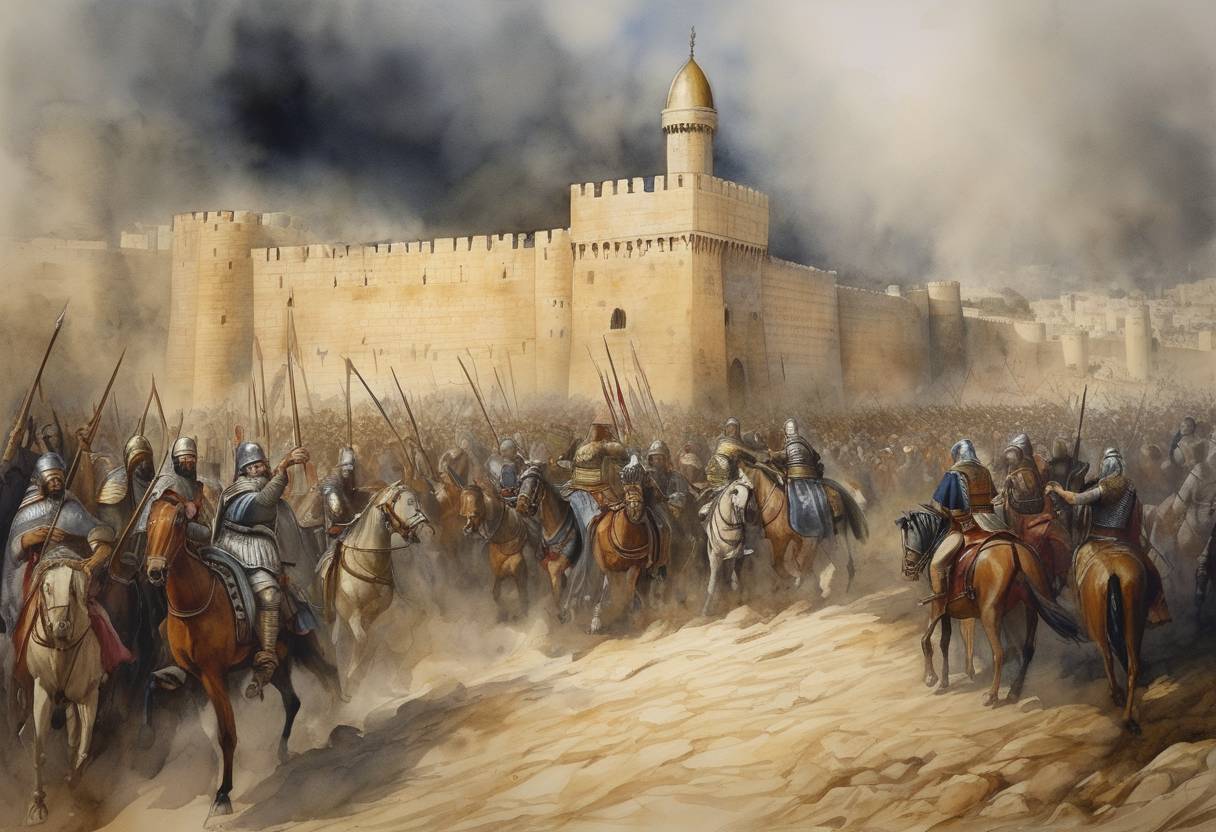
On June 9, 1099, the First Crusade reached a significant milestone as the Crusaders initiated the siege of Jerusalem, a decisive effort to capture the city from the Fatimid Caliphate. Jerusalem was a city of immense religious significance to the Christian world, making its capture a crucial objective of the Crusader campaign.
The First Crusade was launched in 1096 in response to Pope Urban II’s call to reclaim the Holy Land from Muslim control. The Crusaders, a diverse group of knights, nobles, and peasants primarily from Western Europe, embarked on this campaign driven by religious zeal and the promise of spiritual and temporal rewards.
After arduous journeys and several military engagements, including the capture of Antioch in 1098, the Crusaders made their way to Palestine. By the spring of 1099, they approached Jerusalem, which was then under the control of the Shi’a Fatimid Caliphate, following a switching of power from the Seljuk Turks.
On June 9, 1099, the Crusaders encamped outside the walls of Jerusalem. The city was well-fortified, and its defenders were prepared for a siege, bolstered by a substantial garrison of troops. The Crusaders, numbering around 12,000, faced significant challenges, including limited supplies and harsh summer conditions that exacerbated the scarcity of water and food.
Despite these adversities, the Crusaders managed to construct siege towers and other apparatus under the leadership of key figures like Godfrey of Bouillon, Raymond of Toulouse, and Tancred. They aimed to overcome the city’s formidable defenses, which included thick stone walls and strong towers.
The siege of Jerusalem was a critical moment in the First Crusade. On July 15, 1099 – after a month-long siege and intense fighting – the Crusaders successfully breached the city’s defenses, leading to the capture of Jerusalem. The fall of Jerusalem was marked by a brutal massacre of its Muslim and Jewish inhabitants, an event that remains a point of controversy and reflection in the history of the Crusades.
The Crusaders’ victory established the Kingdom of Jerusalem, a Crusader state that would endure, albeit precariously, for several decades. This success also inspired subsequent Crusades and posed a significant moment in the long history of Christian-Muslim relations, characterized by both conflict and coexistence.
The events surrounding the siege of Jerusalem continue to be a pivotal study in medieval history, reflecting broader themes of religious fervor, military strategy, and the shifting power dynamics of the medieval world.
Source: en.wikipedia.org