The United States Formally Recognizes the Soviet Union - November 17, 1933
1933 · Washington, D.C., United States
The United States formally recognizes the Soviet Union.
February 6, 1922
The Washington Naval Treaty was signed, limiting naval construction and aiming to prevent an arms race after World War I.
Washington, D.C., United States | United States Department of State
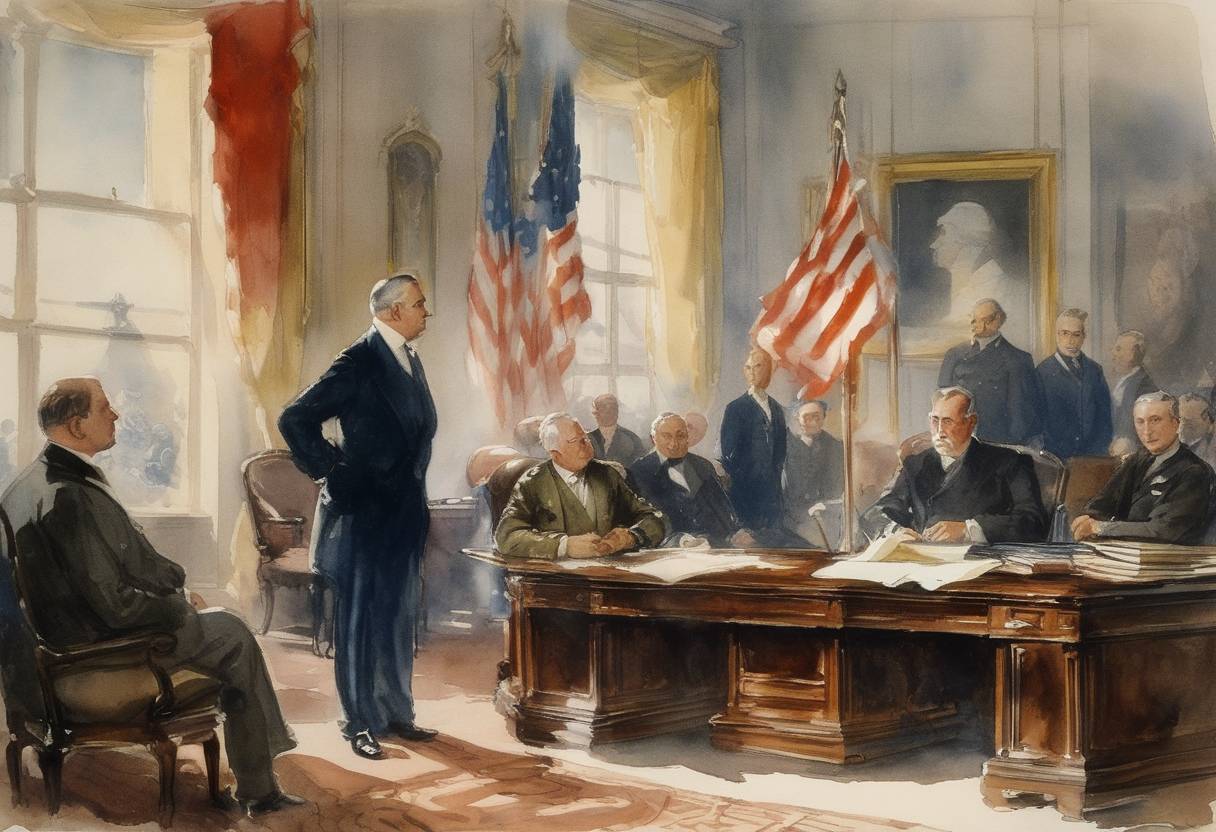
In the aftermath of World War I, the major naval powers sought to prevent another costly arms race that might lead to future conflicts. The Washington Naval Conference, held between 1921 and 1922, was a landmark diplomatic gathering aimed at disarmament and ensuring peace through the limitation of naval power.
On February 6, 1922, the Washington Naval Treaty, also known as the Five-Power Treaty, was signed. This treaty was a pivotal agreement between the United States, the United Kingdom, Japan, France, and Italy. The aim was to prevent an arms race by limiting naval construction and maintaining balances of power in the aftermath of World War I.
Capital Ship Limitations: The treaty established a moratorium on the construction of new capital ships (battleships and aircraft carriers) and set tonnage limits for each of the signatory nations. The agreed-upon ratios were 5:5:3:1.75:1.75 for the U.S., the United Kingdom, Japan, France, and Italy, respectively.
Existing Ships: Each country was required to scrap older ships to comply with the newly set tonnage limits, leading to significant reductions in the number of warships.
Shipbuilding Restrictions: There were stipulations regarding the size and armament of future ships, essentially limiting the type and quantity of naval vessels that could be built.
The Washington Naval Treaty marked a significant step in arms control and set a precedent for future disarmament efforts. It also represented a shift towards diplomatic conflict resolution rather than military build-up during peacetime, highlighting international cooperation in the interwar period.
While the treaty did result in a temporary halt to naval build-ups, its effects were not permanent. Geopolitical tensions and technological advances eventually led to the treaty’s limitations being surpassed. The treaty’s expiration in the mid-1930s, along with the rise of militarism in Germany and Japan, ultimately contributed to renewed global tensions leading up to World War II.
Through this treaty, participating nations aimed to foster peace and consolidate post-WWI stability, although its long-term effectiveness was challenged by subsequent global developments.
Source: history.state.gov