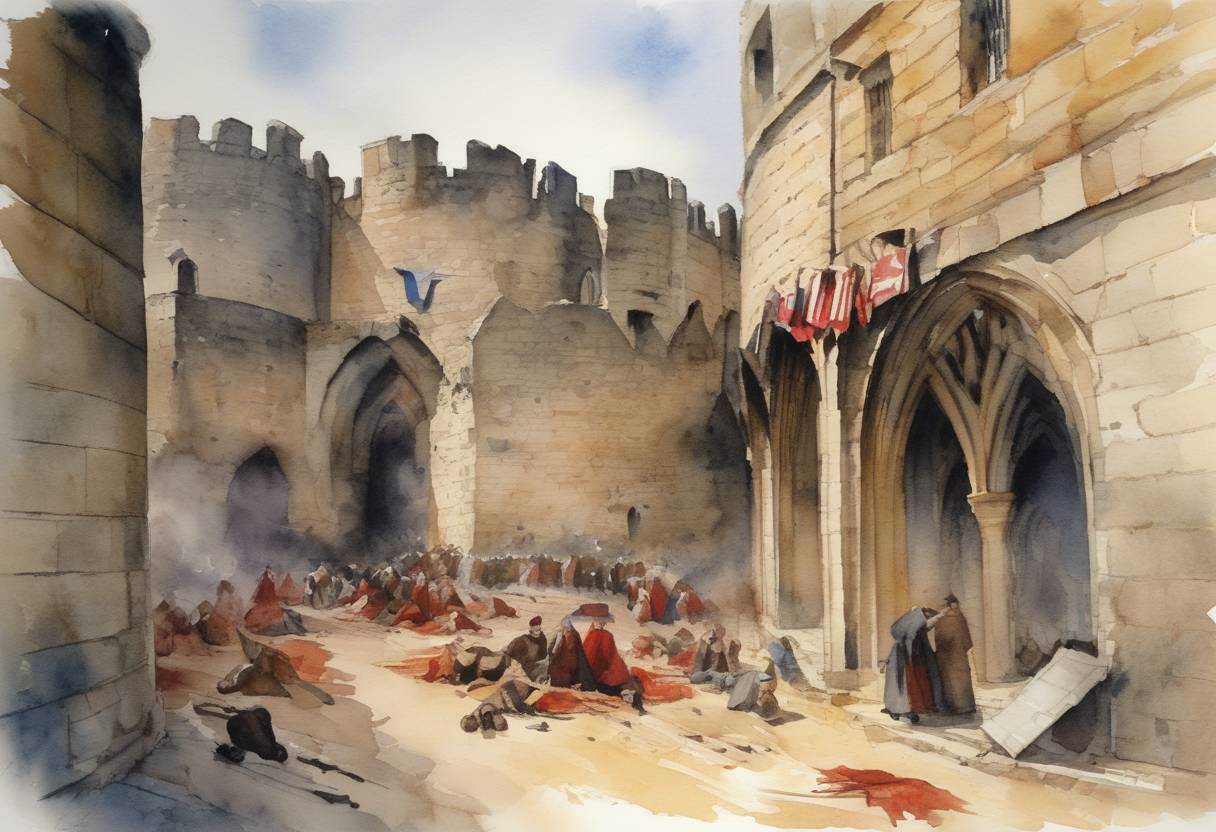
Massacre of the Jews at Clifford’s Tower
The Massacre of the Jews at Clifford’s Tower in York, England, occurred on March 17, 1190. This tragic event unfolded during a period of heightened anti-Semitic sentiment that swept across England following the accession of King Richard I, also known as Richard the Lionheart.
Historical Context
The 12th century was a tumultuous time for Jewish communities in England. Anti-Jewish sentiment had been rising, fueled by financial tensions since Jews were often moneylenders under Christian law, which prohibited Christians from lending money at interest. This led to resentment among debt-ridden crusaders preparing to embark on the Third Crusade, as they were eager to liquidate their debts before departure.
Tensions reached a breaking point upon King Richard I’s coronation in 1189, when Jews were barred from attending the ceremony. However, a few Jews who attempted to present gifts were attacked. This incident triggered wider violence against Jewish populations across England, culminating in the pogrom at York.
The Event
On the night of March 16 into the 17th, 1190, a mob incited by local nobles and religious fervor, targeted the Jewish community in York. The mostly Norman-fueled mob rallied under the guise of seeking revenge for debts owed to the Jews and retaliating against Jewish prosperity and protection under the crown.
Around 150 Jews sought refuge in Clifford’s Tower, a wooden keep within York Castle. As the mob besieged the tower, the Jews faced grave choices. Understanding the futility of their situation, many opted for mass suicide, killing their families and themselves to avoid forced conversion or murder at the hands of their attackers.
The tower was eventually set ablaze, and those who did not take their own lives were killed by the mob once the structure was breached. This massacre eradicated the Jewish community in York for many years.
Aftermath and Significance
The massacre at York was part of a series of violent outbreaks against Jews across England during this period. It pointed to the fragile status of Jews in medieval European society and highlighted the precarious protection offered by the crown, which could vanish due to political and social pressures.
In the aftermath of the violence, King Richard I condemned the attacks and emphasized the rights of Jewish communities under his realm, but no substantial justice or recompense was provided to the survivors. The pogrom at York stands as a chilling reminder of the dangers faced by minority communities in medieval Europe and a testament to the destructive power of intolerance and scapegoating.