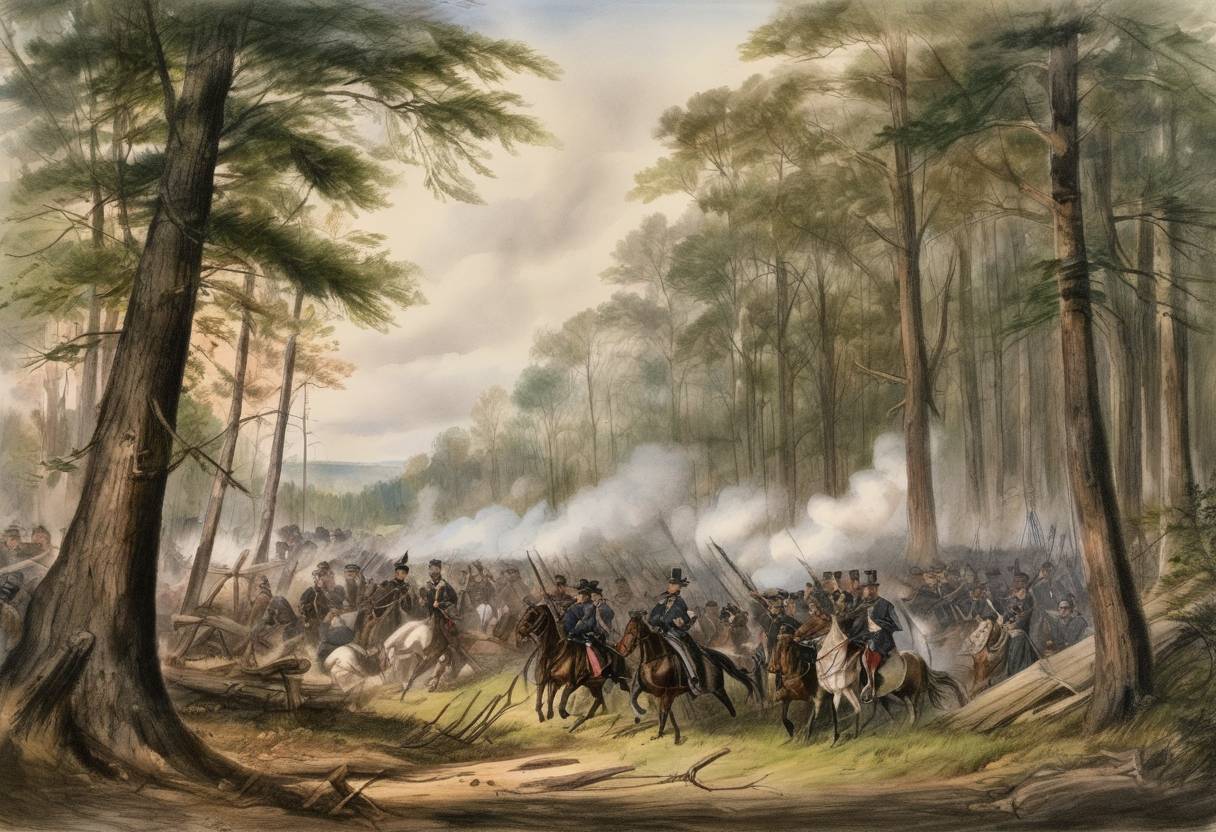
The Battle of the Wilderness: Conclusion on May 7, 1864
The Battle of the Wilderness, fought from May 5 to May 7, 1864, was a key engagement between the Union Army, commanded by Lieutenant General Ulysses S. Grant, and the Confederate Army under General Robert E. Lee. This battle marked the beginning of the Overland Campaign during the American Civil War.
Context and Background
- Commanders: The battle featured two of the war’s most prominent military leaders. Ulysses S. Grant, newly appointed as the General-in-Chief of all Union armies, brought a renewed vigor and strategy to the Union’s efforts. Robert E. Lee, commanding the Confederate Army of Northern Virginia, was noted for his tactical acumen.
- Strategic Importance: Grant aimed to apply constant pressure on Lee’s forces, intending to use the Union’s superior numbers and resources to wear down the Confederate Army. The Wilderness area, a dense and tangled forest in Virginia, presented a challenging environment that would limit the effectiveness of the Union artillery and cavalry.
Key Events Leading to May 7, 1864
- Initial Engagement: On May 5, 1864, the Union and Confederate forces clashed in the dense woods. Fighting was chaotic due to the thick underbrush, which reduced visibility and made formation-based strategies difficult to implement.
- Stalemate and Attrition: Over two days of intense fighting characterized by confusion and high casualties, neither side gained a decisive advantage. The environment negated the Union’s numerical superiority, leading to a brutal war of attrition.
Conclusion of the Battle on May 7, 1864
By May 7, the battle ended inconclusively without a clear victor. Both armies suffered heavy losses, with estimates of casualties reaching around 17,666 for the Union and approximately 11,033 for the Confederates.
Aftermath and Significance
- Grant’s Resolve: Contrary to the outcome of many previous battles in the Eastern Theater, the Union forces, under Grant’s leadership, did not retreat following the inconclusive results. Instead, Grant used this encounter to press forward, maintaining the aggressive posture that would eventually lead to the Union’s strategic victories.
- Continuing the Campaign: The end of the Battle of the Wilderness marked the beginning of continuous and relentless fighting in the Overland Campaign. Grant moved his forces southeast in an attempt to outflank Lee, leading to subsequent battles at Spotsylvania Court House and ultimately, the Siege of Petersburg.
- Overall Impact: The Battle of the Wilderness demonstrated Grant’s commitment to a new kind of warfare — one that was less concerned with holding ground and more focused on destroying Confederate armies. This persistent pressure played a critical role in depleting Confederate resources and morale, which contributed to the eventual Union victory in the Civil War.
The Battle of the Wilderness was a harbinger of the war’s brutal final year, illustrating the shift in Union strategy that would gradually erode Confederate resistance.