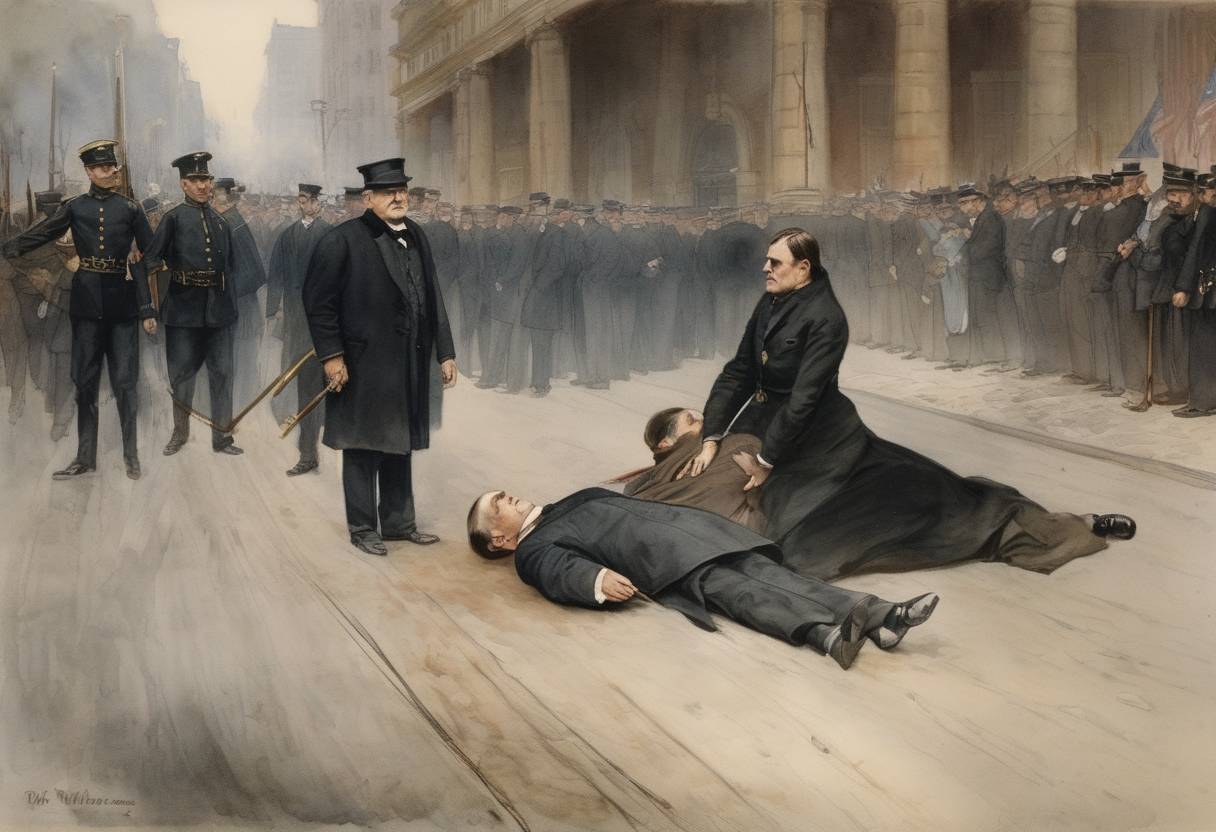
Assassination Attempt on President William McKinley
On September 5, 1901, President William McKinley was visiting the Pan-American Exposition in Buffalo, New York, a showcase of technological advancements and cultural exhibits. This visit was part of McKinley’s efforts to promote economic policy and international relations through industrial cooperation.
The Setting
- Event: Pan-American Exposition
- Location: Buffalo, New York
- Purpose: Celebrating advancements in technology and culture; promoting economic diplomacy.
The Assailant: Leon Czolgosz
Leon Czolgosz, an anarchist influenced by radical political ideas, was deeply opposed to the government and inspired by recent anarchist movements and figures. Czolgosz viewed McKinley as a symbol of oppression and economic inequality.
The Attempt
Contrary to a common misconception, the attempted assassination actually occurred on September 6, 1901. On September 5, McKinley delivered a well-received speech, in which he promoted international trade and cooperation. The focus on economic policy emphasized McKinley’s vision for the United States to be a leader in global commerce.
Key Details:
- Date of Attendance: September 5, 1901
- Speech Focus: Economic diplomacy and international trade.
Aftermath
The following day, Leon Czolgosz approached McKinley in the Temple of Music with a concealed weapon wrapped in a handkerchief. He shot McKinley twice, leading to serious injuries that ultimately resulted in McKinley’s death on September 14, 1901.
Historical Significance
The attack had profound implications:
- Impact on Security: It led to increased security measures for U.S. Presidents.
- Political Consequences: Theodore Roosevelt, McKinley’s vice president, succeeded him, leading to significant shifts in domestic and foreign policy.
- Public Reaction: This event intensified the national debate concerning anarchism and its threat to societal order.
The incident underscored the vulnerabilities of public figures and sparked discussions on balancing open public engagement with security. The Exposition, meant to symbolize progress and innovation, became a historic backdrop to a pivotal and tragic moment in American history.