Guglielmo Marconi Applies for a Patent for Wireless Telegraphy
1896 · London, United Kingdom
Guglielmo Marconi applies for a patent for his wireless telegraphy system in the United Kingdom.
September 30, 1901
Hubert Cecil Booth patented the first powered vacuum cleaner.
London, United Kingdom | British Patent Office
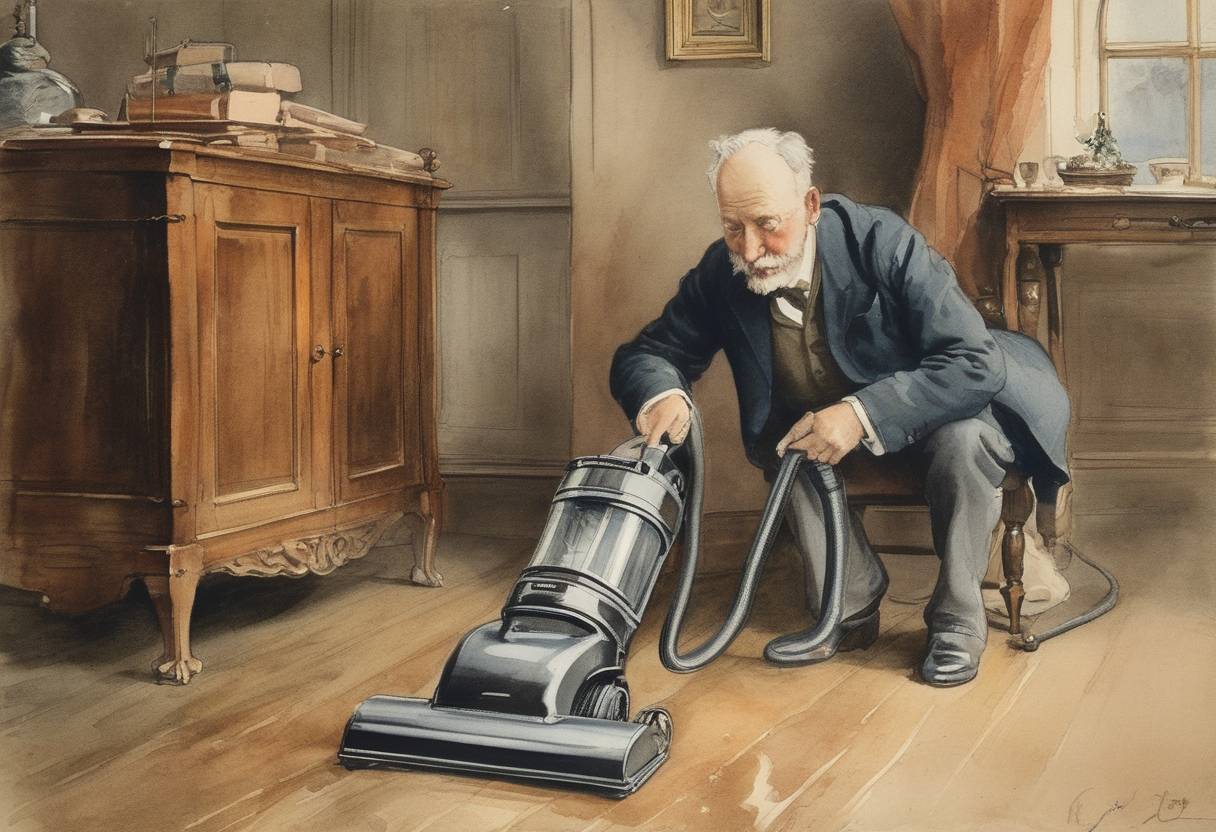
On September 30, 1901, British engineer Hubert Cecil Booth was granted a patent for the first powered vacuum cleaner. Booth’s invention marked a significant advancement in domestic cleaning technology and laid the groundwork for modern vacuum cleaners.
Prior to Booth’s invention, cleaning procedures involved manual methods such as sweeping or using devices that pushed air to blow dirt away. However, during a demonstration of a new American cleaning machine at a British restaurant, which blew dust and debris away rather than collecting it, Booth conceived the idea of a vacuum cleaner that could directly extract dirt by sucking it in.
Booth’s design was distinctive for its use of suction power. The device comprised a motor coupled with a pump that created a vacuum inside the cleaner, drawing in air through a filter and effectively capturing dust and debris. The original model was too large and cumbersome for personal or household use and was mounted on a horse-drawn carriage for operation.
Known as the “Puffing Billy,” Booth’s vacuum cleaner was initially marketed to businesses and large institutions. Although impractical for residential use due to its size and cost, the Puffing Billy became popular for its efficacy in large-scale cleaning projects, including use by the British Royal Navy and in public buildings.
Booth’s invention was a pivotal step in the evolution of cleaning technology, transforming cleaning practices in both commercial and residential spaces. The concept of a suction-based device eventually evolved into more compact and convenient household appliances, influencing designs well into the 21st century. His patent and subsequent developments paved the way for numerous innovations in residential cleaning and household technology.
Hubert Cecil Booth is remembered as a pioneering figure in engineering and home appliance history. His 1901 patent for the powered vacuum cleaner established a foundation upon which modern vacuuming technology continues to build.
Source: en.wikipedia.org