Inauguration of William McKinley as the 25th President of the United States
1897 · Washington, D.C., United States
William McKinley was inaugurated as the 25th President of the United States.
March 4, 1801
Thomas Jefferson was inaugurated as the third President of the United States, marking the first peaceful transfer of power between political parties in U.S. history.
Washington, D.C., United States | United States Government
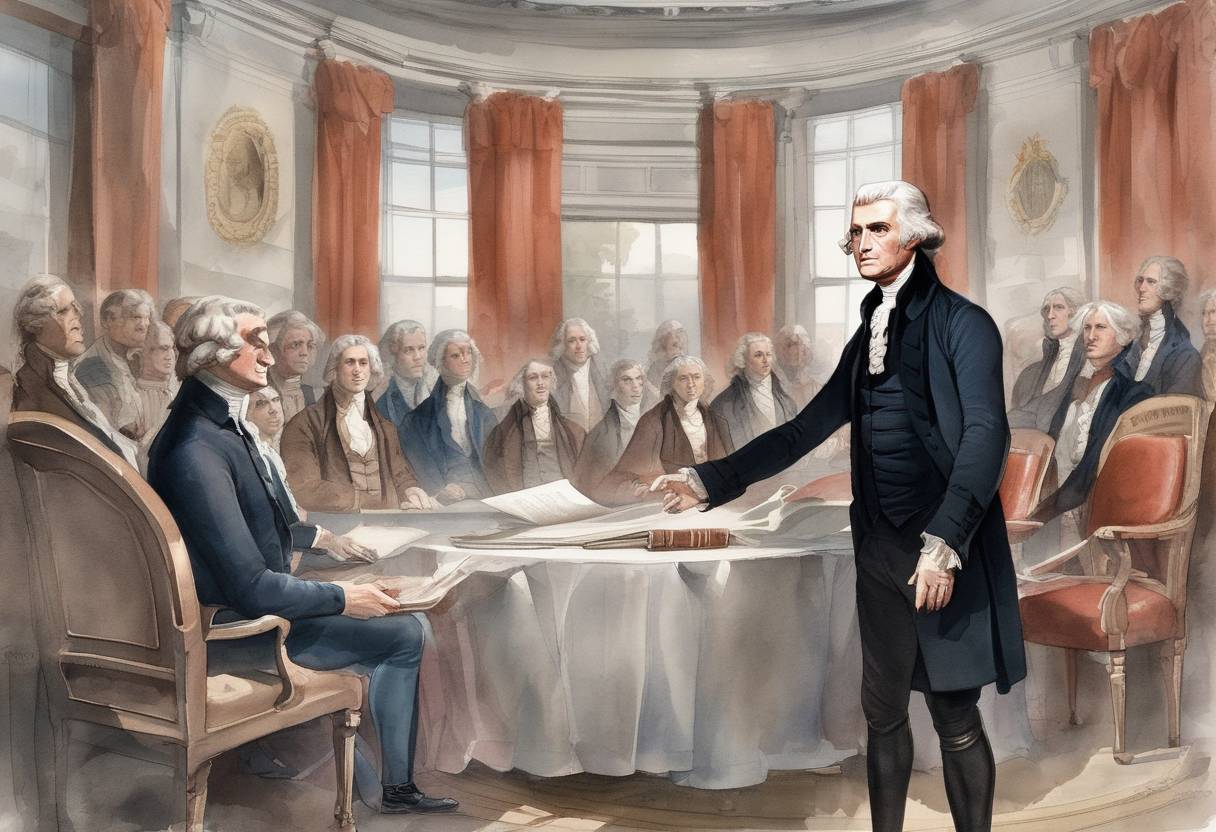
On March 4, 1801, Thomas Jefferson was inaugurated as the third President of the United States, a pivotal moment in American history that marked the first peaceful transfer of power between political parties. This event underscored the resilience of the young nation’s democratic institutions and set a precedent for future transitions of power.
Election of 1800: The election of 1800 was a fiercely contested battle between the incumbent Federalist President John Adams and the Democratic-Republican candidate Thomas Jefferson. The election was characterized by intense partisan rivalry and political maneuvering.
Electoral Tie: The election resulted in an electoral tie between Jefferson and his running mate, Aaron Burr, both receiving 73 electoral votes. This deadlock led to the decision being made in the House of Representatives.
House of Representatives Decision: After 36 ballots and significant political negotiation, the House of Representatives elected Jefferson as President and Burr as Vice President. This outcome was facilitated by the influence of Alexander Hamilton, who, despite his opposition to Jefferson’s policies, preferred him over Burr.
Date and Location: Thomas Jefferson was inaugurated on March 4, 1801, in the new capital city of Washington, D.C. The ceremony took place in the Senate Chamber of the unfinished Capitol building.
Significance: Jefferson’s inauguration was significant as it demonstrated the viability of the U.S. Constitution in facilitating a peaceful transition of power, even amidst deep political divisions. It was the first time power shifted from one political party (Federalists) to another (Democratic-Republicans).
Jefferson’s Address: In his inaugural address, Jefferson sought to unify the nation, emphasizing the principles of democracy and the importance of civil liberties. He famously stated, “We are all Republicans, we are all Federalists,” highlighting his desire to bridge the partisan divide.
12th Amendment: The electoral tie and subsequent political complications led to the adoption of the 12th Amendment in 1804, which established separate electoral votes for President and Vice President to prevent future ties.
Legacy: Jefferson’s peaceful assumption of power reinforced the legitimacy of the electoral process and set a democratic standard for future transitions. It underscored the importance of political compromise and the rule of law in maintaining stability.
Impact on U.S. Politics: The successful transition helped solidify the two-party system in the United States and demonstrated the capacity for political change without violence or upheaval.
Thomas Jefferson’s inauguration remains a landmark event in U.S. history, symbolizing the strength and adaptability of American democracy.
Source: en.wikipedia.org