The October Revolution: November 7, 1917
1917 · Petrograd, Russia
The October Revolution in Russia took place, leading to the Bolsheviks seizing power.
December 20, 1917
The Cheka, a Soviet secret police organization, was established by the Bolshevik government, marking the beginning of a series of secret police organizations in Soviet Russia.
Petrograd, Russia | Bolshevik Government
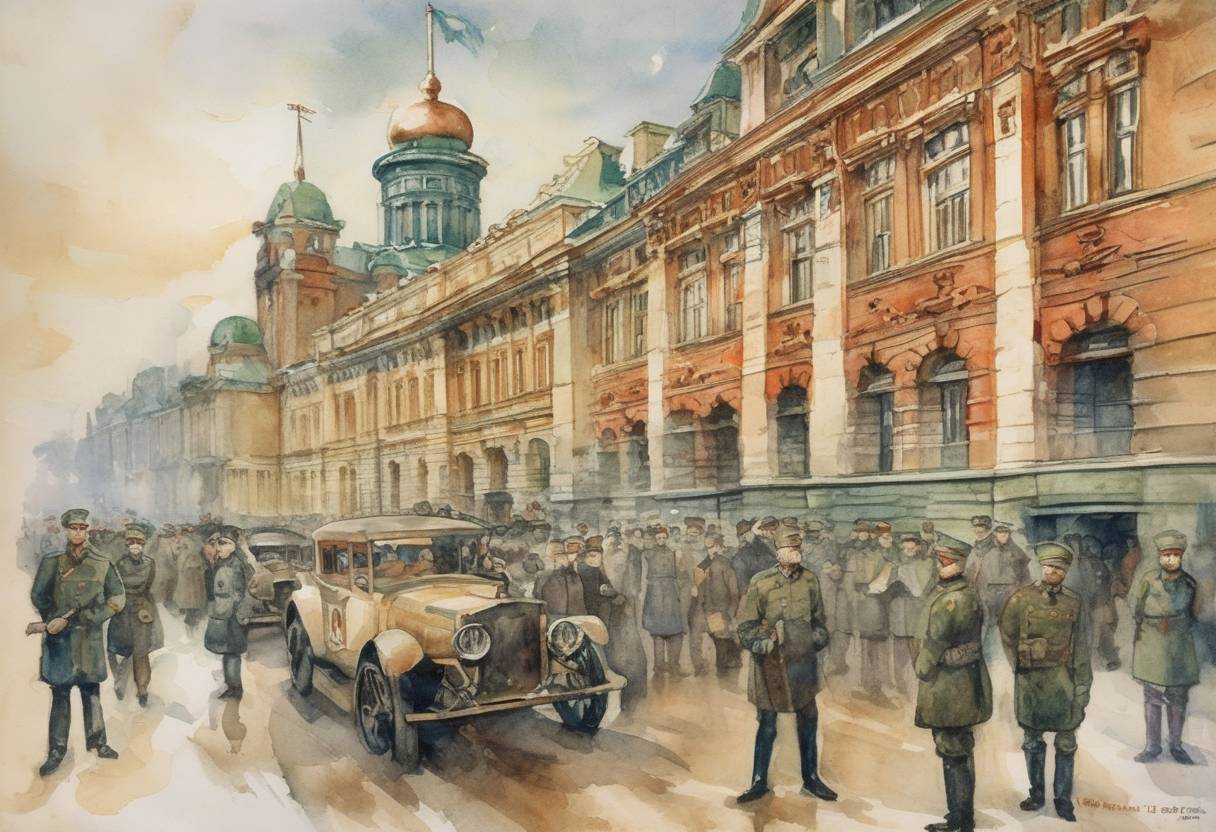
On December 20, 1917, the Bolshevik government, led by Vladimir Lenin, established the All-Russian Extraordinary Commission for Combating Counter-Revolution and Sabotage, commonly known as the Cheka. This marked the beginning of a series of secret police organizations that would play a crucial role in Soviet Russia’s internal security and political repression.
Bolshevik Revolution: The Cheka was formed shortly after the October Revolution of 1917, during which the Bolsheviks seized power from the Provisional Government. The new regime faced significant opposition from various political factions, including monarchists, liberals, and other socialist groups.
Civil War and Instability: The nascent Soviet state was embroiled in the Russian Civil War (1917-1922), fighting against the White Army and other anti-Bolshevik forces. This period was marked by widespread instability, economic collapse, and social unrest.
Founding: The Cheka was established by a decree of the Soviet government, with Felix Dzerzhinsky appointed as its first head. It was initially intended as a temporary measure to combat counter-revolutionary activities and sabotage.
Mandate: The organization was granted broad powers to arrest, detain, and execute individuals deemed threats to the Bolshevik regime. Its operations were characterized by secrecy and a lack of judicial oversight.
Red Terror: The Cheka played a central role in the Red Terror, a campaign of political repression and mass executions aimed at eliminating perceived enemies of the Bolsheviks. This period saw widespread arrests, summary executions, and the establishment of labor camps.
Expansion of Powers: Over time, the Cheka’s authority expanded, allowing it to operate with increasing autonomy. It became a tool for enforcing Bolshevik policies and suppressing dissent within Soviet society.
Successor Organizations: The Cheka was the precursor to several subsequent Soviet security agencies, including the GPU, NKVD, and eventually the KGB. Each organization continued the legacy of political repression and surveillance.
Historical Significance: The establishment of the Cheka marked the institutionalization of state terror as a means of governance in the Soviet Union. Its practices set a precedent for the use of secret police in maintaining political control.
Controversy and Criticism: The Cheka’s methods and the broader system of political repression it initiated have been subjects of significant historical debate and criticism, particularly regarding human rights abuses and the suppression of political freedoms.
The Cheka’s establishment on December 20, 1917, was a pivotal moment in Soviet history, laying the groundwork for the extensive security apparatus that would characterize the Soviet state throughout its existence.
Source: www.britannica.com