Napoleon Bonaparte's Coronation as Emperor of the French
1804 · Paris, France
Napoleon Bonaparte was crowned Emperor of the French at Notre-Dame Cathedral in Paris.
March 9, 1796
Napoleon Bonaparte marries his first wife, Joséphine de Beauharnais.
Paris, France
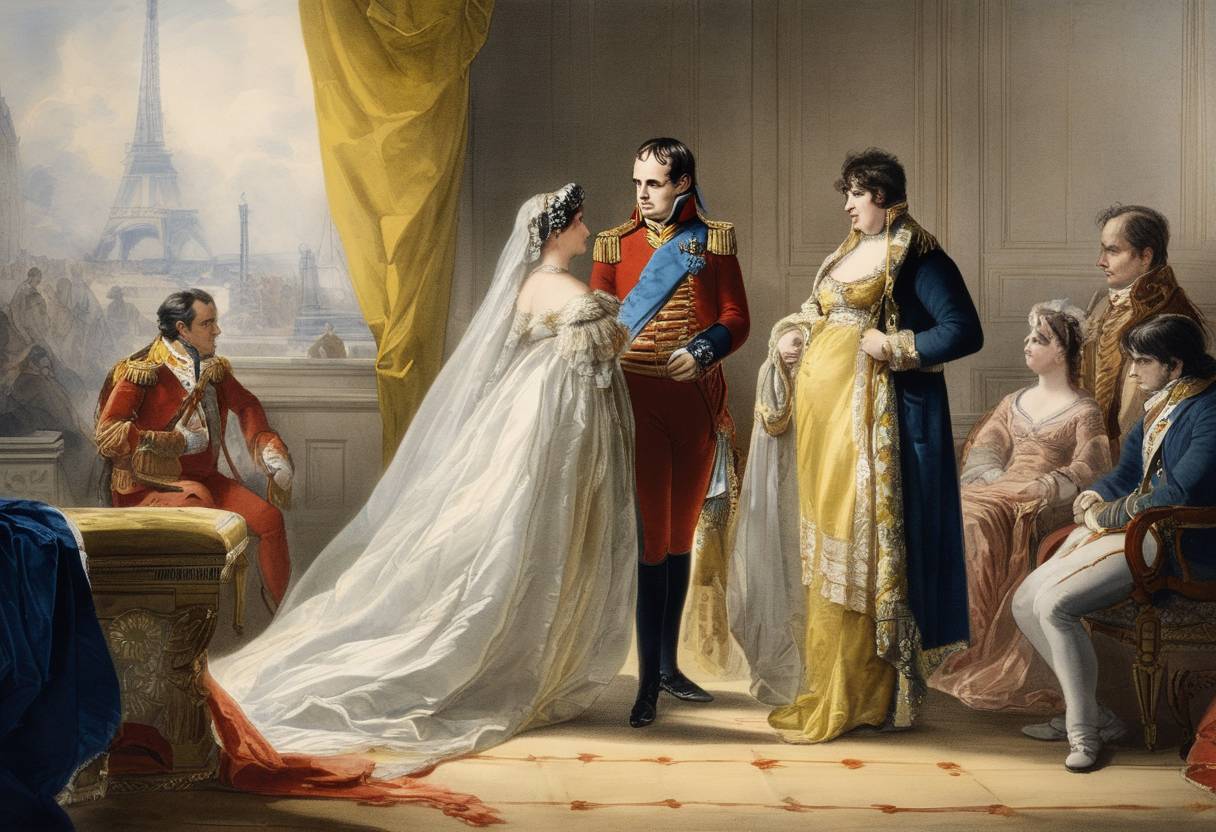
On March 9, 1796, Napoleon Bonaparte married Joséphine de Beauharnais, marking a pivotal personal milestone for the future French Emperor. The civil ceremony took place in Paris and was attended by a small circle of friends due to its relatively private nature.
Napoleon Bonaparte, at the time of the marriage, was a rising military leader. Just days prior to the wedding, he had been appointed Commander of the Army of Italy, showcasing his ascending career trajectory. Joséphine de Beauharnais, born Marie Josèphe Rose Tascher de La Pagerie, was a widow with two children. Her previous husband, Alexandre de Beauharnais, had been executed during the Reign of Terror. Joséphine held a social status that allowed her access to influential circles in post-revolutionary France.
Napoleon, six years Joséphine’s junior, was deeply enamored with her. His letters before the marriage reveal passionate and sometimes desperate expressions of love, highlighting his infatuation and desire for her. Joséphine’s feelings towards Napoleon were more pragmatic; she appreciated his potential and ambition, which promised security and elevation in social standing.
The wedding was officiated by a municipal officer, as the couple chose a civil ceremony rather than a religious one, aligning with the secular values promoted in post-revolutionary France. Notably, both parties adjusted their ages on the marriage certificate, a reflection of the age norms and perhaps personal insecurities of the time.
The union with Joséphine played a critical role in Napoleon’s personal life and public image. Despite their eventual separation in 1810—driven by the need for a marital connection that could produce an heir—Napoleon and Joséphine maintained a relationship of mutual respect and affection. Joséphine’s refinement and social skills complemented Napoleon’s ambition and military prowess, enhancing his profile within the powerful circles of society.
Furthermore, this marriage illustrated the blending of personal relationships with political advantage, a recurring theme throughout Napoleon’s life. The union cemented Joséphine’s role as a significant figure in French history, albeit more as a consort and influencer than a co-ruler.
The marriage underscored the personal dimensions of Napoleon’s rise to power, which were as complex and strategic as his military campaigns. It reflected the broader cultural shifts in France following the revolution, where alliances and affections were tied closely to political power and social mobility. As such, the marriage of Napoleon and Joséphine is viewed as a critical chapter in the narrative of Napoleonic France, intertwining love, ambition, and political strategy.
Source: www.britannica.com