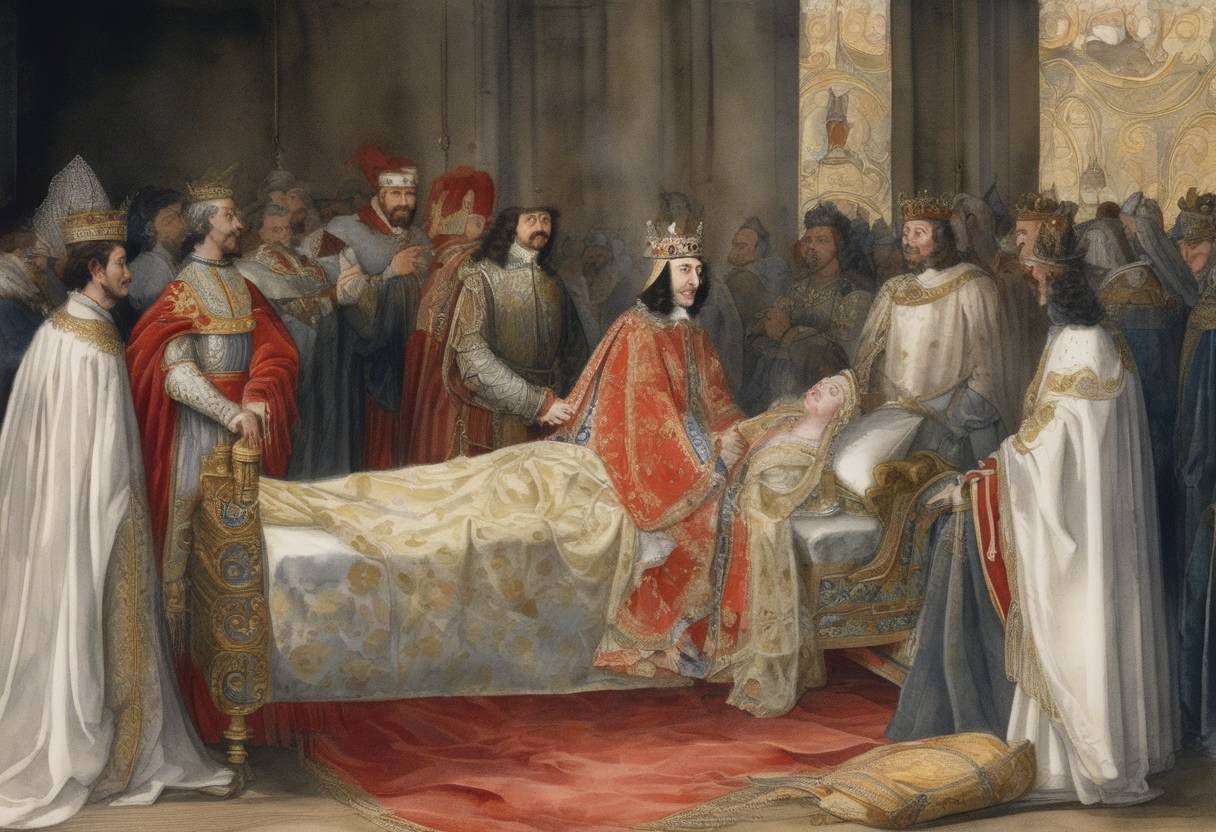
Death of Charles II of Navarre and Succession by Charles III
Context and Background
Charles II of Navarre, often known as Charles the Bad due to his notorious reputation, reigned as the King of Navarre from 1349 until his death on January 1, 1387. His rule was marked by continuous political intrigue and attempts to expand his influence in France during a period of frequent conflict, including the Hundred Years’ War. Charles II was a controversial figure, involved in numerous alliances and betrayals, which often put him at odds with both the French and English crowns.
The Death of Charles II
On January 1, 1387, Charles II died in Pamplona, Navarre. His passing marked the end of a tumultuous reign characterized by ambitious, albeit often unsuccessful, foreign policy maneuvers. His death was reportedly due to an unusual accident involving an ignition of alcohol or ointment—though the precise details are obscured by time and legend, feeding into the narrative of his notorious life.
Succession by Charles III
Charles II was succeeded by his only surviving legitimate son, Charles III, who took over as King of Navarre. Unlike his predecessor, Charles III, often called Charles the Noble, was known for adopting a more stable and conciliatory approach to governance. He was born in 1361 and brought to his rule a desire to strengthen and stabilize the Kingdom of Navarre.
Charles III’s Reign and Policies
Charles III’s reign (1387-1425) saw a significant shift in Navarre’s domestic and foreign policies. He focused on:
- Peaceful Diplomacy: Charles III sought to maintain peace and foster relations with neighboring kingdoms, distancing his court from the confrontational and turbulent alliances favored by his father.
- Economic Development: The new king worked on strengthening the kingdom’s economy and developed internal infrastructures, including roads and fortifications.
- Cultural Flourishing: Under his leadership, Navarre entered a period of cultural growth and architectural advancement, in part due to his patronage of the arts and education.
Historical Significance
Charles III’s reign was crucial in enhancing political stability and economic prosperity in Navarre. His diplomatic skills helped maintain independence in a geographically vulnerable position between powerful neighbors such as France and Castile. Charles III’s legacy as a ruler of peace and development laid a foundation for future monarchs, contrasting sharply with the stormy period of his father’s rule.