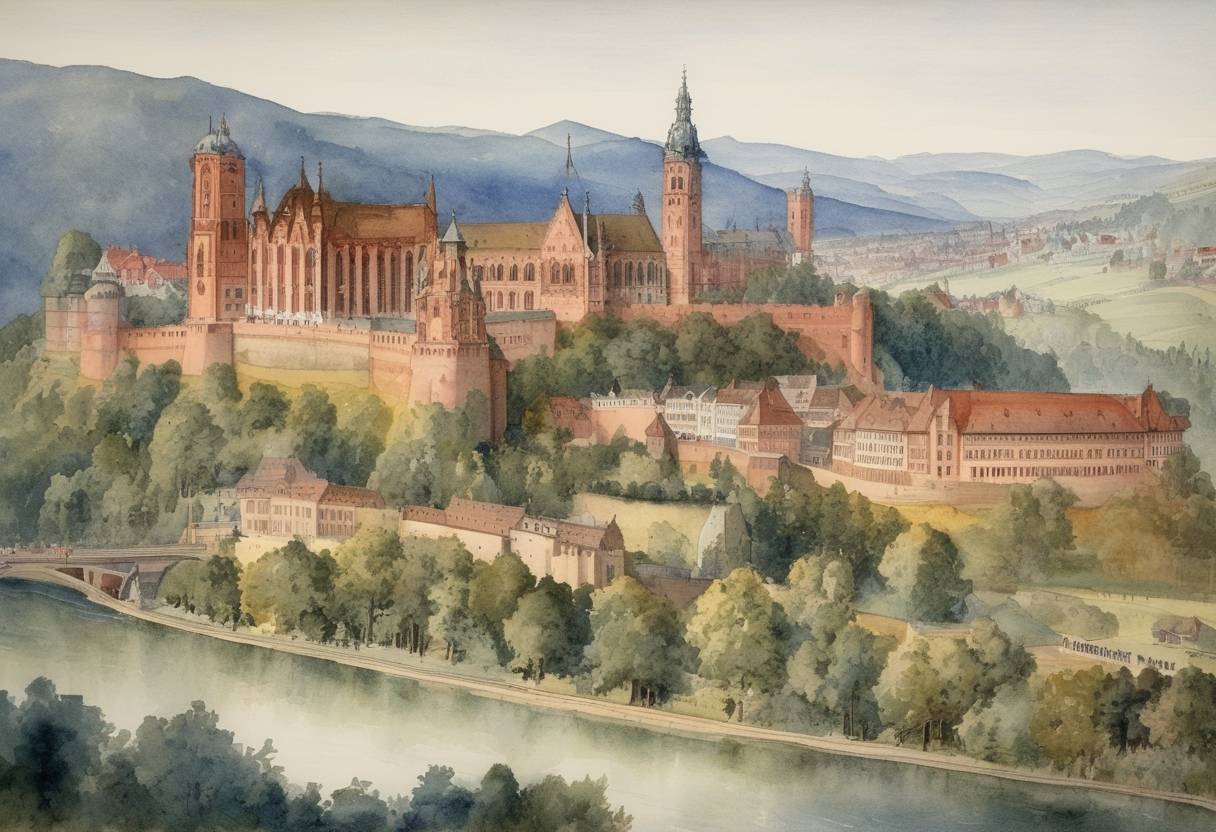
Establishment of the University of Heidelberg
Historical Context
On October 19, 1386, the University of Heidelberg was formally established by Rupert I, the Elector Palatine, marking the creation of the oldest university in Germany. This institution’s founding occurred during the late Middle Ages, a period characterized by growing interest in education and scholarship across Europe. The burgeoning intellectual environment was influenced by the rediscovery of classical texts and the establishment of medieval universities, which emerged as centers of higher learning and academic inquiry.
Foundation and Initial Years
Founded under a papal charter granted by Pope Urban VI, the establishment of the University of Heidelberg was part of Rupert I’s efforts to consolidate his power and improve the intellectual stature of his region, the Palatinate. Modeled after the University of Paris, Heidelberg’s initial structure consisted of the four traditional faculties: theology, philosophy, medicine, and law.
The first lecture was held on October 19, 1386, by Marsilius of Inghen, who became the university’s first rector. The early years saw a small but influential group of scholars who laid the groundwork for the university’s academic prestige. Attracting students and faculty from across Europe, the university played a pivotal role in the intellectual life of the Holy Roman Empire.
Significance and Legacy
Throughout its history, the University of Heidelberg has been at the forefront of academic development and innovation. It became a hub for humanism during the Renaissance, a center for Protestant thought during the Reformation, and a participant in the scientific and philosophical advancements of the Enlightenment.
The university has fostered an environment of free inquiry and has had among its faculty and alumni numerous individuals who made significant contributions to various fields, including natural sciences, philosophy, and the arts. This enduring legacy makes it one of the most respected institutions of higher learning globally.
Aftermath
In the following centuries, the University of Heidelberg would continue to evolve, facing and adapting to various political and social changes, including the upheavals of the Thirty Years’ War and both World Wars. It remains a symbol of Germany’s rich educational tradition and commitment to intellectual growth, advancing research, knowledge dissemination, and cross-cultural dialogue.