1487 · Stoke, England
The Second Battle of Stoke Field, which effectively ended the Wars of the Roses, took place between supporters of Henry VII and Yorkist forces.
August 22, 1485
The Battle of Bosworth Field took place, marking the end of the Wars of the Roses. Richard III was defeated by Henry Tudor, who became King Henry VII of England.
Market Bosworth, England | House of Tudor
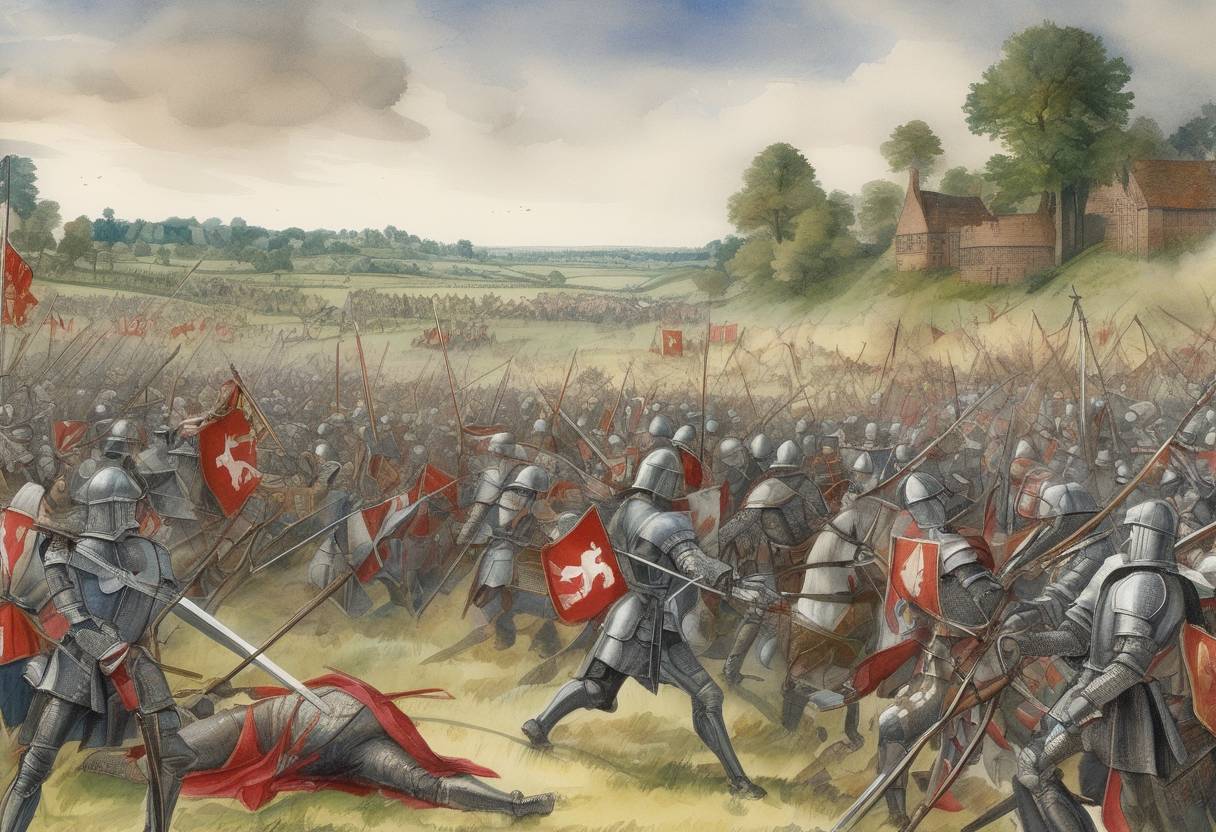
The Battle of Bosworth Field, fought on August 22, 1485, was a pivotal moment in English history, marking the end of the Wars of the Roses—a series of dynastic conflicts between the houses of Lancaster and York. This battle not only concluded a protracted period of civil war but also ushered in the Tudor dynasty, fundamentally altering the course of English history.
The Wars of the Roses were characterized by a struggle for the English throne between the rival factions of the House of Lancaster, symbolized by a red rose, and the House of York, represented by a white rose. By the mid-1480s, Richard III, a Yorkist, was the reigning king. His rule, however, was marred by controversy, including the mysterious disappearance of his nephews, the Princes in the Tower, which eroded his support among the nobility.
Henry Tudor, a Lancastrian claimant, had been living in exile in Brittany and France. He was the son of Edmund Tudor and Margaret Beaufort, a descendant of John of Gaunt, a son of King Edward III. With the support of French troops and English exiles, Henry landed in Wales in August 1485, gathering support as he marched towards England.
The confrontation took place near Market Bosworth in Leicestershire. Richard III’s forces were numerically superior, but Henry Tudor’s army was bolstered by key allies, including the influential Stanley family, whose loyalties were uncertain until the battle’s climax.
Richard III demonstrated personal bravery by leading a cavalry charge aimed directly at Henry Tudor. However, the tide turned when Sir William Stanley, previously undecided, committed his forces to Henry’s side. This decisive intervention led to Richard III being surrounded and killed in combat, reportedly the last English king to die on the battlefield.
Henry Tudor’s victory at Bosworth Field effectively ended the Wars of the Roses. He ascended the throne as King Henry VII, marking the beginning of the Tudor dynasty. To solidify his claim and unify the warring factions, Henry married Elizabeth of York, daughter of Edward IV, thus symbolically uniting the houses of Lancaster and York.
Henry VII’s reign initiated a period of relative stability and the establishment of a strong central government. His efforts to consolidate power laid the groundwork for the future successes of the Tudor dynasty, including the reigns of his son, Henry VIII, and granddaughter, Elizabeth I.
The Battle of Bosworth Field remains a significant event in English history, not only for its immediate impact but also for its long-term effects on the monarchy and the nation. It marked the end of medieval England and the beginning of the Renaissance and early modern periods, setting the stage for England’s emergence as a major European power.
Source: en.wikipedia.org