Hosni Mubarak Elected President of Egypt
1981 · Cairo, Egypt
Hosni Mubarak was elected President of Egypt, following the assassination of Anwar Sadat.
October 6, 1981
Egyptian President Anwar Sadat was assassinated during a military parade in Cairo by members of the Egyptian Islamic Jihad. His assassination was a significant event in Middle Eastern politics.
Cairo, Egypt | Egyptian Islamic Jihad
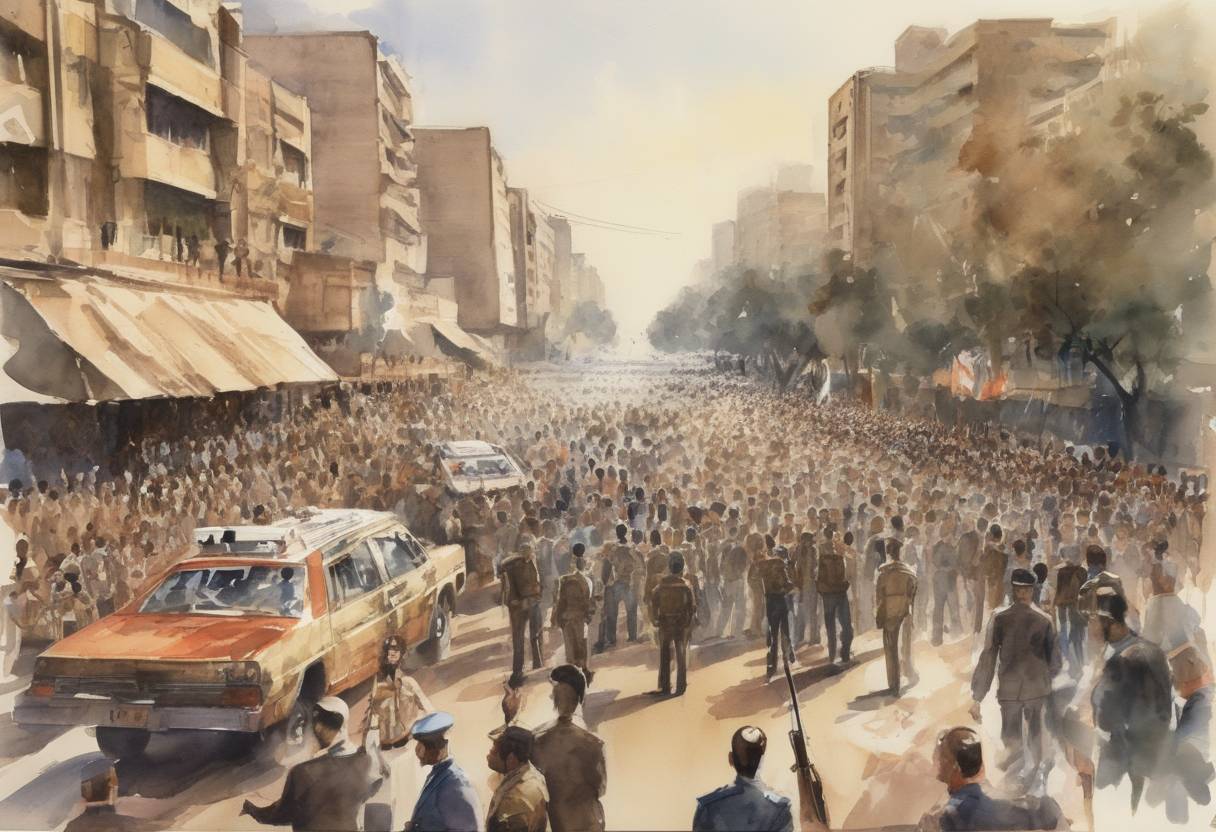
On October 6, 1981, Egyptian President Anwar Sadat was assassinated during a military parade in Cairo, marking a pivotal moment in Middle Eastern politics. This event unfolded during the annual celebration of Egypt’s successful crossing of the Suez Canal during the Yom Kippur War of 1973, a conflict that had bolstered Sadat’s reputation as a military leader.
Anwar Sadat had been a prominent figure in Egyptian and Middle Eastern politics since he succeeded Gamal Abdel Nasser as President of Egypt in 1970. His tenure was marked by significant shifts in both domestic and foreign policy:
Peace with Israel: Sadat’s most notable and controversial move was his peace initiative with Israel, culminating in the Camp David Accords in 1978 and the Egypt-Israel Peace Treaty in 1979. This made Egypt the first Arab country to officially recognize Israel, earning Sadat the Nobel Peace Prize but also significant opposition from many in the Arab world and within Egypt.
Economic Policies: Domestically, Sadat implemented the “Infitah” (open-door) policy, aiming to liberalize the economy. While it attracted foreign investment, it also led to economic disparities and discontent among the poorer segments of society.
Political Repression: Sadat’s regime was marked by increasing political repression, targeting both leftist and Islamist groups, which fostered resentment and opposition.
The assassination was carried out by members of the Egyptian Islamic Jihad, a radical Islamist group opposed to Sadat’s policies, particularly his peace treaty with Israel. The attack occurred during a military parade commemorating the 1973 war. As Sadat watched the parade from a reviewing stand, a group of soldiers, led by Lieutenant Khalid Islambouli, broke ranks and attacked the stand with grenades and automatic weapons. Sadat was struck by multiple bullets and was pronounced dead shortly after being transported to a military hospital.
Immediate Impact: Vice President Hosni Mubarak, who was seated next to Sadat during the attack, was unharmed and quickly assumed the presidency. Mubarak’s rule would last until 2011, characterized by a continuation of Sadat’s policies with a focus on stability and maintaining Egypt’s peace treaty with Israel.
Regional Repercussions: Sadat’s assassination underscored the volatility in the region and highlighted the deep divisions within Egyptian society and the broader Arab world regarding peace with Israel.
Legacy: Sadat’s legacy remains complex; he is remembered as a visionary leader who sought peace but also as a polarizing figure whose policies led to significant internal strife.
The assassination of Anwar Sadat was not just a national tragedy for Egypt but also a significant event in the broader context of Middle Eastern politics, influencing the region’s trajectory for decades to come.
Source: en.wikipedia.org