Isaac Newton’s *Principia Mathematica* and the Royal Society
1687 · London, Kingdom of England
The first performance of Isaac Newton's Principia Mathematica is made at a meeting of the Royal Society.
December 25, 1642
Isaac Newton, one of the most influential scientists of all time, was born in Woolsthorpe, England.
Woolsthorpe, England | none
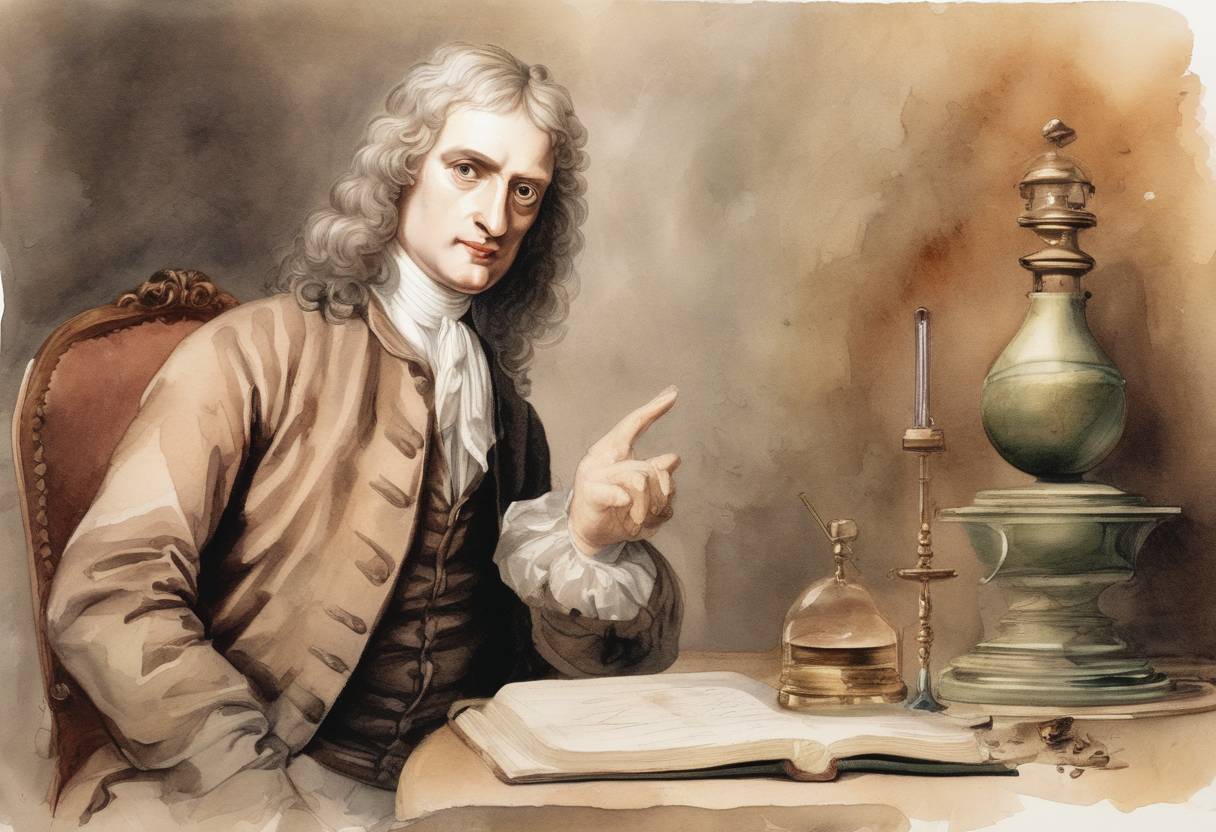
Date of Birth: December 25, 1642 (Julian calendar; January 4, 1643, in the Gregorian calendar)
Place of Birth: Woolsthorpe, Lincolnshire, England
Isaac Newton was born in the small hamlet of Woolsthorpe, near Grantham in Lincolnshire, England. His birth came just a few months after the death of his father, also named Isaac Newton, a prosperous farmer. His mother, Hannah Ayscough Newton, remarried when Newton was three, leaving him in the care of his maternal grandmother. This early separation from his mother is often noted as a significant emotional event in his life.
Newton attended The King’s School in Grantham, where he was introduced to the basics of mathematics and Latin. His academic potential was recognized early, and he was eventually sent to Trinity College, Cambridge, in 1661. At Cambridge, Newton immersed himself in the works of contemporary philosophers and scientists, including Descartes, Galileo, and Kepler.
Isaac Newton’s contributions to science are vast and transformative, laying the groundwork for classical mechanics and advancing the scientific revolution. Some of his most notable achievements include:
Laws of Motion and Universal Gravitation: Newton formulated the three laws of motion, which describe the relationship between a body and the forces acting upon it, and laid the foundation for classical mechanics. His law of universal gravitation explained the gravitational attraction between masses, revolutionizing the understanding of celestial and terrestrial motion.
Calculus: Independently of Leibniz, Newton developed the mathematical discipline of calculus, which he referred to as “the method of fluxions.” This provided a powerful tool for mathematical analysis and problem-solving in physics and engineering.
Optics: Newton conducted extensive research in optics, demonstrating that white light is composed of a spectrum of colors, which can be separated by a prism. His work in this field led to the development of the reflecting telescope, which improved the quality of astronomical observations.
Philosophiæ Naturalis Principia Mathematica: Often referred to simply as the “Principia,” this work, published in 1687, is one of the most important scientific books ever written. It laid out Newton’s laws of motion and universal gravitation, providing a comprehensive framework for understanding the physical world.
Isaac Newton’s impact on science and mathematics is immeasurable. His work not only advanced the scientific understanding of his time but also set the stage for future developments in physics and mathematics. Newton’s principles remained unchallenged until the early 20th century when Einstein’s theory of relativity provided new insights into the nature of gravity and motion.
Newton’s legacy extends beyond his scientific achievements; he is often regarded as a key figure in the Enlightenment, embodying the spirit of inquiry and rationality that characterized the era. His work continues to inspire scientists and mathematicians, and his contributions remain foundational to modern science.
Source: en.wikipedia.org