The Attack on Montreal: November 13, 1775
1775 · Montreal, Canada
American Revolutionary War: Patriot revolutionary forces under Colonel Ethan Allen attack Montreal, but are defeated by British defenders.
September 25, 1775
Ethan Allen was captured by British forces during the Battle of Longue-Pointe, near Montreal, in the American Revolutionary War.
Montreal, Canada | British Army
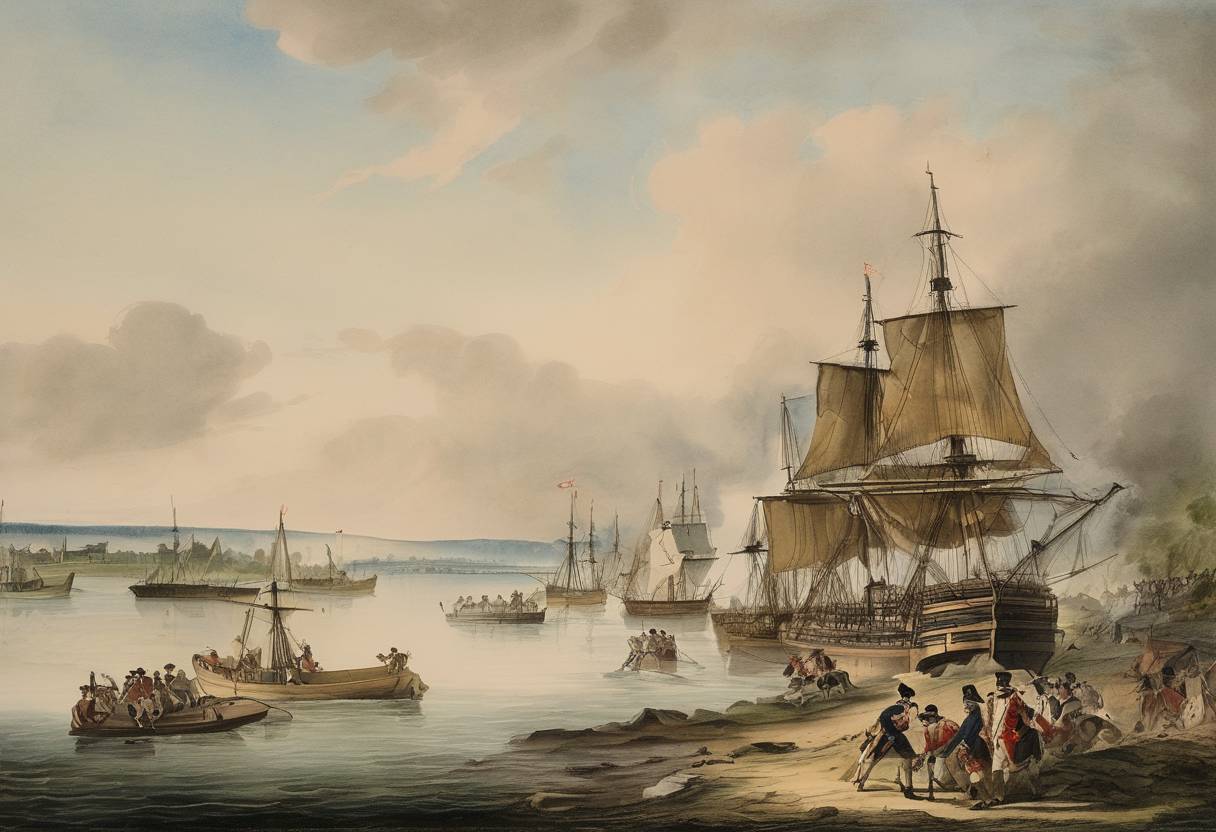
On September 25, 1775, during the early phase of the American Revolutionary War, Ethan Allen, a prominent revolutionary leader, was captured by British forces during a failed attack on Montreal at the Battle of Longue-Pointe. This event was part of the larger American campaign to capture Quebec and bring what is now Canada into the rebellion against British rule.
Ethan Allen was best known for his leadership of the Green Mountain Boys, a militia group originally formed to defend land grants from settlers in the New Hampshire Grants, now Vermont. In the revolution’s early days, he led the capture of Fort Ticonderoga in May 1775, a significant strategic victory that provided the Americans with much-needed artillery.
As the Continental Congress and American military leaders sought to expand the rebellion into Canada, they commissioned an expedition to capture the city of Montreal. Allen, driven by ambition and the desire to replicate previous successes, decided independently to advance on Montreal with a smaller force.
Allen’s plan for an attack was not part of the coordinated strategy developed by General Richard Montgomery, who was leading the main Continental Army forces targeting Montreal. Without sufficient reconnaissance or advice to wait for reinforcements, Allen led a mixed force of around 110 men, including a contingent of Canadian recruits sympathetic to the American cause, across the St. Lawrence River to Longue-Pointe, just outside Montreal.
On September 25, Allen’s forces encountered resistance from a significantly stronger British force led by British Governor Sir Guy Carleton. Allen and his men were poorly equipped and heavily outnumbered. The engagement quickly turned against the Americans, and after a brief skirmish, Allen was compelled to surrender.
Ethan Allen’s capture was a severe blow to American morale in the campaign to add Canada to the revolution. After his surrender, Allen was treated as a prisoner of war and subject to harsh conditions. He was eventually transported to England and then back to North America, enduring captivity until he was exchanged for a British officer in 1778.
The defeat at Longue-Pointe underscored the challenges of amateur military leaders undertaking unauthorized military actions without adequate preparation or coordination. Despite this setback, the broader American invasion of Canada continued, though it ultimately failed to secure significant territorial gains in the region.
The capture of Ethan Allen at Longue-Pointe illustrates key themes in the American Revolutionary War, including the complex dynamics between individual initiative and the need for coordinated military strategy. Allen’s bold yet ill-fated attack highlighted both the revolutionary spirit prevalent among the American fighters and the risks posed by uncoordinated actions in the wartime context.
Allen’s legacy, however, survived beyond this defeat. He remained a symbol of the rugged independence that characterized the revolutionary movement, and his experiences contributed to the understanding of military leadership and strategy as the conflict progressed.
Source: en.wikipedia.org