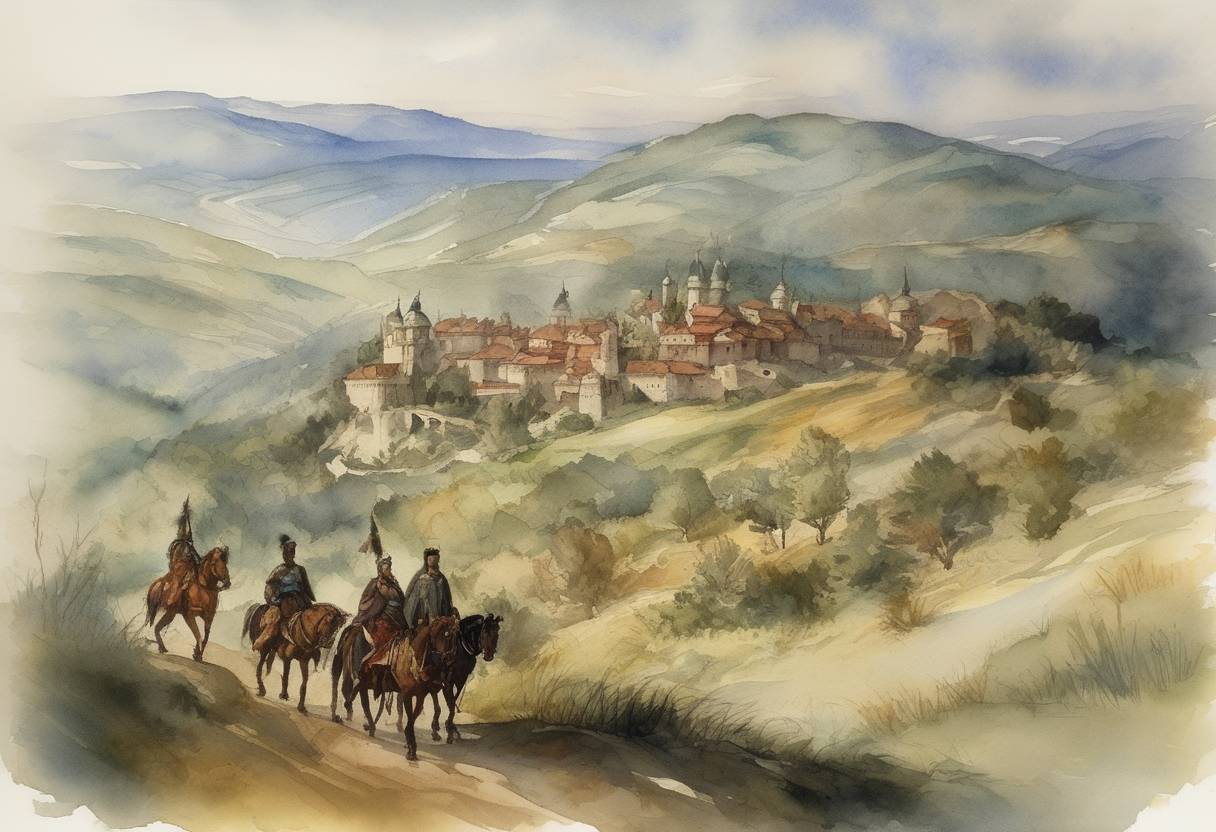
The Serbian Empire at Its Apogee: April 17, 1362
On April 17, 1362, the Serbian Empire, under the rule of Emperor Stefan Uroš V, reached its greatest territorial expanse. While this date marks a significant point in the history of the empire, it is crucial to understand the context and developments that led to this moment.
Background
The Serbian Empire was founded by Stefan Dušan, father of Stefan Uroš V, who ascended to the throne in 1331. Under Dušan’s leadership, the empire experienced rapid expansion, annexing territories from the Byzantine Empire and extending its domains to include parts of present-day Greece, North Macedonia, Albania, and Montenegro. This period saw the empire transform into a significant power in Southeast Europe.
Stefan Uroš V
Succeeding his father in 1355, Stefan Uroš V inherited an empire at its zenith in terms of territory. Despite the vast expanse of his realm, his reign was often overshadowed by internal strife and challenges in maintaining control over his diverse territories. Nicknamed “the Weak,” Uroš V struggled with decentralized power, as regional lords sought autonomous control, notably the powerful Vukašin Mrnjavčević and his family.
Territorial Peak
By April 17, 1362, the empire under Stefan Uroš V had reached its fullest geographical extent. During this period, the Serbian Empire encompassed various Balkan regions, acting as a mosaic of different cultures and ethnicities under the nominal sovereignty of the emperor. Despite this peak in territorial reach, the true authority of the emperor was increasingly nominal, with local nobility wielding more power.
Consequences and Aftermath
The disintegration of centralized power foreshadowed the empire’s decline. The centrifugal forces within the empire continued to exacerbate divisions. The Serbian Empire’s vast size and internal discord left it vulnerable to external threats. This fracturing was a precursor to the empire’s eventual decline, climaxing in the Battle of Maritsa in 1371, where key Serbian forces suffered devastating defeat, signaling the onset of Ottoman encroachment into the Balkans.
In the broader historical context, the territorial peak witnessed on April 17, 1362, represents both the zenith and the beginning of the end of Serbian imperial ambitions, illustrating the complexities of ruling an extensive medieval empire amidst rising internal and external pressures.